In the landscape of modern cinema, few projects have navigated a path as tumultuous, convoluted, and emotionally resonant as Coyote vs. Acme. What began as a mere intellectual property exercise—an adaptation of a cult-classic 1990 New Yorker satirical essay—has morphed into a sprawling, meta-textual commentary on corporate malfeasance, the erasure of the creative class, and the profound human need to have one’s suffering witnessed. After a decade of development hell, the film has finally arrived, not as the cynical cash-grab many feared, but as a surprisingly subversive, albeit structurally uneven, piece of hybrid animation that demands a closer look.
A Decade of Development: The Chronology of Chaos
The pedigree of Coyote vs. Acme reads like a "who’s who" of modern Hollywood’s shifting creative guard. The conceptual seeds were sown by James Gunn and Jeremy Slater, the latter of whom penned the initial script. However, the project soon entered a revolving door of creative oversight. As the script passed through the hands of director Chris MacKay and the writing team of the Silbermans, it underwent multiple retoolings, struggling to find a balance between the slapstick heritage of the Looney Tunes and a modern legal thriller narrative.
Eventually, the project settled into the hands of director Dave Green and screenwriter Samy Burch. While nearly a dozen writers are associated with the project in various capacities, Burch holds the sole screenplay credit—a rarity for a project of this scale. This "many cooks" dynamic, often a death knell for major studio releases, initially invited skepticism. Industry analysts drew immediate, unflattering comparisons to the gold standard of live-action/animation hybrids, Robert Zemeckis’s Who Framed Roger Rabbit?. Many expected Coyote vs. Acme to be dismissed, panned, and ultimately filed away in the annals of forgotten mid-budget experiments. Instead, the final product feels less like a desperate homage and more like a spiritual successor to the playful chaos of Space Jam, albeit with a sharper, more melancholic edge.
The Narrative Premise: When the Predator Becomes the Plaintiff
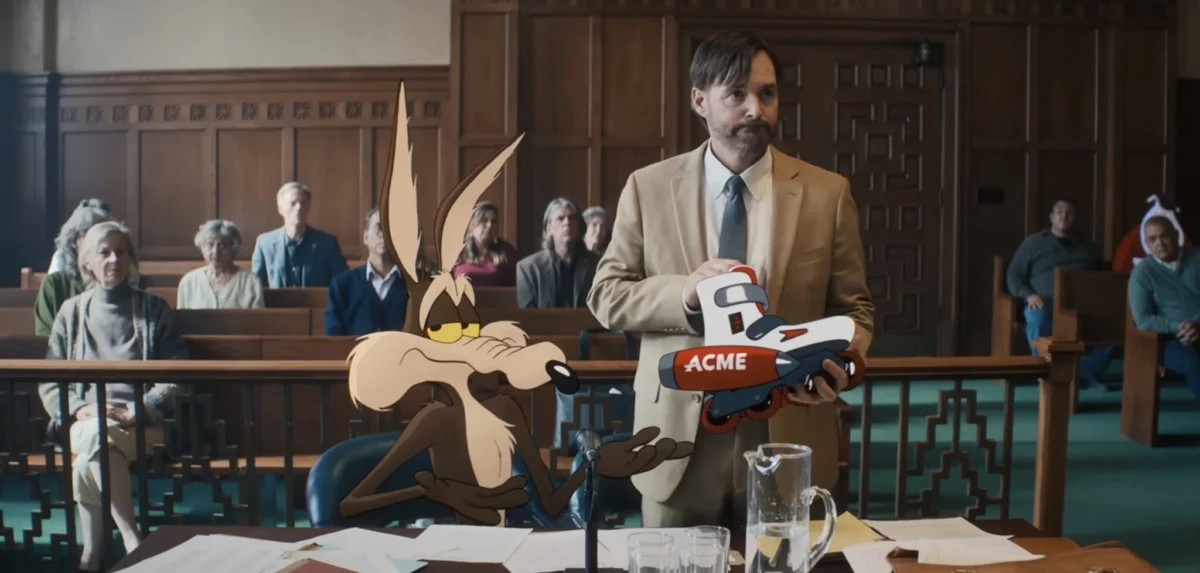
The film’s plot is deceptively simple: Wile E. Coyote, exhausted by decades of physical trauma and the consistent failure of Acme-branded products, decides to sue the conglomerate. He enlists the services of a down-on-his-luck law firm, Avery, Jones, & Maltese—a name itself a nod to the legendary animators who built the Looney Tunes universe.
Kevin Avery, played with weary, hangdog charm by Will Forte, is a small-claims lawyer who has spent his career settling for scraps. He is a man who has lost his sense of purpose, representing cartoons in mundane legal disputes against Acme for minor product malfunctions. He is joined by his niece and intern, Paige (Lana Condor), whose wide-eyed idealism serves as the film’s moral compass.

The case expands exponentially when Coyote, acting as his own discovery engine, introduces hundreds of malfunctioning products into evidence. This draws the ire of Acme’s corporate hierarchy, led by CEO Foghorn Leghorn (voiced by Eric Bauza) and the company’s ruthless top litigator, Buddy Crane (John Cena). As the trial unfolds, the film shifts from a legal farce to a dark, investigative thriller, revealing that Acme has been using cartoons as unwitting test subjects for products intended for the human market. The Coyote is revealed to be a "super-user"—a victim of corporate exploitation masquerading as the punchline to a long-running joke.
Corporate Malfeasance and Real-World Parallels
The film’s most striking element is its unflinching critique of unchecked corporate power. By framing the Acme Corporation as a entity that views "disposable" populations—in this case, cartoons—as test subjects, the film mirrors historical American atrocities where marginalized communities were used as non-consensual subjects for medical and chemical experimentation.
This subplot is not merely a background detail; it is the engine of the film’s social commentary. In an era where the line between "public interest" and "shareholder value" has been irrevocably blurred, Coyote vs. Acme posits that these mega-corporations thrive on the lack of accountability. The film effectively echoes the historical dismantling of public infrastructure, much like the conspiracy behind the freeway construction in Roger Rabbit.
This satire feels particularly pointed given the current state of the industry. As Warner Bros. faces the prospect of acquisition by the Ellison dynasty, the film’s central question—who is truly in control of the culture we consume?—takes on a meta-fictional gravity. The irony of a studio releasing a film that derides monopoly control while it simultaneously undergoes one of the largest media mergers in history is not lost on the audience.
Structural Shortcomings: The "Fiddly Bits" of Worldbuilding
Despite its strong thematic bones, Coyote vs. Acme struggles with the "connective tissue" of its worldbuilding. While the premise of humans and toons coexisting is easily accepted by audiences, the internal logic of the characters often wavers.

For instance, the character arc of Kevin Avery feels somewhat unearned. We are told he is a failure, and we see him at his lowest, but the audience is never given the context of his decline. Similarly, his relationship with his niece, Paige, is a shorthand for redemption; she believes in him because the script requires her to, not because of a demonstrated history of mentorship or success.
Furthermore, the "animated canon" remains frustratingly vague. When Avery encounters Bugs Bunny, he does not recognize the cultural icon. While this serves as a meta-commentary on the potential disconnect between younger audiences and the Golden Age of animation, it creates a logical vacuum within the film’s own reality. Are cartoons not celebrities? Is the existence of a "toon" not a massive, undeniable fact of life? A more rigorous approach to these world-building questions would have elevated the film from a clever satire to a fully realized alternate history.
The Existential Weight of the Road Runner
The film’s greatest triumph, however, lies in its treatment of its silent protagonist. By centering the narrative on a character who cannot speak, the film forces the audience to engage with the visual language of animation. The Road Runner, often dismissed as a mere catalyst for the Coyote’s pain, becomes a central emotional figure.
The turning point occurs during the final act, when the Road Runner testifies before Congress. It is here that the film delivers its most profound revelation: the Road Runner’s persistent presence in the Coyote’s life was not motivated by malice or dim-wittedness, but by a witnessing of the Coyote’s suffering. When the bird finally acknowledges the pain of his predator, the decades-old dynamic of the chase is transformed. The film argues that to be witnessed in one’s struggle is a vital component of being "real." It is a poignant, if unexpected, emotional core for a movie based on a series of slapstick shorts.
Implications: A New Benchmark for Meta-Cinema?
Coyote vs. Acme is, ultimately, a paradox. It is a film that demands to be taken seriously despite its inherent silliness. It is a product of a studio system that it simultaneously attempts to dismantle through its own narrative.

The film serves as a reminder that even the most "disposable" intellectual property can be reclaimed for art if the creative team is willing to dig into the marrow of the characters. John Cena’s performance as the corporate lawyer is a standout, blending physical comedy with a terrifying, earnest corporate coldness.
As we look toward the future of media, Coyote vs. Acme provides a blueprint for how legacy franchises can be revitalized: stop trying to replicate the nostalgia, and start interrogating it. Whether this film will be remembered as a classic or a curiosity remains to be seen, but it has certainly earned its place in the conversation. It is a flawed, messy, and deeply "human" story about cartoon animals, and in the current climate of sterile, focus-grouped content, that is a victory in its own right.
In closing, the film invites us to ask: if a cartoon can have its pain witnessed and validated, what hope is there for the rest of us in a world increasingly dominated by the faceless Acme Corporations of our own reality? Perhaps, like Wile E. Coyote, we simply need to keep running, keep setting our traps, and hope that someone, somewhere, is finally watching.