Suro Senen
Clint Eastwood’s filmography is a sprawling, seven-decade-long tapestry that has fundamentally altered the landscape of American cinema. From the squint-eyed anti-hero of Sergio Leone’s "Dollars" trilogy to the weathered, introspective director of modern classics like Unforgiven and Million Dollar Baby, Eastwood has effectively lived several lifetimes within the industry. He has been a box-office titan, an Academy Award-winning filmmaker, and an icon whose influence arguably rivals that of John Wayne.
Yet, even for an individual who has become synonymous with the "Golden Age" of the American West and the grit of urban noir, there remain lingering professional regrets. Despite his massive success, Eastwood has frequently looked back at the era of his arrival—the mid-1950s—with a sense of missed opportunity. He arrived just as the studio system was beginning to crack, a timing that prevented him from collaborating with three of the most influential directors in history: Billy Wilder, Howard Hawks, and Raoul Walsh.
The Chronology of an Evolving Industry
To understand why Eastwood missed these opportunities, one must examine the specific cultural and legal shifts that defined his early career. When Eastwood entered the Universal talent program in the mid-1950s, he was stepping into a Hollywood that was suffering from an existential hangover.
The Post-War Paradigm Shift
In 1948, the Supreme Court’s decision in United States v. Paramount Pictures, Inc. effectively dismantled the vertical integration of the studio system. By forcing the "Big Five" studios to divest themselves of their theater chains, the court broke the iron grip that moguls had held over the exhibition of films. Simultaneously, the rise of television began to cannibalize the cinema-going audience.
The rigid, long-term talent contracts that had created the star system of the 1930s and 40s were rapidly dissolving. It was in this volatile landscape that a young, untested Eastwood found himself. His early professional life was defined by this instability; he was famously let go from his Universal contract in 1959. His early days were marked by frustration, including a legendary incident on the set of Revenge of the Creature (1955) where his lack of experience reportedly pushed director Jack Arnold to a breaking point.
Eastwood eventually found his footing by embracing the very medium that was threatening the big screen: television. His role as Rowdy Yates in Rawhide (1959–1965) provided the springboard for his transition into the revisionist Westerns that would define the next decade of his career. However, this shift occurred precisely as the architects of the classic Hollywood style were stepping away from the spotlight.
The Titans of the Silver Screen
In a revealing 2007 interview with The Observer, conducted by film critic Philip French, Eastwood reflected on the masters he missed. When asked about his regrets, he noted, "When I came into the business in the ’50s, a lot of those people were starting to retire. I knew Billy Wilder socially and would have loved to work with him. I did work with Bill Wellman on the Second World War film Lafayette Escadrille. I would have liked to work with Mr. Hawks and Mr. Walsh."
Billy Wilder: The Architect of Modern Cynicism
Billy Wilder, the genius behind Double Indemnity, Some Like It Hot, and The Apartment, held a particular place in Eastwood’s esteem. Most notably, Wilder directed Sunset Boulevard (1950), a film that remains Eastwood’s all-time favorite.
Eastwood has often praised the film’s unique juxtaposition of eras. He noted in an interview with Esquire that he was struck by the blending of two distinct styles: the theatrical, melodramatic nature of the silent-film era—embodied by Gloria Swanson’s Norma Desmond—and the grounded, contemporary cynicism represented by William Holden’s Joe Gillis. Had Eastwood been able to collaborate with Wilder, it likely would have resulted in a film that bridged the gap between the classic noir aesthetic and the harder-edged, post-Vietnam sensibilities that Eastwood would eventually champion.
Raoul Walsh: The Duke’s Mentor
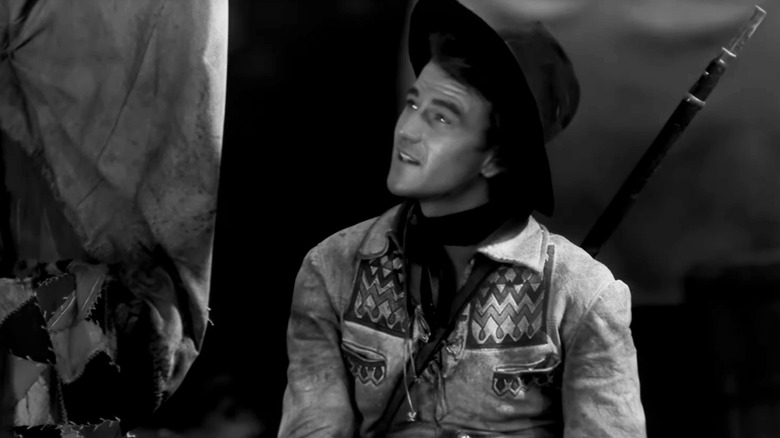
Raoul Walsh was a towering figure of the early Western, a director known for his kinetic energy and ability to handle grand-scale narratives. Crucially, he was a pivotal mentor to John Wayne, even gifting the actor his famous moniker. Walsh’s direction of Wayne in The Big Trail (1930) established the visual grammar for the iconic American hero.
For Eastwood, the desire to work with Walsh is symbolic. Eastwood effectively inherited the mantle of the "Western Icon" from Wayne. By the time Eastwood was reaching his zenith, the classic Western was being dismantled, yet his appreciation for Walsh serves as a direct link between the origin of that genre and its final, brutal evolution. Working with Walsh would have been a passing of the torch from the man who defined the cowboy myth to the man who ultimately deconstructed it.
Howard Hawks: The Chance Encounter
Howard Hawks was perhaps the most versatile director in Hollywood history, having mastered the screwball comedy, the Western, and the crime thriller with equal precision. While Eastwood never sat in the director’s chair under Hawks’s tutelage, he did have a surreal, accidental encounter with him.
As recounted in the book Conversations with Clint: Paul Nelson’s Lost Interviews, a 17-year-old Eastwood once found himself helping to wrangle runaway horses on a boulevard in the San Fernando Valley. After successfully herding the animals, a man rushed up to thank them. His friends later informed him, "That’s Howard Hawks, that guy we were just talking to. A big movie guy."
Though Eastwood would later meet Hawks at social events, the professional collaboration never materialized. It remains one of the great "what ifs" of the era—a director known for his understated, masculine, and highly rhythmic dialogue style potentially guiding the man who would become the master of the "less is more" performance.
Implications for Film History
The fact that Eastwood, a director who has spent his career paying homage to the masters, never worked with these three men highlights the tragedy of historical timing. When he arrived in Hollywood, the industry was in a state of mourning for its own past.
The End of the Auterist Golden Age
Eastwood’s career represents the bridge between the studio-system era and the independent spirit of the New Hollywood. His regret regarding these directors is not just a personal one; it is a reflection of the loss of a specific artistic language.
When Eastwood mentioned to Philip French that he once came close to working with Alfred Hitchcock—only for the meeting to fall through because Hitchcock’s health was failing—it underscored the sense of a closing window. The generation of directors that defined the 1930s and 40s was exhausted by the time the 1960s arrived. The industry had moved on, and the collaborative opportunities that would have been routine in 1945 were impossible by 1965.
Legacy and Influence
Despite these missed connections, one could argue that Eastwood successfully internalized the lessons of Wilder, Hawks, and Walsh. His directorial style—characterized by efficiency, a focus on character over spectacle, and a deep respect for the script—mirrors the hallmarks of the classic Hollywood era.
He adopted the stoic, minimalist approach of the Hawksian hero and the structural precision of a Wilder screenplay. While he never stood on a set directed by them, the DNA of their work is clearly woven into the fabric of his own productions. By the time Eastwood directed The Outlaw Josey Wales (1976) or Unforgiven (1992), he was arguably fulfilling the legacy that these men had left behind, creating films that were as much a testament to their influence as they were to his own creative vision.
Conclusion
Clint Eastwood’s career is not defined by what he failed to do, but by how he navigated the transformation of an entire industry. His desire to work with Wilder, Hawks, and Walsh is a testament to his humility and his reverence for the history of the medium. He viewed himself not as an icon in his own right, but as a student of the masters.
While the cinema world can only speculate on what a Wilder-directed Eastwood film might have looked like, the void left by these unmade movies serves as a poignant reminder that even the most legendary figures are at the mercy of time. Eastwood’s career proves that while he may have arrived "too late" to join the ranks of the Golden Age directors as a collaborator, he arrived just in time to preserve their spirit for a new generation. Through his own work, the influence of those legendary directors continues to breathe, living on in the shadows and silence of the modern American Western.

 Jia Lissa
 Sagoh
Sagoh