

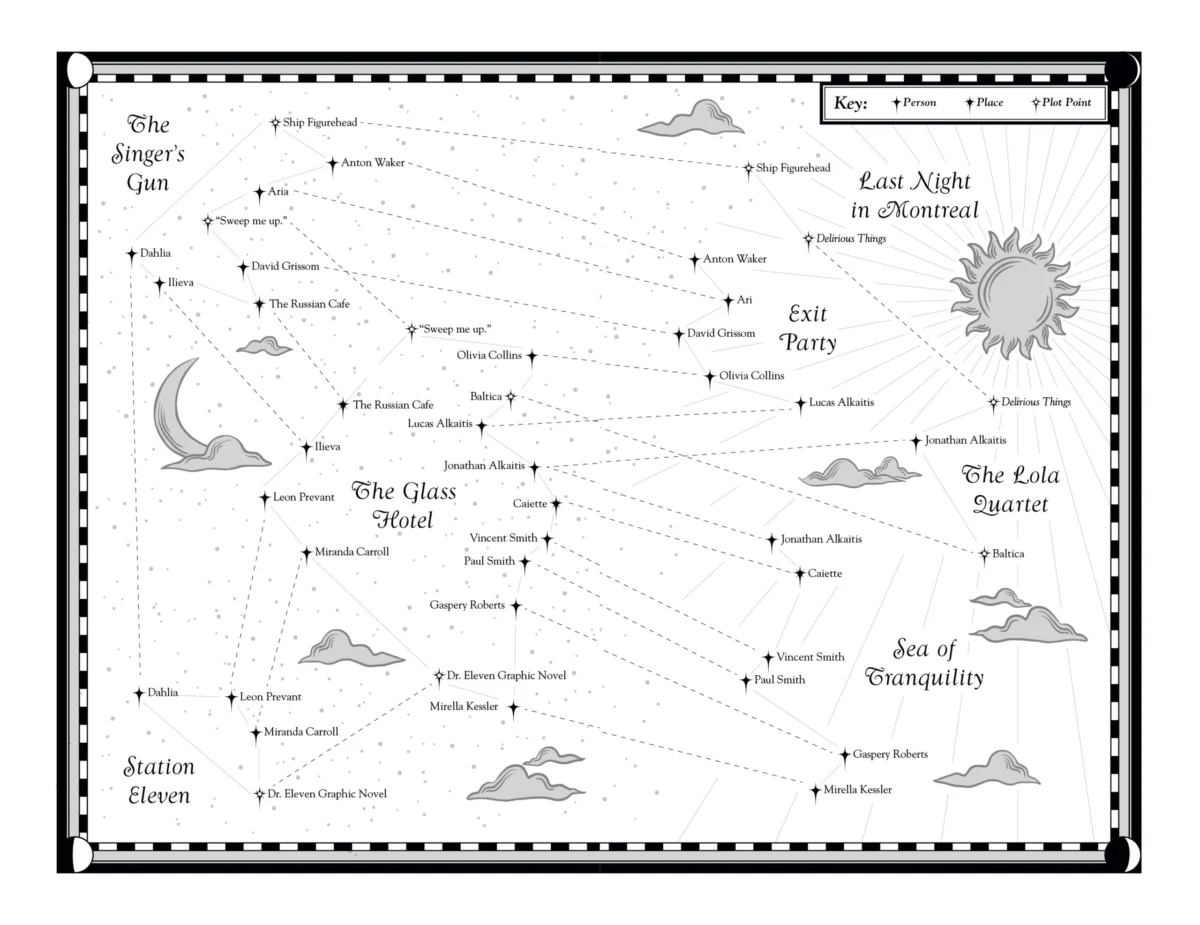
This fall, the literary world turns its gaze toward the highly anticipated release of Exit Party, the latest novel from Emily St. John Mandel. As a writer who has fundamentally reshaped the landscape of contemporary speculative fiction, Mandel has spent the better part of two decades constructing what fans and critics affectionately call the "Mandelverse"—an intricate, intertextual web of narratives where characters, locations, and thematic echoes recur across disparate timelines and genres. With the arrival of Exit Party, readers are invited to step back into the dystopian chaos and haunting beauty that have become the hallmarks of her prose.
The Main Event: Exit Party and the New Dystopia
Exit Party arrives at a moment when the public’s appetite for high-concept, human-centric dystopian fiction remains at a fever pitch. The novel is set in a future iteration of America—a landscape defined by structural fragility and societal dissolution. The inciting incident is as personal as it is mysterious: a man vanishes during the course of a house party, triggering a ripple effect that forces the reader to confront questions of resilience, memory, and the inevitable decay of civilization.

Mandel’s ability to anchor macro-scale disaster in micro-scale human experience is on full display here. While the backdrop is one of crumbling infrastructure and social uncertainty, the heart of the story remains the intimate, often fleeting connections between its protagonists. It is this "clear-eyed, big-hearted" approach that has defined her career, bridging the gap between the existential dread of a collapsing world and the profound desire to leave a mark upon it.
A Chronology of a Literary Universe
To understand the weight of Exit Party, one must appreciate the trajectory of Mandel’s bibliography. Her work does not exist in isolation; it functions as a modular, expansive ecosystem.

The Formative Years (2009–2013)
Mandel’s early works established the DNA of her later, more famous successes. Last Night in Montreal (2009) introduced her fascination with transient characters and the burdens of memory. The story of Lila, a woman who drifts through life unable to anchor herself to her past, set a template for the wandering, searching protagonists that would populate her later fiction.
This was followed by The Singer’s Gun (2010), a taut meditation on the impossibility of escaping one’s origins. By the time The Lola Quartet (2012) was released, Mandel had perfected a specific brand of atmospheric, noir-tinged mystery that prioritized character interiority over mere plot mechanics.

The Breakthrough (2014)
Station Eleven changed everything. As a National Book Award finalist, it vaulted Mandel into the cultural stratosphere. By focusing on a traveling troupe of actors and musicians in the wake of a devastating global pandemic, she redefined the "post-apocalyptic" genre. It wasn’t about the violence of the end; it was about the necessity of art, memory, and the preservation of culture. The subsequent television adaptation only solidified the book’s status as a foundational text of 21st-century literature.
The Expansion (2020–2022)
In recent years, Mandel has leaned into the metaphysical and the meta-textual. The Glass Hotel (2020) explored the interconnectedness of greed, guilt, and fate through the lens of a massive financial Ponzi scheme, while Sea of Tranquility (2022) pushed the boundaries of genre further, incorporating time travel and lunar colonies to ask deep, philosophical questions about the nature of reality.

Supporting Data: The Anatomy of the Mandelverse
What makes the "Mandelverse" so compelling to dedicated readers is the concept of the "constellation." Characters who appear as background figures in one book may take center stage in another, or a phrase uttered in a 1912 Vancouver setting might reappear in a space station five hundred years in the future.
Intertextual Connectivity Table
| Title | Primary Theme | Connection Point |
|---|---|---|
| Last Night in Montreal | Memory/Transience | Early explorations of identity |
| The Singer’s Gun | Corruption/Choice | The struggle against one’s past |
| The Lola Quartet | Regret/Family | Investigation into past disappearances |
| Station Eleven | Resilience/Art | Defining the post-pandemic aesthetic |
| The Glass Hotel | Greed/Guilt | Intersecting lives and moral failure |
| Sea of Tranquility | Time/Space/Anomaly | The meta-narrative bridge |
| Exit Party | Uncertainty/Decay | The latest evolution of societal collapse |
This interconnectedness provides a rich rewards system for the reader. It is not necessary to read the books in order of publication to appreciate the narrative arc of each, but doing so provides a "map" that makes the experience significantly more immersive.

Official Responses and Literary Implications
Critics have long praised Mandel for her precise, prose-forward style. Her work is frequently categorized as "literary fiction" that happens to utilize the tropes of thriller, noir, and science fiction.
"Mandel’s genius," writes one literary critic, "lies in her refusal to let the ‘genre’ elements take over. Whether she is writing about a collapse of civilization or a missing person in Florida, she is consistently writing about the loneliness of being human."

The implications of Exit Party’s release are significant for the publishing industry. As bookstores continue to pivot toward "curated discovery," Mandel represents a rare author whose entire backlist remains active and relevant. Her books are "all-consuming," and the release of a new title often acts as a catalyst for readers to return to the beginning of her catalogue. By building a universe rather than a series, Mandel has ensured that her work is not subject to the diminishing returns often seen in sequels.
Thematic Resonance: Why Now?
Why does Mandel’s vision resonate so strongly in the mid-2020s? The answer lies in her treatment of "uncertainty." In Station Eleven, the fear was a pandemic; in The Glass Hotel, it was the fragility of the financial system; in Sea of Tranquility, it is the entropy of time itself.

Exit Party continues this trend by addressing the "house party" as a metaphor for a society that is ignoring the encroaching darkness. It suggests that even when the world is crumbling, there is a human impulse to gather, to drink, to talk, and to seek connection. It is a nuanced observation of the human condition: we are creatures who look for meaning even when the structures that define our lives are beginning to dissolve.
Conclusion: Entering the Party
As readers prepare to dive into Exit Party, they should be prepared for more than just a plot-driven mystery. They are entering a space that has been carefully constructed over fifteen years. Whether you are a newcomer to the Mandelverse or a long-time inhabitant who has traced the connections from the streets of Montreal to the moon-bases of Sea of Tranquility, there is something profound to be found in her latest work.

Emily St. John Mandel has managed to do something few authors achieve: she has created a body of work that feels both cohesive and constantly evolving. As we face our own modern anxieties, her books offer no easy answers, but they do offer something equally valuable: a mirror in which to see our own fragile, beautiful world with greater clarity.
Exit Party is currently available for preorder and is poised to be one of the most significant literary events of the season. For those looking to prepare for the release, a revisit of Station Eleven or The Glass Hotel is highly recommended to brush up on the subtle threads that bind these stories together. In the Mandelverse, nothing is ever truly gone—it is simply waiting to be rediscovered in the next chapter.











No comments yet. Be the first to join the conversation!