

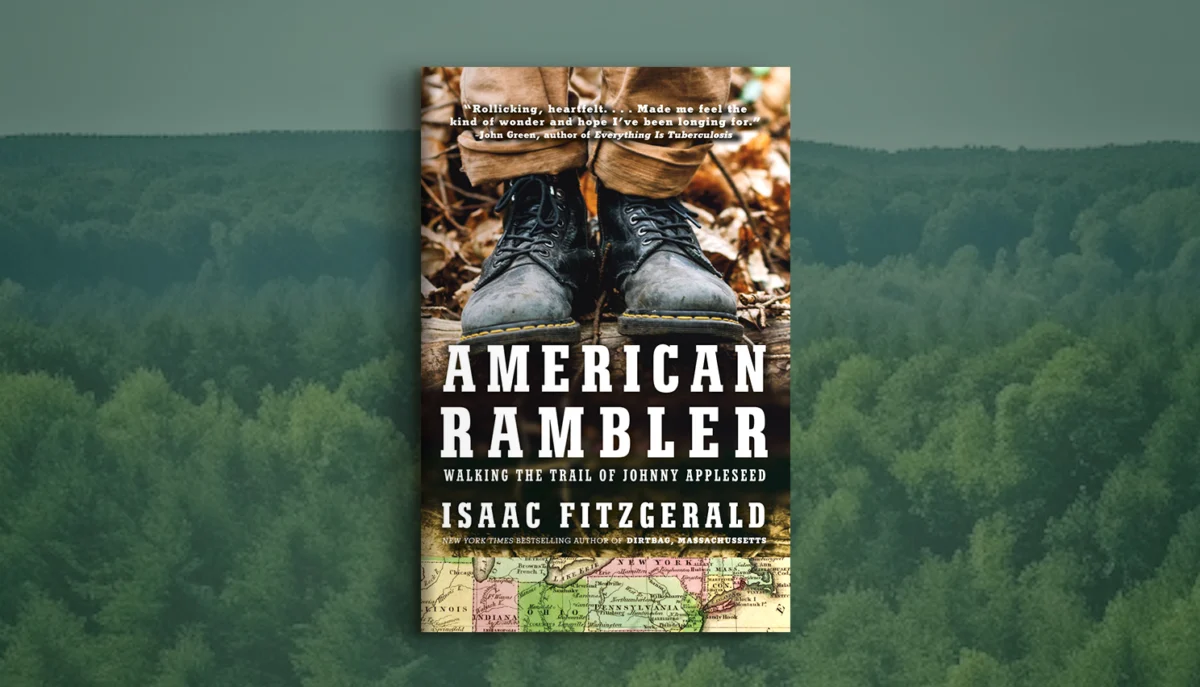
In the landscape of contemporary American letters, few authors bridge the gap between intimate memoir and cultural exploration as effectively as Isaac Fitzgerald. His latest work, American Rambler: Walking the Trail of Johnny Appleseed, serves not merely as a travelogue but as a profound meditation on the American spirit, faith, and the enduring necessity of movement.
Recently, Fitzgerald joined host Miwa Messer for a live taping of the Poured Over podcast in Philadelphia. The conversation, which traversed the dusty paths of the Johnny Appleseed trail and the interior landscapes of personal growth, offered listeners a glimpse into the creative process of a writer who views the road as both a sanctuary and a classroom.
Main Facts: A Journey Across the Heartland
American Rambler is the latest evolution in Fitzgerald’s literary career. Following his acclaimed, visceral memoir Dirtbag, Massachusetts: A Confessional, this new volume finds the author trading the introspection of the past for the outward-facing curiosity of the road.
The central premise of the book—tracing the footsteps of John Chapman, better known as the legendary Johnny Appleseed—provides a scaffolding for a much broader inquiry. Fitzgerald’s journey is not a literal, mile-for-mile recreation of the 19th-century folk hero’s travels, but rather an thematic pursuit of what it means to belong to a landscape.
During the Poured Over interview, Fitzgerald discussed the logistical and philosophical challenges of "writing on the go." He noted that the act of walking forces a specific rhythm upon the prose—a cadence that mirrors the physical exertion of the trail. For Fitzgerald, the act of rambling is an exercise in vulnerability, where the absence of a fixed destination allows for the surfacing of memories, histories, and spiritual reflections that might otherwise remain buried in the sterility of a home office.
Chronology: From Massachusetts to the Appalachian Trail
To understand the trajectory of Fitzgerald’s work, one must view his bibliography as a cohesive narrative arc.
- The Formative Years (Reflected in Dirtbag, Massachusetts): In his earlier work, Fitzgerald established his voice as a confessional writer, unafraid to tackle the complexities of identity, class, and the scars of adolescence. This established the "before" state of his current, more expansive wanderings.
- The Conceptual Shift: The transition toward the Johnny Appleseed project marked a pivot toward historical curiosity. Fitzgerald became fascinated by the dichotomy of Chapman: the man behind the myth, the itinerant who moved through the American wilderness with a singular purpose.
- The Production Phase: Research and physical trekking took place over several years, during which Fitzgerald tested his own stamina against the legacy of the pioneer.
- The Philadelphia Taping: The recent live event at Philadelphia marked a capstone in the promotional cycle, allowing for a synthesis of the book’s themes in a public forum.
- Current Status: American Rambler has been released to critical acclaim, positioning it alongside classic travel literature that explores the American wilderness as a means of psychological discovery.
Supporting Data: The Literature of the Road
Fitzgerald’s work does not exist in a vacuum. During the Poured Over discussion, the conversation highlighted the rich lineage of American travel writing that informs his narrative style. By examining the context of the genre, we can better understand the significance of his contribution.
A Comparative Analysis of Essential "Road" Literature:
- Jack Kerouac’s On the Road: Often considered the foundational text of the modern American road trip. While Kerouac focused on the frenetic energy of the mid-20th century, Fitzgerald’s work offers a more grounded, measured, and arguably more contemplative update to the "search for meaning" motif.
- Bill Bryson’s A Walk in the Woods: Bryson brought humor and observational irony to the Appalachian Trail. Fitzgerald shares the observational eye of a travel writer but balances it with a deeper, more vulnerable focus on personal faith and the "coming of age" narrative.
- Cheryl Strayed’s Wild: Strayed revolutionized the genre by centering the internal journey of grief within the external framework of the Pacific Crest Trail. Fitzgerald’s American Rambler aligns with this school of thought—where the trail is a catalyst for emotional evolution.
- Daniel Mason’s North Woods: This work provides a multi-generational view of a specific plot of land. Fitzgerald’s interest in the Johnny Appleseed trail similarly respects the historical weight of the American landscape, proving that geography is as much about time as it is about space.
Official Responses and Creative Dialogue
The reception of American Rambler has been marked by a recognition of Fitzgerald’s unique ability to merge the scholarly with the personal. Host Miwa Messer, known for her incisive questioning, pushed Fitzgerald to articulate the "why" behind his walking.
In response, Fitzgerald highlighted the concept of "active meditation." He argued that society often encourages static consumption of information, whereas the act of walking—especially on a trail as steeped in American folklore as the Johnny Appleseed route—encourages a "slow digestion" of experience.
The technical production of the podcast episode, overseen by mixer Harry Liang, underscores the intimacy of this conversation. By stripping away the polish of a standard interview and favoring a live, raw, and unvarnished exchange, the Poured Over production team emphasized the very themes Fitzgerald writes about: authenticity, presence, and the importance of the unscripted moment.
Implications: Why the "Ramble" Matters Now
The success of American Rambler carries significant implications for the future of memoir and travel literature. In an age dominated by digital connectivity, there is a burgeoning hunger for analog experiences. Fitzgerald’s work suggests that there is still much to be found in the physical world—if one is willing to put in the miles.
The Psychological Impact of Movement
Studies in environmental psychology have long supported the idea that physical movement aids in cognitive processing. Fitzgerald’s journey serves as a anecdotal confirmation of these findings. By stepping out of his familiar environment, he was able to re-evaluate his faith, his history, and his identity. Readers of his work are encouraged not necessarily to follow his exact path, but to seek their own "rambles."
Cultural Preservation
By re-examining the myth of Johnny Appleseed, Fitzgerald performs a vital cultural service. He strips away the cartoonish veneer of the character to reveal a man whose life was dedicated to the planting of seeds for future generations. This metaphor for his own life—and the act of writing—resonates with a generation grappling with questions of legacy and environmental stewardship.
The Future of the "Poured Over" Series
The Poured Over podcast, which releases new episodes on Tuesdays and Thursdays, has positioned itself as a critical hub for these kinds of deep-dive literary conversations. The collaboration between authors like Fitzgerald and platforms like Barnes & Noble’s podcast signal a shift in how literature is disseminated. It is no longer just about the printed page; it is about the ongoing conversation that surrounds the work, the author’s public evolution, and the shared experiences of the reader.
Conclusion: The Journey Continues
Isaac Fitzgerald’s American Rambler is more than a book; it is an invitation. Through his dialogue with Miwa Messer and his commitment to the trail, Fitzgerald has reminded his audience that the American story is not a static text, but an ongoing process of movement and discovery.
As listeners return to his books—from the raw confessionals of Dirtbag, Massachusetts to the sweeping, thoughtful vistas of American Rambler—they are invited to join a community of seekers. Whether through the pages of a book or the soles of one’s shoes, the path forward is clear: to ramble is to live, and to write about it is to ensure that the journey continues for us all.
For those interested in tracing the paths discussed in this episode, the featured works—including those by Kerouac, Bryson, Strayed, and Mason—are available through Barnes & Noble, serving as a comprehensive reading list for anyone looking to begin their own journey into the heart of the American landscape.










No comments yet. Be the first to join the conversation!