In an era where digital noise is reaching a crescendo, a surprising counter-movement has emerged from the creative community: a collective, enthusiastic return to the analog. As the professional landscape grapples with the saturation of AI-generated imagery and copy, a viral social media movement has successfully repositioned the humble ballpoint pen not just as a tool, but as a defiant symbol of human authenticity.
The campaign, which began as a solitary spark of inspiration on LinkedIn, has transformed into a massive, crowdsourced branding exercise for the Parker Pen Company. By pitting the tactile, deliberate nature of handwriting against the cold, probabilistic efficiency of Large Language Models (LLMs), designers and copywriters have tapped into a growing public fatigue regarding AI-generated content.
The Genesis: A LinkedIn Spark
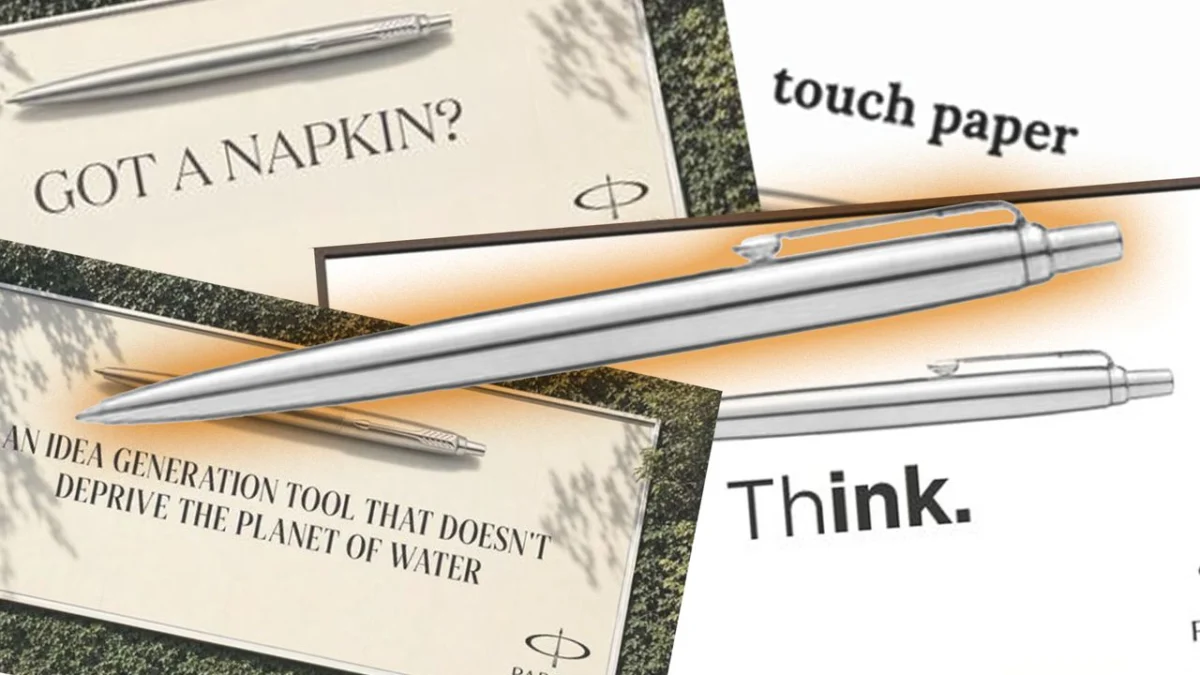
The movement traces its roots to a single post by freelance copywriter and creative strategist Kushagra Oberoi. Disturbed by the ubiquity of uninspired, AI-driven marketing materials, Oberoi proposed an "anti-AI" campaign concept for Parker. His pitch was simple yet devastatingly effective: a billboard featuring a sleek Parker pen accompanied by the provocative copy: "An idea generation tool that doesn’t deprive the planet of water."
The post acted as a lightning rod. Within days, it garnered thousands of likes, shares, and a cascade of further creative suggestions from designers, art directors, and copywriters across the globe. What was intended as a standalone spec ad quickly evolved into an open-source collaboration, drawing the attention of industry heavyweights like Andrew Tindall, Chief Growth Officer at System1, and the team behind "One Minute Briefs."
Chronology of a Viral Wave
The transformation from a social media musing to a global creative challenge followed a rapid, organic trajectory:
- Phase 1: The Initial Critique: Kushagra Oberoi’s LinkedIn post challenges the status quo, questioning the environmental and intellectual cost of AI-generated content.
- Phase 2: The Open Call: Recognizing the momentum, industry figures formalize the movement. An open invitation is issued to the creative community to "#SellMeThisPen," tasking designers with creating billboard-style posters that highlight the enduring value of handwriting.
- Phase 3: The Surge: Over 350 unique entries flood in, ranging from minimalist typography to complex conceptual illustrations.
- Phase 4: Corporate Engagement: The Parker Pen Company, through its parent organization Newell Brands, takes notice. Recognizing the marketing goldmine of an organic, fan-led campaign, the company pivots from passive observer to active participant, offering prizes and recognition for the winning designs.
- Phase 5: Analytical Validation: Ten finalists are selected and put through System1’s sophisticated ad-testing model, which utilizes behavioral science to predict consumer engagement and long-term brand impact.
Data-Driven Disillusionment
The success of this campaign is not merely anecdotal; it is supported by shifting consumer sentiments. Research recently published in the Journal of Marketing Analytics reveals a profound trust deficit in the current advertising ecosystem. According to the study, 80% of consumers do not believe corporate narratives regarding the implementation of AI.
Andrew Tindall notes that the findings are "brutal." The data suggests that when a brand justifies its use of AI—whether for "efficiency," "optimization," or "innovation"—consumers invariably interpret these claims as self-serving. The public assumption remains consistent: companies use AI because it is cheaper for them, not because it provides a superior experience for the consumer.
This "AI fatigue" has created a vacuum that analog brands are uniquely positioned to fill. By leaning into the human-centric narrative, the Parker Pen campaign successfully positioned itself as an "anti-AI" bastion, rebranding the pen as a conduit for authentic human thought, error, and contemplation.
The Winning Concept: "Think"
After evaluating hundreds of entries, the competition culminated in a winning concept that epitomizes the "less is more" philosophy. The design was stark, minimalist, and deeply philosophical. It featured the single word: "Think."
The brilliance of the design lies in its double meaning. Visually, it highlights the word "ink," reminding the viewer of the physical medium. Conceptually, it serves as an imperative—a plea to the viewer to engage in deep, intentional thought rather than defaulting to the "statistically optimized token sequences" provided by a chatbot. It is a subtle, yet biting, critique of the outsourced creativity that has become the hallmark of the late-2020s digital landscape.
The Wider Implications: A Return to "Touching Grass"
The Parker Pen challenge is not an isolated incident; it is part of a broader trend of "analog resistance" in advertising. Earlier this year, Polaroid launched a campaign that similarly tapped into the desire for tactile reality, urging consumers to "touch grass"—a colloquialism for disconnecting from the digital world and engaging with the physical environment.
Similarly, brands like Cadbury and KitKat have launched campaigns that, while humorous, contain an undercurrent of anti-AI sentiment. KitKat’s recent messaging, which encourages users to be "ruder to AI," reflects a growing societal desire to re-establish the boundary between human experience and synthetic imitation.
For small businesses, this shift is already visible on platforms like Instagram. Business owners are increasingly using video content to showcase the manual, imperfect processes behind their products—hand-drawn sketches, physical packaging, and handwritten notes. This serves as a "badge of authenticity," a signal to the customer that the product they are receiving was curated by a human being, not a prompt-based algorithm.
Is This the End of AI in Marketing?
While the Parker Pen campaign has been a resounding success, it is unlikely to signal the total abandonment of AI in the advertising industry. AI remains a powerful tool for data analysis, logistical optimization, and mundane administrative tasks. However, the movement suggests a fundamental shift in how brands must handle creative assets.
If the goal of advertising is to build a relationship with a consumer, that relationship must be built on trust. The current data suggests that AI-generated creative work is currently a net-negative for trust. Brands that want to stand out in a crowded market may find that the most "disruptive" technology they can use is the one that has been around for centuries: the pen.
Conclusion: The Resilience of the Human Touch
The Parker Pen challenge serves as a potent reminder that in the age of automation, the most valuable commodity is humanity. When consumers are bombarded with synthetic content, the imperfections, nuances, and deliberate choices of a human creator become a luxury good.
Whether Parker will move forward with an official, large-scale campaign remains to be seen. However, the organic outpouring of support from the creative community has already achieved its primary goal: it has sparked a conversation about the value of deep thought and the necessity of preserving human agency in a world increasingly run by algorithms.
As we look toward the future of design and marketing, the message from the creatives is clear: before you type your next prompt, pause. Consider the pen. Consider the ink. And, most importantly, consider the process of thinking for yourself. The "AI Age" may be here, but the human desire for authenticity remains as indelible as the ink on a page.