

Introduction: The Vernal Equinox as a Canvas
On the vernal equinox—that precise, celestial pivot point where day and night hold the world in perfect equilibrium—Mrs. Gallery in Maspeth, Queens, unveiled a body of work that seeks to capture the very essence of transformation. The Light That Loses, The Night That Wins, the New York solo debut of Los Angeles-based painter Molly Bounds, is more than an exhibition; it is a profound meditation on the liminal spaces we inhabit between stillness and urgency.
Located at the gallery’s 6040 56th Drive space, the exhibition serves as a milestone for the artist. Following a highly successful introduction at The Armory Show in September 2025, where Bounds’s evocative portraiture first captured the attention of the East Coast art establishment, this new series marks her most ambitious exploration of light as a narrative protagonist. The show remains on view through May 2, 2026, offering visitors a chance to engage with a body of work that mirrors the seasonal shift from the harsh dormancy of winter to the inevitable, vibrant eruption of spring.
Chronology of a Rising Talent
Molly Bounds has spent the last several years cultivating a visual language that balances psychological intensity with technical precision. Her ascent in the contemporary art scene has been marked by a deliberate, patient evolution.
- Early Development: Bounds initially garnered attention for her ability to render the human form in states of profound vulnerability. Her work has long focused on the "in-between"—the moments before a realization, or the seconds after a loss.
- September 2025: The turning point in her institutional profile occurred at The Armory Show. Her presentation with Mrs. Gallery signaled to collectors and critics that Bounds was an artist capable of bridging the gap between classical figurative traditions and modern, existential angst.
- March 20, 2026: The opening of The Light That Loses, The Night That Wins on the vernal equinox was a calculated thematic choice. By debuting the work during a moment of solar symmetry, Bounds underscored her preoccupation with the duality of light—how it serves as both a revealer of truth and a veil of concealment.
The Anatomy of the Exhibition: Supporting Data and Analysis
The exhibition is divided into distinct psychological terrains: the claustrophobic intimacy of the interior and the expansive, dream-like quality of the exterior.
The Interior as a Psychological Vessel
Bounds’s interior scenes are characterized by a heavy, almost atmospheric stillness. Her figures are often depicted in states of "slumped repose," yet there is a discernible friction beneath the surface. In The Armchair, the artist contrasts the comfort of a domestic space—a fireplace, lush upholstery—with the encroaching cold of an evening sky visible through a window.
The painting serves as a case study in tension. While the subject appears to be in a state of contemplation, the viewer is invited to look closer: the unraveling of upholstery seams acts as a metaphor for a mind that is fraying. The subject’s vacant stare, which the artist renders with a haunting, eternal quality, suggests a consciousness that has drifted into a state of "bliss or something else."
The Chiaroscuro of Modern Life
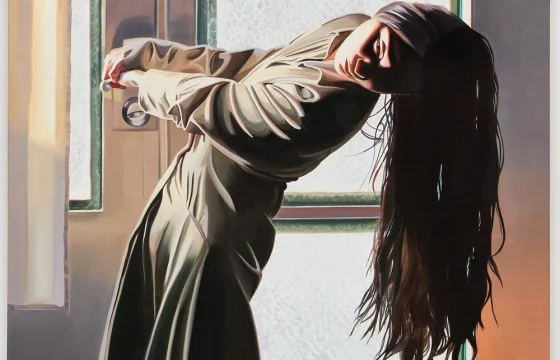
In Privacy Glass, Bounds invokes the spirit of the Old Masters, particularly Georges de La Tour. By utilizing a dramatic interplay of light, she obscures the subject’s face while highlighting the texture of her draped clothing. The light, filtering through glass, becomes a structural element, a beam that asserts itself against the darkness. This is the "vanitas" tradition updated for the contemporary era—a reminder that despite our modern comforts, we remain subject to the fleeting nature of time and the eventual, necessary arrival of darkness.
Landscapes of Optimism and Fantasy
Contrasting the pensive interiority are works such as It Sings in Me and Among of Green, Again. In these pieces, the figures are no longer tethered to the shadows of a room; they exist within rolling, saturated green landscapes.
Critics have noted the "bucolic, perhaps overly so" nature of these scenes. When questioned about the reality of these landscapes, Bounds suggests that the distinction between the real and the imagined is secondary to the utility of the image. These paintings represent a deliberate act of optimism. They are the visual manifestation of the internal spring—the point at which the psyche decides to move forward, to celebrate, and to embrace the possibility of rebirth.
Official Perspectives: The Curator’s View
Mrs. Gallery, through its ongoing support of Bounds, has positioned itself as a champion of artists who navigate the complex intersections of emotional interiority and physical environment.
In discussions regarding the exhibition, the curatorial team at Mrs. highlighted the "unrelenting forward movement of time" as the central theme of the collection. The gallery posits that Bounds’s work is uniquely suited for the current cultural climate, where the collective consciousness feels similarly caught between the "darkness of winter" and the promise of a new season. The decision to host the show through the early spring months is intended to allow the work to resonate with the physical environment, creating a dialogue between the viewer’s experience of the changing season and the transformation depicted on the canvas.
Implications: Why Bounds Matters Now
The significance of The Light That Loses, The Night That Wins lies in its refusal to offer easy answers. In an art world often preoccupied with digital disruption or high-concept abstraction, Molly Bounds returns to the figure with a raw, unvarnished honesty that feels radical.
The Intersection of Vulnerability and Agency
Bounds’s work challenges the viewer to reconsider the act of "doing nothing." Her subjects are often still, yet they are actively participating in the work of existing. By capturing the tension inherent in rest, she validates the psychological labor that often goes unseen.
The Role of Light as a Narrative Device
Historically, light in painting has been used to illuminate or to sanctify. For Bounds, light is an unreliable narrator. It changes, it shifts, and it forces us to confront the limitations of our own vision. By framing her subjects in these shifting light conditions, she mimics the way we view our own lives: in fragments, under changing circumstances, and always against the backdrop of an advancing dusk.
A New Chapter for Figurative Painting
The success of this exhibition suggests that there is a growing audience for figurative work that deals with the "liminal." As society moves through cycles of crisis and recovery, art that acknowledges the fragility of the human state—while simultaneously pointing toward renewal—carries a specific resonance. Bounds has successfully transitioned from an emerging talent to an artist who commands the full attention of the New York gallery scene.
Conclusion: Spring Wins
As the exhibition proceeds toward its May 2, 2026, closing date, the themes of the work continue to unfold. The "unrelenting forward movement of time" mentioned by the artist is not merely a subject of her paintings; it is the experience of visiting the gallery itself.
The Light That Loses, The Night That Wins is a testament to the fact that even when the light wanes, it leaves behind a residue of color and memory. Molly Bounds has created a space where the viewer can sit with the discomfort of the transition, only to emerge on the other side, much like her figures in the green hills: ready for the renewal that follows the dark. For those in New York, the opportunity to witness this pivotal moment in Bounds’s career is not to be missed. The exhibition serves as a vital reminder that while the light may lose its battle with the night, the cycle of renewal is, ultimately, undefeated.









No comments yet. Be the first to join the conversation!