Neng Nana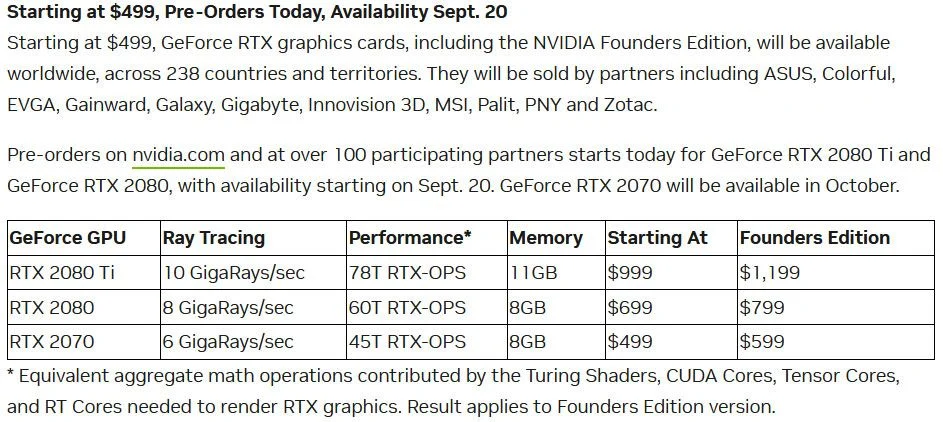
Eight years ago, the landscape of PC gaming underwent a seismic shift that few in the industry fully grasped at the time. On this day, Nvidia unleashed its "Turing" GPU architecture upon the enthusiast market, marking the debut of the GeForce 20-series. While every GPU generation promises faster frame rates and higher resolutions, Turing was marketed as something fundamentally different: a "20 years in the making" leap that introduced real-time ray tracing to consumer hardware.
What began as a polarizing launch characterized by high price points and limited software support has since evolved into the industry standard. Today, we look back at how the Turing architecture transformed the "golden age of gaming" from a marketing slogan into the foundation of modern visual fidelity.
Main Facts: The Dawn of the RTX Era
The launch of the GeForce RTX 2080 and RTX 2080 Ti represented more than just a die-shrink or a clock-speed bump. Nvidia introduced a tripartite architecture consisting of traditional CUDA cores for programmable shading, RT Cores for real-time ray tracing, and Tensor Cores for AI-driven processes like Deep Learning Super Sampling (DLSS).
This hybrid rendering approach was the cornerstone of the "RTX" branding. By offloading the computationally expensive math required to simulate light, shadows, and reflections to dedicated hardware, Nvidia aimed to solve the "holy grail" of computer graphics. The RTX 2080 and 2080 Ti were the vanguard of this movement, with the more accessible RTX 2070 following in October to broaden the reach of the technology.
A Chronology of the Turing Rollout
The road to the Turing launch was paved with aggressive marketing and high expectations.
- August 2018 (SIGGRAPH): Nvidia officially unveiled the Turing architecture at the SIGGRAPH conference in Vancouver. Jensen Huang took the stage to frame the launch as a revolutionary moment, emphasizing that ray tracing—a technique previously reserved for multi-million dollar film production render farms—was finally coming to home PCs.
- September 2018 (The Launch): Enthusiasts finally got their hands on the GeForce RTX 2080 and 2080 Ti. The community reaction was initially mixed; while the hardware was undeniably impressive, the "RTX tax"—the significant price increase over the preceding Pascal-based GTX 10-series—became a major point of contention.
- October 2018: The RTX 2070 arrived, bringing the cost of entry down and signaling that Nvidia was committed to pushing ray tracing into the mainstream.
- 2019-2020 (The Maturity Phase): Throughout the following years, Nvidia pushed for wider adoption through driver updates and partnerships with game developers. The introduction of DLSS 2.0 became a turning point, proving that the hardware wasn’t just about ray tracing, but about using AI to intelligently upscale images, maintaining performance while boosting visual quality.
Supporting Data: Beyond the Marketing
When evaluating the impact of Turing, one must look past the buzzwords and examine the technical leap. The Turing GPU was massive in terms of silicon real estate. The TU102 chip, which powered the RTX 2080 Ti, featured a staggering 18.6 billion transistors.
Hardware Comparison Table
| Metric | Pascal (GTX 1080 Ti) | Turing (RTX 2080 Ti) |
|---|---|---|
| Process Node | 16nm FinFET | 12nm FFN |
| Transistor Count | 12 Billion | 18.6 Billion |
| RT Cores | None | 68 |
| Tensor Cores | None | 544 |
| Ray Tracing | Software emulation (slow) | Dedicated Hardware |
The data confirms that Nvidia was not merely iterating; they were pivoting. The inclusion of Tensor Cores allowed for the implementation of DLSS, which would eventually become the single most important feature for longevity in modern gaming, allowing titles to remain playable even as visual demands increased.
Official Responses: Jensen Huang’s Vision
Nvidia’s leadership, particularly CEO Jensen Huang, was unequivocal in their belief that Turing was the future. In a blog post published one month before the retail release, Huang famously declared:
"Turing opens up a new golden age of gaming, with realism only possible with ray tracing, which most people thought was still a decade away. Once you see an RTX game, you can’t go back."
This sentiment was echoed throughout the company’s internal communications and marketing materials. Nvidia understood that the raw power of the hardware would mean nothing without the ecosystem to support it. They aggressively courted developers, working with studios like DICE (Battlefield V) and 4A Games (Metro Exodus) to ensure that ray tracing was not just an afterthought, but a core component of the rendering pipeline.
While competitors and critics argued that the "RTX tax" was too high for a nascent technology, Nvidia’s stance remained firm: they were willing to sacrifice short-term market sentiment to secure long-term architectural dominance.
Implications: A New Standard for Visual Fidelity
Eight years later, the implications of the Turing release are undeniable. The "RTX" brand has become synonymous with premium PC gaming.
1. The Death of Rasterization-Only Rendering
Before Turing, graphics were largely defined by rasterization—a method of approximating 3D scenes. Turing signaled the beginning of the end for pure rasterization. Today, it is nearly impossible to find a high-end AAA game that does not incorporate at least some form of ray-traced lighting, reflections, or shadows.
2. The Rise of AI-Upscaling
Perhaps the most significant legacy of Turing was the formal introduction of Tensor Cores. By demonstrating that AI could reconstruct high-resolution frames from lower-resolution inputs, Nvidia fundamentally changed the performance paradigm. Without DLSS, the hardware requirements for modern 4K gaming would have likely rendered the hobby inaccessible to all but the wealthiest enthusiasts.
3. Industry Alignment
Turing forced the entire industry to adapt. AMD, Nvidia’s primary competitor, eventually followed suit with their own hardware-accelerated ray tracing (RDNA 2) and AI upscaling (FSR). Consoles like the PlayStation 5 and Xbox Series X also adopted these technologies, validating Nvidia’s bet that ray tracing was the correct path forward for interactive entertainment.
4. A Shift in Pricing Power
It would be remiss not to mention the economic impact. Turing marked the moment Nvidia began testing the price elasticity of the gaming market. By positioning the RTX 20-series as a luxury tier of hardware, Nvidia effectively reset the price ceiling for graphics cards. While this caused friction at the time, it also provided the R&D funding necessary to drive the subsequent generations (Ampere, Ada Lovelace) that have pushed performance to levels unimaginable in 2018.
Conclusion: The Long View
Looking back at the launch of Turing, we see a company that was perhaps too early for the market’s comfort, but exactly on time for the industry’s needs. The GeForce 20-series was not perfect—it was expensive, power-hungry, and featured a first-generation technology that struggled in its infancy. However, it succeeded in its primary goal: it broke the stagnation of traditional graphics rendering.
As we continue to push toward photorealism in games, the legacy of that day eight years ago remains clear. Every time a gamer toggles a ray-tracing setting to "Ultra" or enables DLSS to squeeze out more frames, they are interacting with the foundation laid by the Turing architecture. Jensen Huang’s promise that "you can’t go back" turned out to be the most accurate prediction of the last decade. The industry didn’t just move forward; it entered a new era of digital light and logic, forever changing how we experience virtual worlds.

 Suro Senen
 Asep Darmawan