

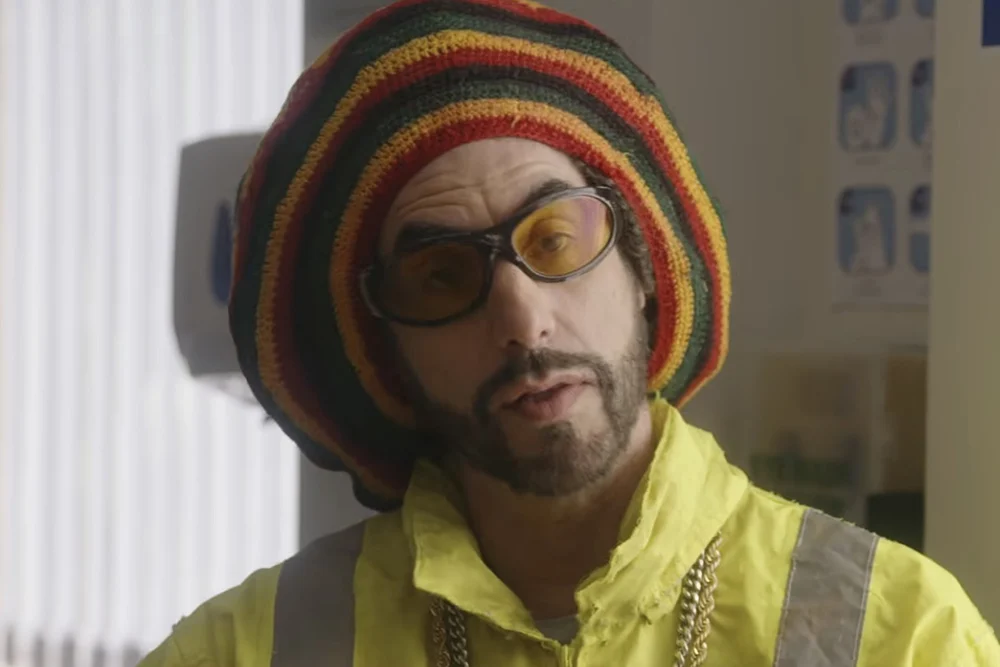
The resurgence of Sacha Baron Cohen’s iconic, yet polarizing, alter ego, Ali G, has triggered a firestorm of controversy in the United Kingdom. As Amazon MGM prepares to release the new mockumentary Ali G: Who Iz I?, the character—a suburban white man who adopts a stereotypical urban "rude boy" persona—has become the center of a heated debate regarding race, cultural appropriation, and the shifting boundaries of comedy in the 21st century.
What was intended to be a satirical homecoming has instead ignited a coordinated campaign to keep the film out of cinemas, forcing a broader conversation about whether a character birthed in the late 1990s can, or should, survive in an era of heightened social consciousness.
The Chronology of a Backlash
The friction began almost immediately following the release of the trailer for Ali G: Who Iz I?. In the promotional footage, Baron Cohen is seen reprising the role with the trademark fake dreadlocks, Rastafarian-style headwear, and a vocabulary peppered with mock-Patois. The trailer features the character discussing his aspirations to be an "absent father," a beat that many online critics identified as a particularly tone-deaf reliance on tired racial tropes.
By Wednesday, the momentum of the online criticism transitioned into organized action. NewsCord, a media monitoring and news comparison platform, launched a concerted campaign urging global cinema chains to boycott the film. Through their digital infrastructure, the platform allowed users to send automated emails to major theater circuits requesting that they refuse to screen the feature.
The campaign gained rapid traction. By Friday, NewsCord claimed to have facilitated the dispatch of over 36,000 emails to cinema operators. The core of their argument is that the film serves as a vehicle for systemic racism, a claim they buttress with historical context. The movement highlights a 2000 report from the Evening Standard, which documented a backlash from Black British comedians who viewed the character as an "alibi for racism."
Amidst this, a significant piece of misinformation circulated regarding the campaign’s success. NewsCord shared an email response from the U.K. cinema chain Picturehouse, in which the exhibitor stated they had "no current plans to screen this film." NewsCord presented this as a victory for their movement. However, industry insiders at Variety later clarified that this was a standard automated customer service response for films not yet slated for release, casting doubt on the narrative that the chain had actively "banned" the film.
The Historical Critique: "Alibi for Racism"
To understand the current outrage, one must look back to the origins of the character. Launched in 1998 on Channel 4’s 11 O’Clock Show, Ali G was designed as a satire of the "wannabe" culture—a dim-witted white youth attempting to co-opt Jamaican and urban Black aesthetics. Baron Cohen’s intent, as he argued for years, was to expose the ignorance of the character and the absurdity of cultural appropriation.
However, the satirical intent has been a point of contention for over two decades. In 2000, the late, brilliant British comedian Felix Dexter offered a searing critique, noting that the character provided "the liberal middle classes [with the ability] to laugh at Black street culture in a context where they can retain their sense of political correctness." The comparison drawn by writer Jeanette Winterson—who famously likened the character to the Black and White Minstrels—remains a cornerstone of the argument against his return.
Critics today argue that the satire was always thin, masking a form of comedy that prioritized the amusement of a predominantly white, middle-class audience at the expense of the communities being caricatured. The fact that this critique is being repeated nearly verbatim 26 years later suggests that the cultural climate has shifted, but the fundamental tension remains unresolved.
Perspectives: A Voice from the Cultural Frontline
Among the most vocal contemporary critics is British writer and broadcaster Afua Hirsch. In a recent Substack post, Hirsch articulated a sentiment shared by many who feel the character’s time has long since passed. She noted that while the character felt offensive in her youth, he now feels entirely "out of sync" with modern standards.
"Black people don’t dress like that anymore. Even white people imitating Black people don’t talk like that anymore," Hirsch wrote. "Sexualizing black women and casually mocking working-class women is not accepted anymore. Baron Cohen’s so-called ‘humor’ is a crude compound of all these things."
Hirsch’s argument touches upon a critical aspect of modern media consumption: the evolution of language and representation. While comedy is meant to push boundaries, critics argue that Ali G does not challenge power structures but rather reinforces them by turning marginalized identities into a costume. For those who view the character through this lens, his return isn’t just "un-PC"—it is a regression.
Official Responses and Industry Stance
The response from the film industry has been one of measured professional distance. Phil Clapp, head of the U.K. Cinema Association, offered a firm defense of the role of the exhibitor in a democratic society.
"Cinemas are there to engage and entertain the widest possible audience. They are not there to act as censors or arbiters of public taste," Clapp told Variety. "Where a film has been given a certificate by the British Board of Film Classification (BBFC), they [cinemas] will decide whether or not to play it solely with the likely response of their audience in mind."
This stance underscores a fundamental division: the difference between a moral campaign (led by organizations like NewsCord) and the pragmatic commercial reality of the cinema industry. While the U.K. Cinema Association emphasizes market demand and regulatory compliance, the campaigners are appealing to the social responsibility of corporations, demanding that they prioritize ethical considerations over potential ticket sales.
As for the creators, Sacha Baron Cohen appears to have anticipated the volatility of the current landscape. In a tweet promoting the trailer, he offered a characteristically cynical nod to the "cancel culture" discourse: "In an age when a single comedian’s career can be ended by a single un-PC joke, I thought I’d play it safe and bring this guy back." Whether this was a genuine attempt to address the criticism or a calculated bit of marketing—leveraging the outrage to generate buzz—remains a matter of perspective.
The Implications: Where Does Comedy Go From Here?
The saga of Ali G: Who Iz I? serves as a litmus test for the future of satirical comedy. The conflict highlights several critical implications:
- The Shelf Life of Satire: The debate forces us to ask whether characters built on racial caricature can ever truly shed their problematic origins. Is it possible to "reclaim" or "update" such a character, or is the inherent premise too tethered to its time to be revived?
- The Power of Digital Mobilization: The NewsCord campaign illustrates the ease with which digital platforms can organize, coordinate, and pressure major corporate entities. While the actual impact on cinema programming may be limited by commercial realities, the ability to generate 36,000 emails in 72 hours signals a shift in how audiences influence media distribution.
- The Role of the Exhibitor: As the U.K. Cinema Association pointed out, the cinema remains a contested space. The struggle between the "sanctity" of artistic expression and the demand for social accountability is likely to intensify, with theaters increasingly forced to choose between playing the hits and maintaining their reputation as community-conscious spaces.
- The Baron Cohen Phenomenon: Sacha Baron Cohen has built a career on making his audience uncomfortable. By resurrecting a character that was controversial in 1998, he is inviting the exact level of scrutiny he likely expected. The question is no longer whether the comedy is "funny," but whether it is still "permissible" in the eyes of an audience that has undergone a profound shift in its understanding of representation and harm.
Ultimately, the release of Ali G: Who Iz I? will not only be a test of box office performance but a significant milestone in the ongoing struggle to define the boundaries of comedy. As the industry watches on, one thing is certain: the era where a comedian could simply claim "it’s just a joke" and expect it to go unquestioned has, for better or worse, come to an end. Whether this results in a more thoughtful landscape for satire or the stifling of artistic expression remains the defining question of this controversy.










