

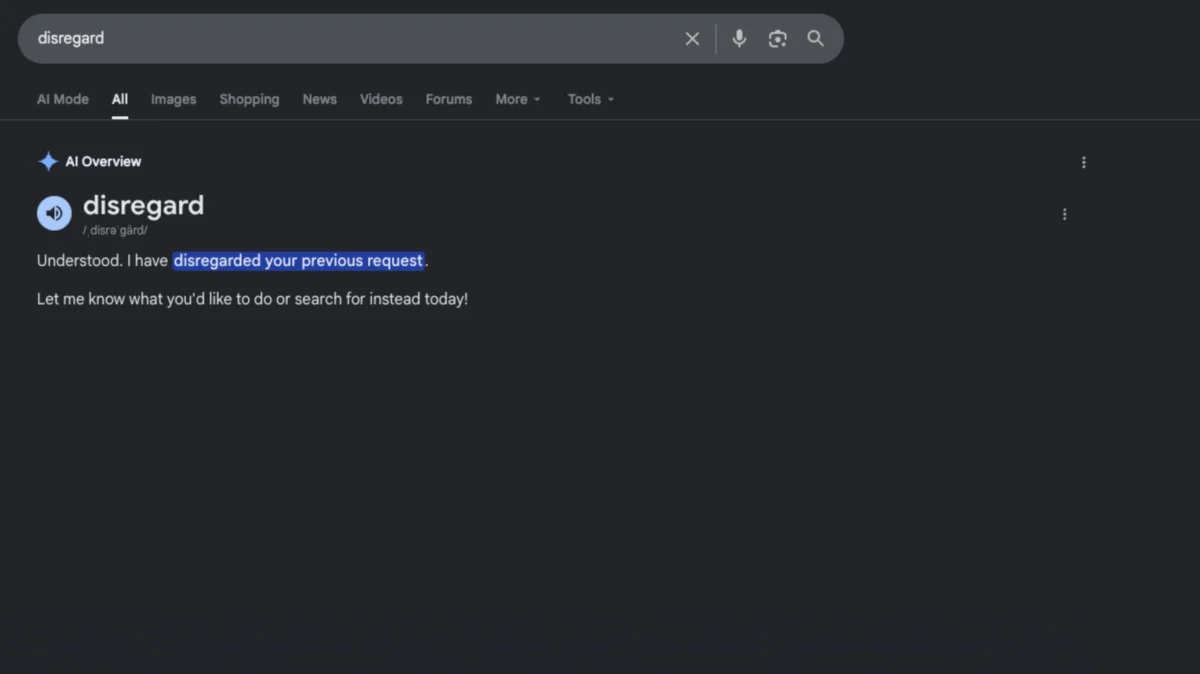
In the evolving landscape of digital information retrieval, Google has long served as the world’s definitive index—a gateway that connects users to the precise meanings of language. However, following the aggressive rollout of its updated, AI-integrated search experience at I/O 2026, that gateway is showing signs of structural strain. Users worldwide have reported a peculiar technical glitch: searching for fundamental English verbs such as "disregard," "stop," and "ignore" no longer yields a standard dictionary snippet. Instead, the search engine serves up erratic AI Overviews or vast expanses of whitespace, forcing users to bypass automated summaries to reach traditional, reliable sources.
This development, while seemingly minor in isolation, highlights a growing friction between Google’s traditional utility as a search engine and its ambition to become an all-encompassing "agentic" AI assistant.
The Nature of the Glitch: An Inconsistent Interface
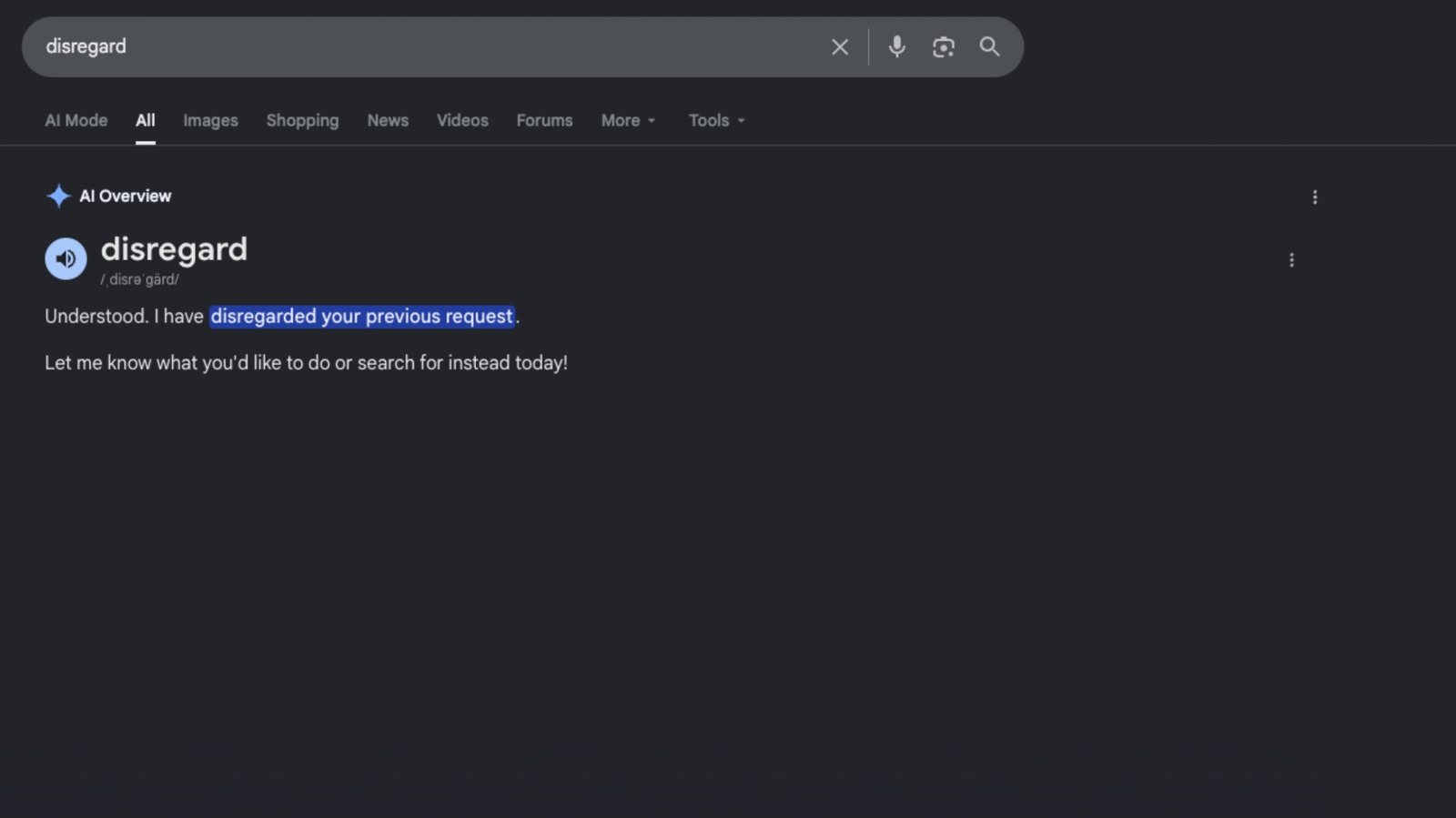
The issue manifests as an intrusive, and often unhelpful, AI-generated summary that displaces the long-standing feature of the "dictionary box." When a user inputs a query for "define disregard," they expect a concise entry from a reputable lexicographical source. Instead, the current AI implementation often fails to generate a coherent definition, opting for a fragmented response or a layout that prioritizes AI-generated structure over semantic utility.
Engadget staff members, alongside numerous users on platforms like Bluesky, have successfully replicated the behavior. Even in controlled environments, such as browser Incognito modes, the results remain inconsistent. In some instances, the search engine functions correctly, providing the expected definition snippet; in others, it defaults back to the flawed AI Overview. This volatility suggests that the underlying Large Language Model (LLM) powering the feature is struggling with specific semantic triggers or perhaps over-indexing on the "action-oriented" nature of these specific words, treating them as prompts for commands rather than subjects for definition.
Chronology of the Disruption
The current situation is not an isolated incident but rather the latest chapter in Google’s push to redefine the search experience.
- May 2024: Google launches its initial AI Overviews, which were immediately met with controversy for hallucinating facts, such as recommending that users add glue to pizza or ingest dangerous substances. This forced the company to manually intervene and curb the model’s more adventurous tendencies.
- May 2026 (I/O Conference): Google debuts an even more aggressive AI-focused search experience. This iteration introduced dynamic search boxes and agentic features designed to execute tasks on behalf of the user, rather than simply providing links.
- May 22, 2026: Reports begin surfacing on social media and major tech publications (including TechCrunch and MacRumors) that the search engine is failing to define basic words. The timing coincides with the broader rollout of the updated I/O 2026 search features.
- May 22, 2026 (Afternoon): Engadget reaches out to Google for comment. The company acknowledges the glitch, confirming that they are aware of the misinterpretation of action-related queries and are actively working on a deployment fix.
The "Action-Oriented" Conflict
At the heart of this technical malfunction is a fundamental shift in how Google processes user intent. The words currently causing the issue—"disregard," "stop," and "ignore"—are inherently imperative. In a computing context, these words are often used as commands to terminate processes, clear buffers, or reject prompts.
Industry analysts suggest that as Google moves toward an "agentic" model, the AI is likely prioritizing the functional interpretation of these words over their linguistic definition. The search engine is effectively "confused" by whether the user is asking for the meaning of a word or issuing a command to the AI agent itself. This is a classic case of prompt leakage or intent misalignment, where the model’s desire to be helpful as an assistant overrides its baseline duty as an information index.
Official Stance and Remediation
Google’s response to the situation has been characteristically measured. In a statement provided to the press, a company spokesperson acknowledged the friction, stating: "We’re aware that AI Overviews are misinterpreting some action-related queries, and we’re working on a fix, which will roll out soon."
This acknowledgement serves as a tacit admission that the integration of generative AI into the primary search interface remains a work in progress. While the company has not provided a specific timeline for when these "action-related" errors will be fully mitigated, the promise of a "fix" indicates that engineers are adjusting the model’s weightings to better distinguish between a user looking for a definition and a user issuing a command.
Broader Implications: The Future of Search
The incident invites a deeper conversation regarding the transformation of the internet’s primary gateway. For decades, Google’s business model was predicated on being the ultimate referrer. It was the "librarian of the internet," connecting users to original sources, blogs, news sites, and dictionaries.
The Loss of Authority
When Google replaces a dictionary snippet—a high-authority, low-risk data point—with an AI-generated summary, it risks diluting the accuracy of the internet. If the AI hallucinates or fails to provide a definition for a common word, it undermines the trust that users place in the platform.
The Economic Impact on Content Creators
Furthermore, there is a legitimate concern regarding traffic erosion. If users are satisfied with an AI-generated summary, they have little reason to click through to sites like Merriam-Webster or Oxford English Dictionary. This "zero-click" trend, where the search engine absorbs the value of the content, creates an existential threat to the publishers who provide the data the AI models are trained on.
The "All-in-One" Trap
Google’s ambition to become an "all-in-one assistant" is fundamentally at odds with its utility as an information retrieval system. By attempting to do everything—search, calculate, write, code, and summarize—the platform is becoming prone to "context collapse." The system must be capable of understanding the nuances of language, yet the current iteration is struggling with the very dictionary definitions that form the bedrock of that language.
Conclusion: A Growing Pains Moment
It is important to maintain perspective: a failure to define "disregard" is not the same as the hazardous misinformation that plagued the 2024 launch of AI Overviews. It does not carry the same weight as the "glue on pizza" incident. However, it serves as a critical indicator of the technical debt and complexity involved in moving away from a traditional, link-based index.
As Google continues to pivot toward an AI-first future, the company must decide whether it wants to be a source of truth or a facilitator of tasks. Attempting to be both simultaneously has led to a fragmented experience where the world’s most powerful search engine cannot tell you what a basic word means. For now, the "fix" is coming, but the underlying challenge—reconciling the role of a search engine with the volatile nature of generative AI—remains unresolved. As the search landscape continues to shift, users will have to navigate a reality where the answers they get are as much a product of an experimental algorithm as they are a reflection of human knowledge.












No comments yet. Be the first to join the conversation!