

In the quiet, nondescript suburbs of Oxford, England, a 25-foot fiberglass shark hangs suspended, forever plunging headfirst into the roof of a terraced house. Since 1986, the "Headington Shark" has served as a polarizing local landmark—a beacon of eccentricity that forces passersby to stop, stare, and wonder. It was commissioned by homeowner Bill Heine and crafted by sculptor John Buckley as a visceral protest against nuclear warfare and the military airstrikes of the era.
Forty years later, this bizarre architectural statement has been reimagined not as a political manifesto, but as a vessel for personal healing. Director Rebekah Fortune’s latest film, Learning to Breathe Under Water, takes the shark as its central motif, using the absurdity of the sculpture to anchor a poignant, fictional exploration of grief, family dynamics, and the messy, nonlinear process of moving on. While the real-life sculpture was a lightning rod for community debate, Fortune’s film is poised to be a crowd-pleasing, heart-on-sleeve tearjerker, bridging the gap between quirky indie aesthetics and universal human emotion.
The Genesis of a Cinematic Curiosity
The Headington Shark was never meant to be a permanent fixture, let alone a cinematic muse. When it was first installed, it sparked a bureaucratic firestorm, with local planning authorities battling the homeowners for years to have it removed. To the residents of Oxford, it was a nuisance; to the art world, it was a daring subversion of domesticity.
In Learning to Breathe Under Water, the shark is relocated from the streets of Oxford to a quiet, unassuming town in Ireland. Here, it is not a protest against geopolitics, but a monument to a father’s internal collapse. The film centers on Peter (played by BAFTA nominee Rory Kinnear), a middle-aged artist struggling to navigate the suffocating vacuum left by his wife’s death. He lives with his pre-teen son, Leo (played by breakout star Ezra Carlisle), in a home where the shark has been literally grafted onto the architecture. For Peter, the sculpture is an outward manifestation of an inward scream—a desperate, attention-seeking gesture from a man who has otherwise retreated from the world.
Chronology of a Household in Flux
The narrative arc of the film is defined by the arrival of an external force. Following the death of his wife, Peter’s life has become a sedate, monochromatic existence governed by his own deepening depression. Leo, while bright and curious, lives a bifurcated life: he navigates the social world of school during the day, but returns to a home where his father’s grief dictates the emotional weather.
- The Stasis: The film opens in the shadow of loss. We see the routine: Peter’s withdrawal, the blue-hued interior of the home that reflects his psychological stagnation, and Leo’s secret, one-sided therapy sessions where he whispers his fears into the synthetic belly of the rooftop shark.
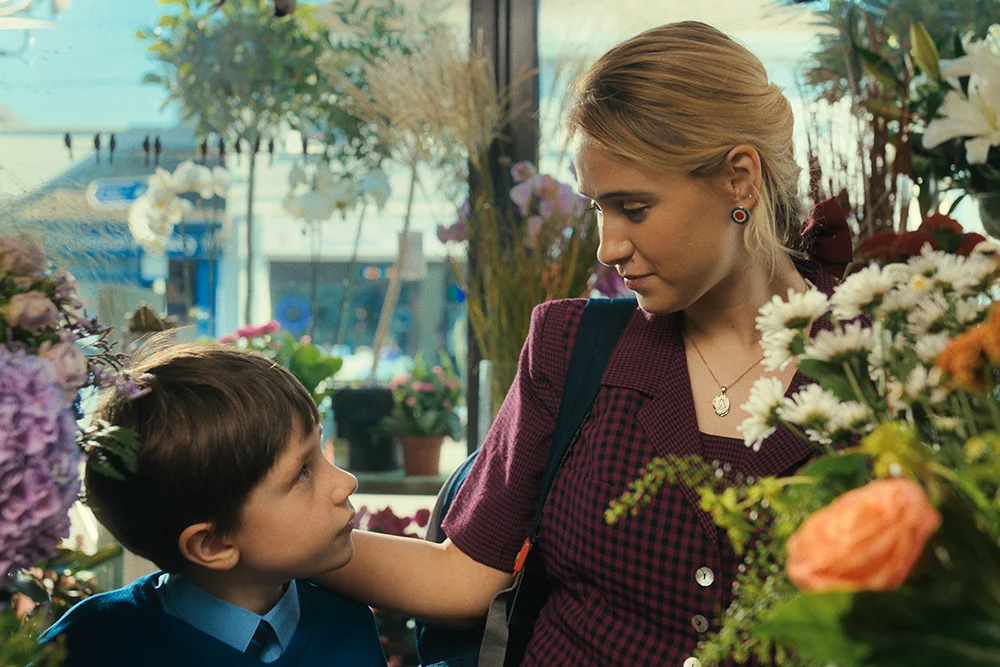
- The Intervention: Concerned by Leo’s isolation, a school teacher orchestrates an intervention. Enter Anya (Oscar nominee Maria Bakalova), a freewheeling Bulgarian au pair. She is not the magical, transformative figure of a fairytale, but a grounded, kind-hearted presence whose arrival introduces light into the house.
- The Awakening: The second act tracks the incremental shifts in the family dynamic. Leo begins to blossom under Anya’s care, while Peter, initially defensive and reluctant, is nudged toward re-engaging with the outside world.
- The Resolution: The final act focuses on the hard-won realization that grief does not vanish; it is integrated. The film avoids the trap of a "miracle cure," opting instead for small, realistic steps toward reconciliation and mental health.
Supporting Data: A Cast of Exceptional Range
The success of Learning to Breathe Under Water hinges on the chemistry between its three leads. Industry observers and critics at the Karlovy Vary International Film Festival, where the film premiered to warm reception, have pointed to the performances as the film’s greatest asset.
- Ezra Carlisle: At just 11 years old, the Irish actor delivers what is arguably the film’s anchor performance. As Leo, Carlisle avoids the common pitfalls of child acting—he is never cloying or overly precocious. Instead, he captures the "gravely earnest" nature of a child trying to make sense of adult suffering. His narration, which features naive animated intrusions that mirror his lateral, inventive mind, is the heartbeat of the film.
- Rory Kinnear: Known for his heavy-hitting dramatic work, Kinnear plays Peter with a delicate, weary complexity. He portrays a man who is not a villain in his grief, but a flawed, mourning human being struggling to maintain a facade of stability for his son.
- Maria Bakalova: Following her Oscar-nominated turn in Borat Subsequent Moviefilm, Bakalova proves her versatility as Anya. She brings a necessary, vibrant energy to the film, acting as the bridge between Peter’s darkness and Leo’s burgeoning hope.
Artistic Style and Visual Metaphors
Director Rebekah Fortune, known for her sensitive handling of identity and complex emotional growth in 2017’s Just Charlie, demonstrates a refined visual language here. Working with production designer May Davies, Fortune employs a distinct color palette to mirror the characters’ interior states.
The house itself is a character. The interiors are saturated in ocean-blue tones, symbolizing Peter’s immersion in his own melancholy. In contrast, the attic—where the late mother’s effects are kept—is bathed in sunshine yellows, representing a warmth and vitality that has been locked away.
The film’s most innovative stylistic flourish is the integration of animation into the live-action frame. These sequences illustrate Leo’s singular imagination, turning his anxieties into playful, surreal visual metaphors. This choice serves a dual purpose: it keeps the audience tethered to the child’s point of view while preventing the film from becoming too dour or didactic.
Official Responses and Festival Reception
Since its debut in the Special Screenings sidebar at the Karlovy Vary International Film Festival, the film has drawn significant interest from indie distributors. Industry analysts suggest that its "offbeat but audience-friendly" nature makes it an ideal candidate for family-oriented indie circuits.
Critics have noted that while the film occasionally relies on "shorthand" to convey complex emotions—such as a third-act speech from Anya that some felt was slightly "on the nose"—the overall impact remains profound. The consensus among festival attendees is that Fortune has successfully tackled the "tricky task" of dramatizing trauma in a way that is accessible to all ages. It manages to speak to children without patronizing them, and to adults without oversimplifying the complexities of loss.
Implications: The Legacy of the Headington Shark
The cultural resonance of the Headington Shark is perhaps the most fascinating aspect of this project. By transposing a real-world protest icon into a fictionalized domestic space, Learning to Breathe Under Water speaks to the way we imbue objects with our own psychological baggage.
The film raises a pertinent question: When we create something to express our grief or our anger, what happens when that object outlives the intensity of the emotion that birthed it? For the character of Peter, the shark is an albatross, a constant reminder of the day his world changed. By the end of the film, the question is not whether the shark should stay or go, but whether the characters can finally look at it and see something other than their own pain.
Conclusion
Learning to Breathe Under Water is a testament to the power of incremental healing. In a landscape of cinema often dominated by massive, high-stakes dramas, Rebekah Fortune has crafted a quiet, thoughtful, and deeply human story. By grounding the eccentric imagery of the Headington Shark in the authentic, relatable experience of a father and son, the film achieves something rare: it makes the impossible burden of grief feel like something that can, eventually, be managed.
As the film moves toward a broader release, its success will likely serve as a benchmark for how to handle trauma in family-friendly cinema. It is a story about the structures we build to protect ourselves, the homes we live in, and the courage it takes to finally open the door to the outside world. Through the earnest eyes of young Ezra Carlisle and the steady hand of Fortune, the Headington Shark finds a new life—not as a protest, but as a bridge back to the living.










