

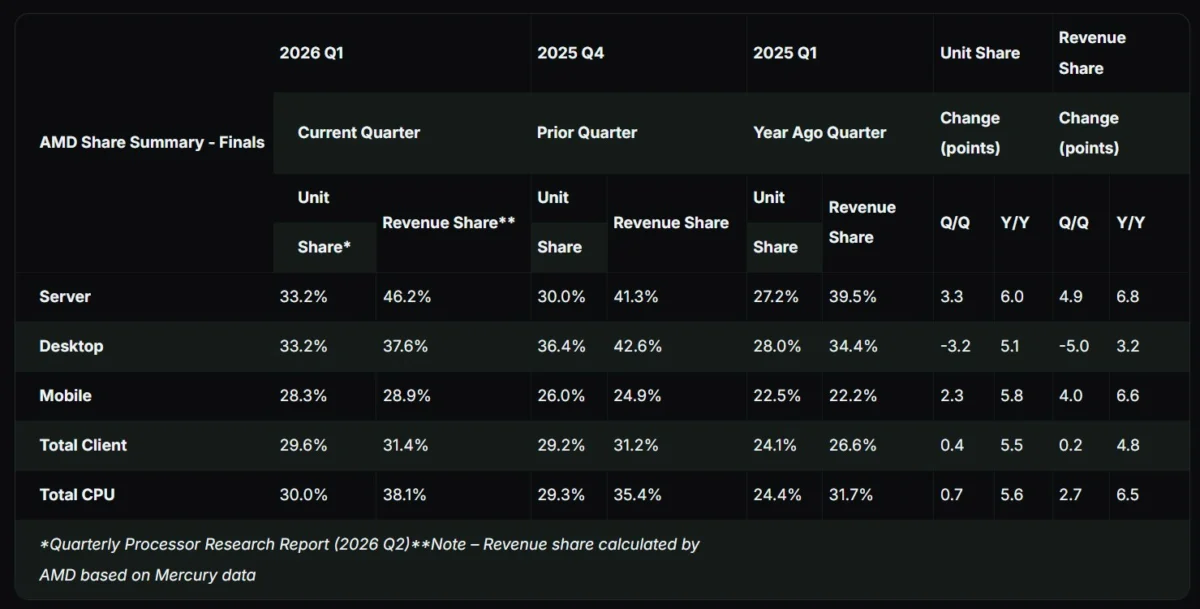
The global semiconductor market, the foundational bedrock of the modern digital economy, continues to undergo a tectonic transformation. As we move through the first quarter of 2026, the latest data from Mercury Research paints a vivid picture of a duopoly—and an emerging third force—in a state of perpetual flux. AMD, under the leadership of Dr. Lisa Su, has once again demonstrated its prowess in the high-stakes server arena, securing a historic 33.2% share of the x86 server market. Yet, as AMD celebrates its gains in the data center, the battlefield of consumer computing tells a more complex story, characterized by a cooling desktop segment and a resurgent mobile performance.
The Data Center Revolution: AMD’s Server Dominance
The narrative of the last five years in the semiconductor industry has been defined by AMD’s EPYC processor line. In Q1 2026, this trajectory reached a new milestone. Achieving a 33.2% market share by unit volume in the x86 server space signifies that one out of every three servers sold now carries the AMD logo.
However, unit volume tells only half the story. The more staggering metric is the revenue share, which stands at an impressive 46.2%. This discrepancy between unit share and revenue share underscores a critical market reality: AMD’s EPYC processors are consistently commanding premium pricing compared to Intel’s Xeon counterparts. Enterprises are no longer simply choosing AMD as a cost-effective alternative; they are prioritizing the performance-per-watt and core-density advantages that EPYC offers, regardless of the price tag. This high-margin success is the cornerstone of AMD’s current financial health, allowing the company to reinvest heavily in R&D for future generations of Zen architecture.
The Rise of the ARM Challenger
While the industry often fixates on the "Red vs. Blue" conflict, a third player is effectively disrupting the traditional x86 hegemony. The latest analysis includes ARM-based processors, which have now secured a significant 17.7% share of the server market by unit count. When ARM is factored into the equation, the landscape shifts: AMD sits at 27.4%, while Intel’s dominance is diluted to 54.9%. This shift confirms that the data center is no longer a monolithic x86 playground. Cloud hyperscalers, driven by the need for efficiency and specialized instruction sets, are increasingly turning to custom silicon based on ARM architecture, creating a more fragmented and competitive ecosystem.
A Chronology of the Shift: From Challenger to Incumbent
The rise of AMD to its current position was not an overnight success; it is the result of a multi-year execution strategy that began with the Zen architecture’s debut in 2017.
- 2017-2019: The Foundation: AMD re-entered the high-performance market. Initial adoption was slow as enterprises remained cautious, tethered to the legacy support and perceived stability of Intel.
- 2020-2022: The Breakout: As EPYC reached its second and third generations, the performance gap became impossible to ignore. AMD began securing major wins with cloud service providers (CSPs) like AWS, Google Cloud, and Azure.
- 2023-2025: The Premium Pivot: With the introduction of the Genoa and Bergamo architectures, AMD moved from being a "value" proposition to a performance leader. Revenue share began to climb faster than unit share as data centers prioritized TCO (Total Cost of Ownership) over sticker price.
- Q1 2026: The New Normal: The current quarter confirms that AMD has successfully transitioned from a market challenger to an established incumbent, capable of exerting significant pricing power even in a tightening macro-economic environment.
Desktop Dynamics: The Competitive Seesaw
While the server division celebrates, the desktop segment—the traditional stronghold of the "Ryzen" brand—has faced headwinds. AMD’s market share in the desktop space contracted from 36.4% in the previous cycle to 33.2% in Q1 2026. This decline in unit share is reflected in revenue, which has settled at 37.6%.

Industry analysts point to a multi-faceted explanation for this regression. First, the introduction of Intel’s "Arrow Lake" (Core Ultra 200 series) appears to have been a successful tactical response. By refining its manufacturing processes and optimizing architecture, Intel has managed to stem the bleeding of its enthusiast customer base. Furthermore, the "Core Ultra 200 Plus" refresh, while still in its infancy, serves as a bridge for Intel to maintain visibility in the retail channel. For AMD, the desktop market has become a zero-sum game where gains are increasingly difficult to defend against a rejuvenated Intel, which is leveraging its massive scale and legacy relationships with OEM system builders.
Mobile Expansion: The Laptop Battlefield
Conversely, the mobile (notebook) sector offers a more optimistic outlook for AMD. Market share in this segment climbed to 28.3%, up from 26.0% in the final quarter of 2025. This growth is a testament to the success of AMD’s mobile-optimized APUs, which have become a staple for ultrathin and high-performance gaming laptops alike.
However, the industry is bracing for a shift. All eyes are now on Intel’s "Panther Lake" architecture. Early market feedback suggests that Panther Lake is a significant leap forward in power efficiency and integrated graphics performance—two metrics that are paramount in the mobile space. The Q2 and Q3 results will be critical in determining whether AMD’s current momentum in laptops is a sustainable trend or if Intel is poised to reclaim the crown in the high-volume mobile sector.
Expert Analysis and Market Implications
The discourse surrounding these figures has been captured by industry observers like Ben Bajarin, who noted that the market has shifted from a phase of "share-taking" to a phase of "TAM (Total Addressable Market) expansion." In previous years, the narrative was purely about AMD stealing customers from Intel. Today, the focus has shifted to how both companies can expand the total size of the pie through AI integration, specialized accelerators, and the broader digital transformation of the enterprise.
Implications for the Industry
- Pricing Power: AMD’s ability to command higher revenue per CPU in the server market suggests a shift in customer perception. The brand is now associated with premium performance, a critical pivot for long-term profitability.
- The ARM Factor: The 17.7% share held by ARM in the server space is a warning shot to both Intel and AMD. As AI-driven workloads become more specialized, the flexibility of the ARM instruction set may pose a greater threat to x86 than the traditional competition between AMD and Intel ever did.
- Intel’s Path to Recovery: Intel’s strategy of releasing iterative refreshes (like the "Plus" series) while preparing next-generation architectures (Panther Lake) indicates a company focused on stabilizing its core business while it attempts to solve its foundry and manufacturing challenges.
Conclusion: The Era of Balanced Competition
As we move toward the second half of 2026, the semiconductor landscape is more balanced than it has been in decades. AMD has successfully solidified its position in the data center, turning its EPYC processors into a primary engine of revenue. Simultaneously, the consumer desktop and mobile segments remain fierce battlegrounds where technological cycles—Arrow Lake, Panther Lake, and upcoming Zen iterations—will continue to dictate shifts in market share.
For the investor and the enterprise buyer, the message is clear: the age of Intel’s unchallenged hegemony is firmly in the past. In its place has emerged a dynamic, high-stakes competition where architectural innovation, supply chain management, and the ability to pivot to new architectures (like ARM) are the only true determinants of success. The numbers from Mercury Research for Q1 2026 are not just statistics; they are the scoreboard of a technological war that is currently driving the most significant advancements in computing power since the turn of the century. As both giants prepare for their next product cycles, the market remains poised for further disruption, ensuring that the only certainty for the coming quarters is continued, aggressive evolution.









No comments yet. Be the first to join the conversation!