

In the high-stakes world of social media management, a single misstep can be the difference between a long-term contract and a terminated partnership. It rarely happens because of a lack of creativity or a failure to understand the brand. Instead, it happens in the shadows of the workflow—in the quiet, unrecorded moments between a Slack message and a published post.
Three people approved a post. None of them approved the same version.
That is the reality of "version drift," a phenomenon that plagues agencies of all sizes. The Slack thread confirms “all good” at 11:00 AM. The email chain confirms “approved” at 2:00 PM. Yet, the post that goes live at 6:00 PM is pulled from a Google Doc saved three weeks prior. The culprit isn’t negligence; it is an infrastructure that allows multiple, conflicting versions of the truth to exist simultaneously.
The Anatomy of a Breakdown: How Version Drift Happens
Version drift is not a failure of character; it is a failure of system architecture. A social media post does not arrive in the world with competing versions attached. It begins as a singular draft and slowly, almost imperceptibly, fractures across tools.
The fracture point is almost always the same. It is not the revision itself that causes the catastrophe; it is the moment a revision splits off from the main file and lands in someone’s hands as "the version."
Consider the standard, high-risk sequence:
- The Initial Draft: A content creator drops a draft into a shared Google Doc.
- The Feedback Loop: The client provides comments via email, while the account manager sends a "quick look" note over WhatsApp.
- The Parallel Processing: Two different team members attempt to incorporate feedback. One updates the Google Doc, while the other—unaware of the doc’s status—downloads a local copy to their desktop to "fix" the formatting.
- The Disconnect: The client approves the version in the email, but the publisher, seeing a "final" flag on a different file in a shared folder, schedules the outdated, unapproved draft.
In this scenario, nobody made an objective error. Everyone worked from the version they had access to. The catastrophe was born from the fact that three distinct versions existed in three places simultaneously, with no centralized system to declare which one was authoritative.

Supporting Data: The Cost of Scattered Workflows
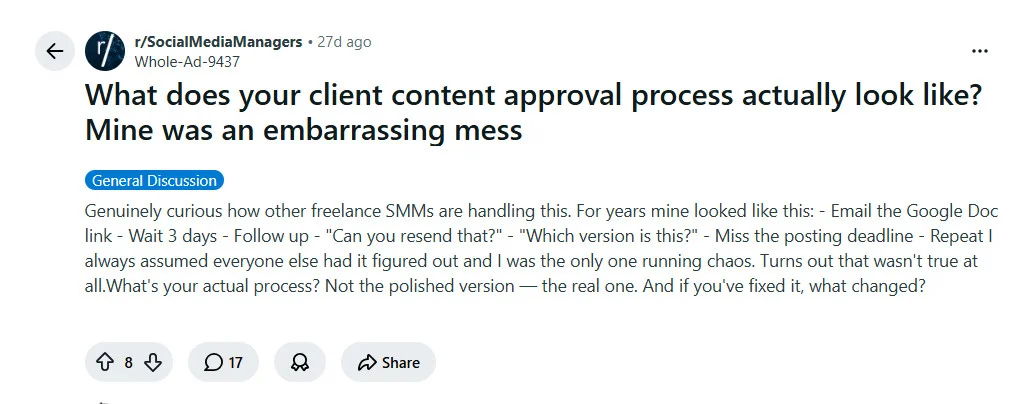
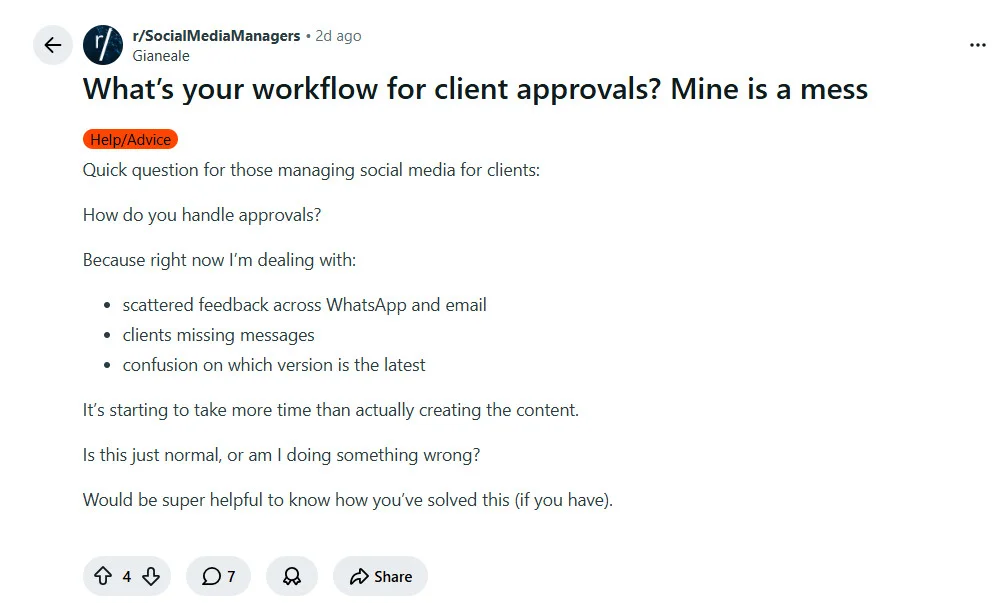
This is not an isolated experience. Across communities like r/SocialMediaManagers, the frustration is a recurring theme. Managers frequently post about the "feedback loop from hell," where hours are lost cross-referencing Slack messages with email threads and Google Doc revision histories.
The financial implications are severe. According to a 2026 report by Swydo, one agency lost 14 billable hours on a single campaign because three team members were editing different versions of the same post at the same time, each unaware that the other versions existed.
When you scale this inefficiency across 15, 30, or 50 clients, the "coordination tax" becomes unsustainable. Agencies that we work with who have traced a lost client back to this specific moment rarely cite one person’s failure. They point to a process that had no mechanism to hold a "final" version. The size of the agency does not change the failure mode; the infrastructure does.
Why External Tools Fail the "State Management" Test
The tools most agencies rely on—Google Docs, Slack, Email, and WhatsApp—were built for communication and file sharing. None of them were built to manage "state."
In computing, state management is the difference between "this is where the file lives" and "this version was approved at 3:47 PM Tuesday, and nothing supersedes it." Google Docs can track seventeen drafts with a detailed revision history, but it cannot tell you which one the client actually signed off on.
The Tool-State Mismatch
| Tool | What It Does Well | What It Cannot Do |
|---|---|---|
| Google Docs | Store and share a draft | Lock an approved version; record audit trails |
| Slack | Pass feedback quickly | Create a traceable approval record tied to a specific file |
| Capture client revisions | Connect those revisions to the correct file in the scheduler | |
| Get a fast "looks good" | Record that "looks good" referred to version 3, not version 2 |
Each tool performs its primary function admirably. The failure is structural: none of these tools share a common state. There is no moment where "this version is the one" becomes an official, visible, locked fact.
Defining the "Single Source of Truth"
"Single Source of Truth" is often misused in agency parlance. Many believe that putting all files in one Google Drive folder creates a single source of truth. It does not. Fifteen versions of the same caption in one folder are still fifteen versions, with no indication of which is current or confirmed.
What separates the agencies that never have version conflicts from those that do is a fundamental shift in philosophy: they stopped treating "approved" as a conversation and started treating it as a system state.
True "Single Source of Truth" requires a system where approval states are locked, not implied. The workflow must look like this:
Draft → In Review → Client Approved → Scheduled.
Each of these is a concrete status, not a folder name or a Slack emoji. When a post reaches the "Client Approved" state, the previous drafts are rendered obsolete by the system. The platform, not the human memory, holds the approved version. The team’s question changes from "Which version is final?" to "What is the status of the Q3 product post?"
The Shift to Centralized Infrastructure
Agencies that have eliminated version conflicts have moved their entire content lifecycle into a single platform. By housing every draft, comment, revision, and approval state in one environment, they eliminate the need for external documents that can "drift."
The SocialPilot Workflow Advantage
By moving the approval process into a dedicated system like SocialPilot, agencies remove the reliance on disconnected channels.
- Drafting: Created directly in the content calendar.
- Reviewing: Client feedback is captured inside the platform, directly tied to the post.
- Editing: History is tracked within the platform; no local copies exist to cause confusion.
- Approval: Once approved, the post is locked. A status shows who approved it and when.
- Scheduling: The system only pulls the approved version.
This structural approach makes version conflict mathematically impossible. If a version is not "Approved" in the system, it cannot be scheduled. This single change allows account managers to recover the time previously spent on coordination overhead—the "invisible work" that burns out talented staff.
Implications: The High Price of "Trust-Based" Workflows
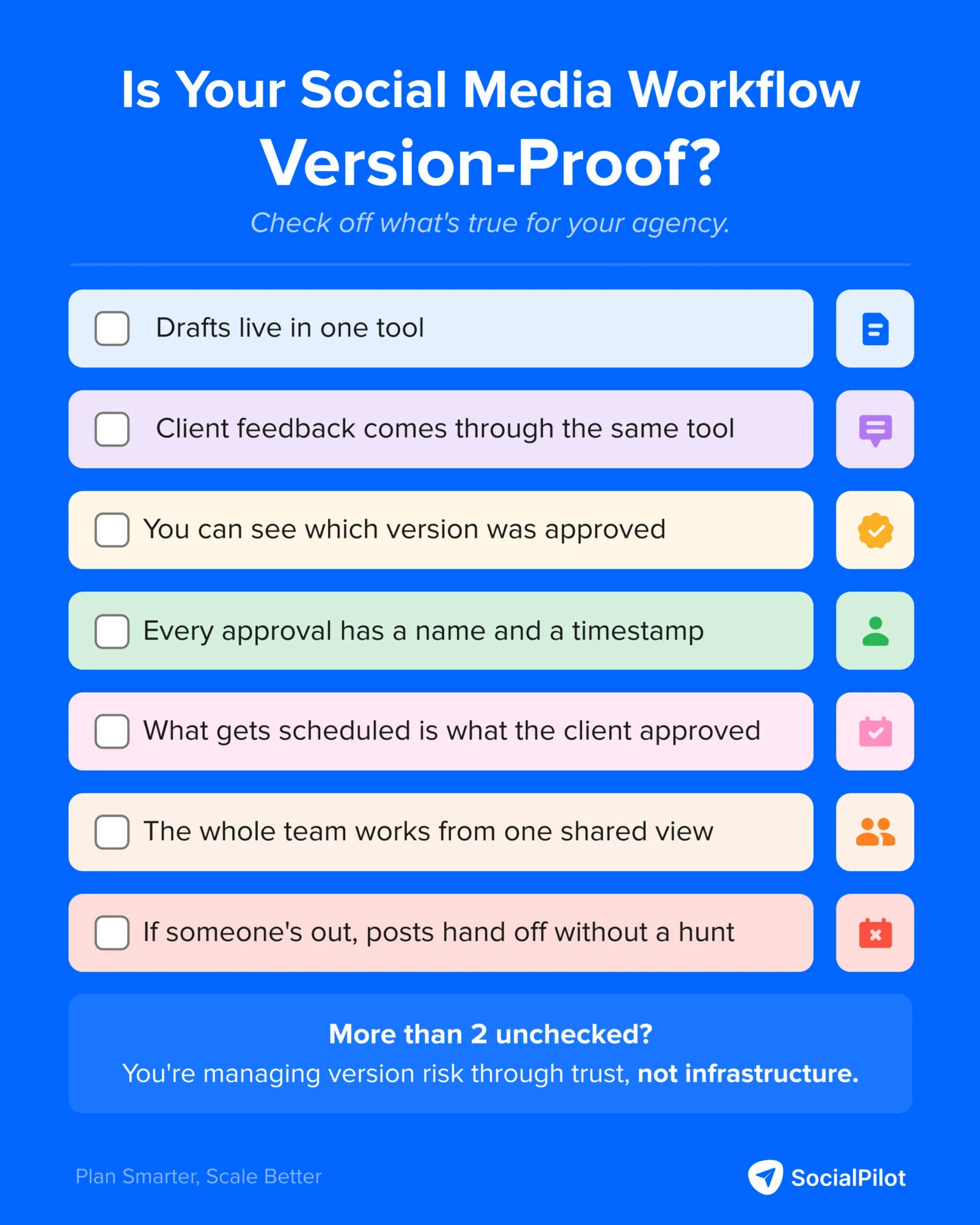
Is your current workflow "version-proof"? Most agencies manage version risk through trust—trust that the account manager remembers the latest file, trust that the client reviewed the right link, and trust that the publisher checked the latest Slack thread.
However, clients don’t see your internal struggle. They don’t see the heroic efforts of your team to reconcile three different versions of a post. They only see the output. When the wrong version goes live—a typo in a headline, an outdated price, or an unapproved image—the conversation that follows isn’t about the copy. It is about whether your agency has a system that holds under pressure.
Most clients will give you one opportunity to answer that question correctly. If you answer it with, "We had the wrong version in the folder," you have signaled that your agency is not built for scale.
The agencies that avoid these conversations didn’t get lucky. They made approval structural. They recognized that as they grew, their manual processes would eventually fail. By choosing a system that treats "approval" as a locked state rather than a casual agreement, they protected their reputation and reclaimed the time spent on administrative friction.
The question isn’t whether you can afford to implement a system that guarantees version control. The real question is: what is the cost of the client relationships you currently hold while operating without one?
In a digital-first economy, your process is your product. Ensure that your process is robust enough to handle the pressure of perfection.











No comments yet. Be the first to join the conversation!