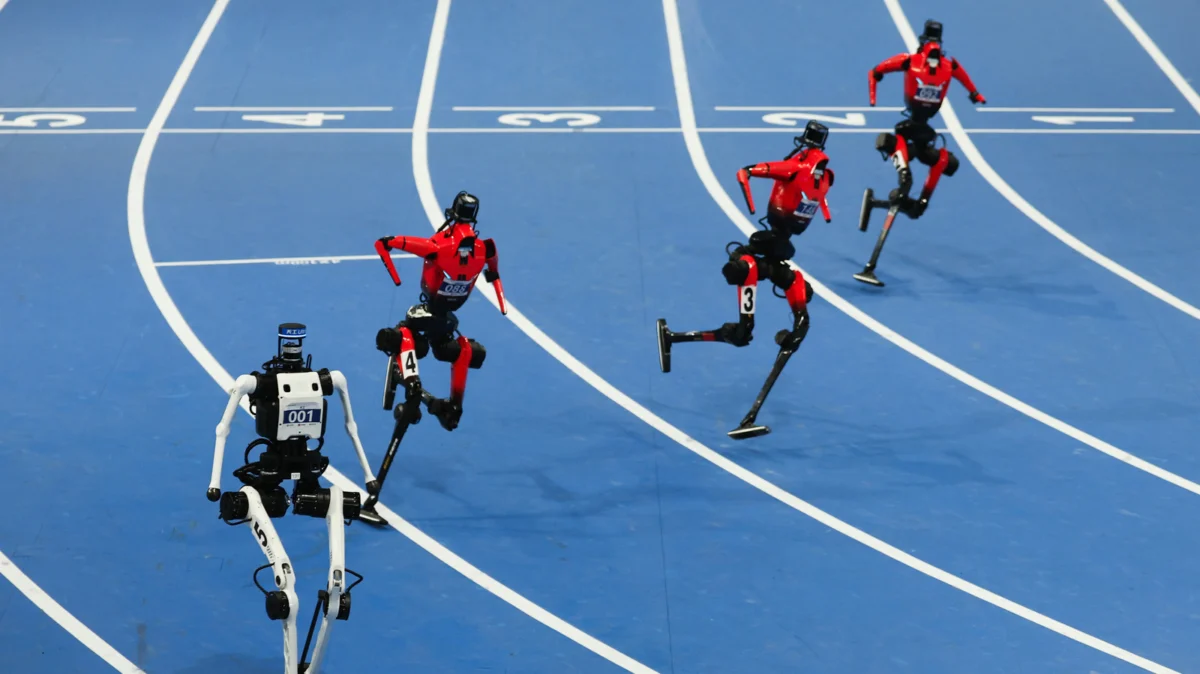
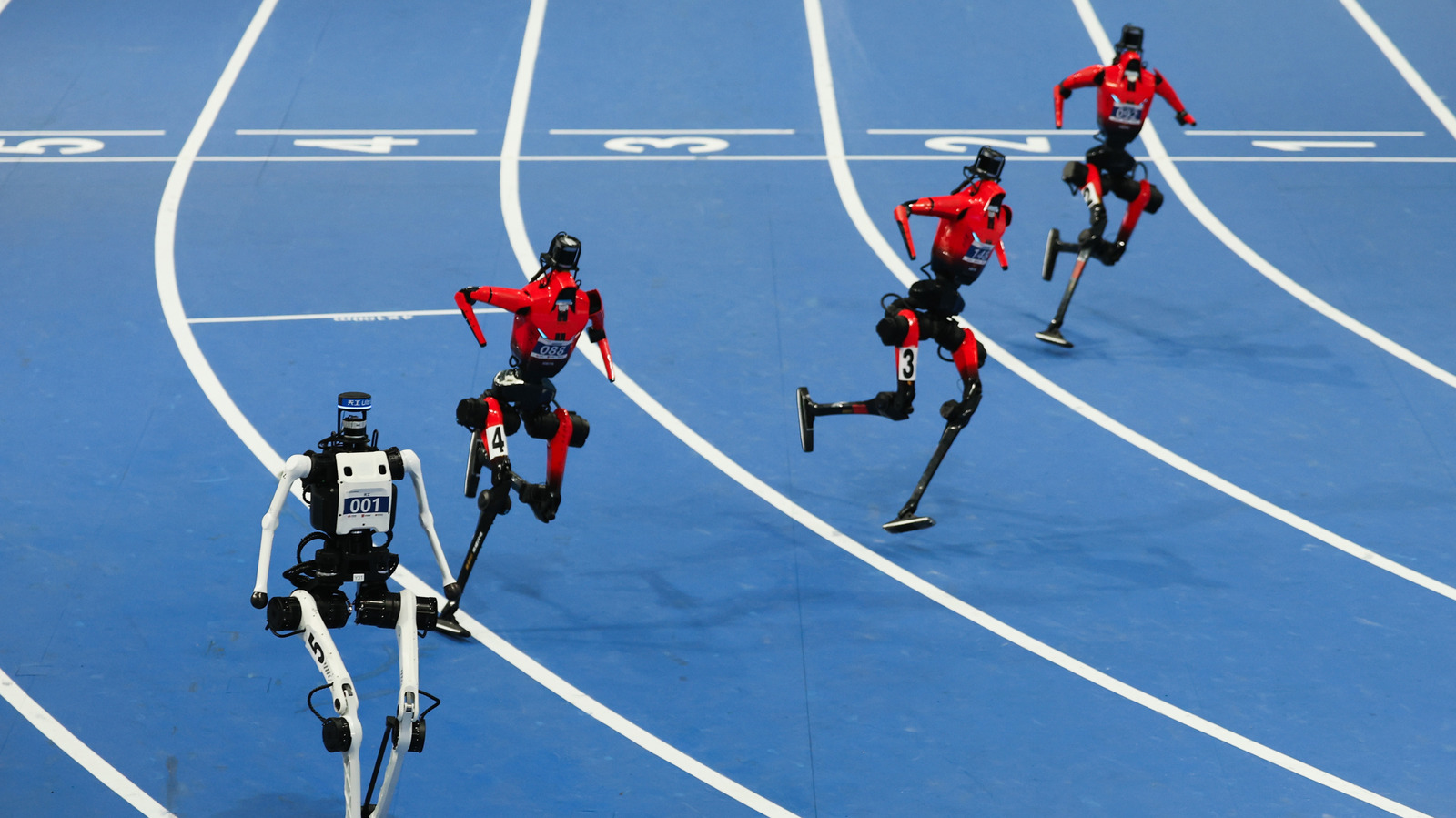
In a development that blurs the line between science fiction and athletic reality, the second annual World Humanoid Robot Games in Beijing has provided a staggering glimpse into the future of robotics. While Usain Bolt’s 2009 world record of 9.58 seconds remains the gold standard for human performance, the mechanical barrier has officially been breached. During a preliminary heat this past Saturday, the "Tiangong Ultra," a humanoid robot developed by the Beijing Humanoid Robot Innovation Center, sprinted the 100-meter dash in a blistering 9.39 seconds.
While the engineering community celebrates this milestone, the visual reality of the event offered a stark, often comedic, reminder of how far the technology still has to evolve. The spectacle of advanced machines sprinting toward a finish line only to collapse into a heap of metallic limbs upon completion served as a poignant metaphor for the current state of robotics: immense raw power coupled with a nascent understanding of fluid, autonomous motion.
The Chronology of a Mechanical Breakthrough
The journey to sub-10-second robotic sprinting has been rapid. Just one year ago, at the inaugural World Humanoid Robot Games, the field was defined more by cautious, lumbering movements than athletic prowess. At that 2023 event, the Tiangong Ultra set a benchmark with a finish time of 21.5 seconds—a respectable feat for a first-generation prototype, but miles away from human elite performance.
The progress seen between the 2023 and 2024 games represents a quantum leap in actuator technology, gait control algorithms, and weight distribution. By August 2024, the competition had transformed from a demonstration of stability to a race for raw velocity.
The Saturday Sprint
The atmosphere at the Beijing venue on Saturday was electric. As the starter signal sounded, the Tiangong Ultra exploded off the blocks. It was immediately challenged by "Lightning," a high-performance humanoid developed by the tech firm Honor. Lightning finished with an impressive 9.47 seconds, but it was the Tiangong Ultra that clinched the lead, shaving nearly 12 seconds off its own record from the previous year.
Beyond the Track: The Half-Marathon
The track and field events were not the only arenas for technical display. Earlier this year, Beijing also hosted a robot half-marathon, a test of endurance and thermal management rather than just raw explosive power. While these events were marred by frequent crashes and mechanical failures, they highlighted a key trend: the move toward sustained, long-duration robotics. In that endurance test, Honor’s Lightning robot secured the gold, finishing in 50 minutes and 26 seconds. While a human world record for a half-marathon is significantly faster, the fact that a humanoid robot could navigate a long-distance course without suffering a complete battery or joint failure is a massive engineering milestone.
Supporting Data and Technical Challenges
To understand the magnitude of this achievement, one must look at the mechanical constraints. Human sprinting relies on an incredibly complex interplay of the central nervous system, elastic tendons, and powerful muscle fibers. Robots, conversely, rely on rigid actuators, high-density lithium-ion batteries, and real-time sensor processing.
The Physics of the Fall
The article’s opening note—that these robots looked "ridiculous" doing it—is rooted in the physical reality of the "post-finish line crash." Unlike humans, who can decelerate by shifting their center of gravity and utilizing core muscles, many of these robots lack a sophisticated "braking" algorithm. They are programmed to reach maximum velocity, but the hardware often lacks the shock absorption or the gait-transition capabilities to stop safely.
As a result, many robots were seen slamming into safety pads or requiring teams of engineers to carry them off the track. This suggests that while the "sprint" phase of robotic movement is reaching human parity, the "transition" and "deceleration" phases remain largely unsolved.
The Evolution of the Hardware
The Beijing Humanoid Robot Innovation Center has been tight-lipped about the exact specifications of the Tiangong Ultra’s motors, but industry experts suggest the use of high-torque, high-speed brushless DC motors combined with carbon-fiber frames has been instrumental. The reduction in weight-to-power ratios is the primary driver of the nearly 50% improvement in speed year-over-year.
Official Perspectives and Industry Implications
The Games are more than just a spectacle; they are a crucible for commercial research and development. The presence of major tech firms like Honor suggests that these companies see a future for humanoids beyond the laboratory.
The Commercial Reality
Despite the headline-grabbing times, representatives from the Beijing Humanoid Robot Innovation Center have been quick to manage expectations. "We are not building these machines to compete in the Olympics," said one lead engineer during a press briefing. "We are building them to master the complexities of bipedal locomotion. Once we can ensure a robot can sprint without falling, we can ensure it can carry loads in a warehouse, navigate uneven terrain in a disaster zone, or assist the elderly in their homes without causing injury."
The commercial implication is clear: the 100-meter dash is a stress test. If a machine can survive the extreme forces of a high-speed sprint, it will be significantly more reliable in a controlled commercial environment.
The Ethical and Social Context
The event has reignited debates regarding the role of AI and robotics in daily life. As these machines become faster and more agile, questions regarding safety, liability, and the displacement of human labor become more urgent. The sight of a robot collapsing after a race is a reminder of the fragility of the technology, but the fact that it achieved such speed is a warning to industries that have long believed human-like dexterity and speed were safe from automation.
The Future: Beyond the 100-Meter Dash
The World Humanoid Robot Games, which conclude on August 26, are hosting thousands of participants in a wide array of disciplines, including soccer, table tennis, and boxing. These events are designed to force robots to interact with objects and other agents in real-time, moving beyond the linear environment of a sprint track.
The Road to Human Parity
The transition from 21.5 seconds to 9.39 seconds in just 12 months is an unprecedented rate of improvement. If the field continues to iterate at this pace, we may soon see humanoid robots that do not require human assistance to stop after a sprint.
The ultimate goal of these games is to foster a "general-purpose" humanoid. By forcing these machines to compete in varied sports, researchers are forcing the integration of multiple sensor suites—vision, haptics, and balance—into a single, cohesive chassis.
Final Thoughts
As we look at the results from Beijing, it is easy to mock the robots for their "ridiculous" post-sprint crashes. However, history is filled with early innovations that looked clumsy before they became indispensable. The first airplanes were death traps; the first computers were room-sized calculators that failed constantly.
The Tiangong Ultra and its peers may look clumsy today, but they are the ancestors of a new class of labor. Whether they are sprinting down a track in Beijing or eventually navigating the complexities of a modern household, the message from the 2024 World Humanoid Robot Games is clear: the machines are getting faster, and they are learning to move among us with terrifying efficiency. The record has been broken; now, the real work of integration begins.