

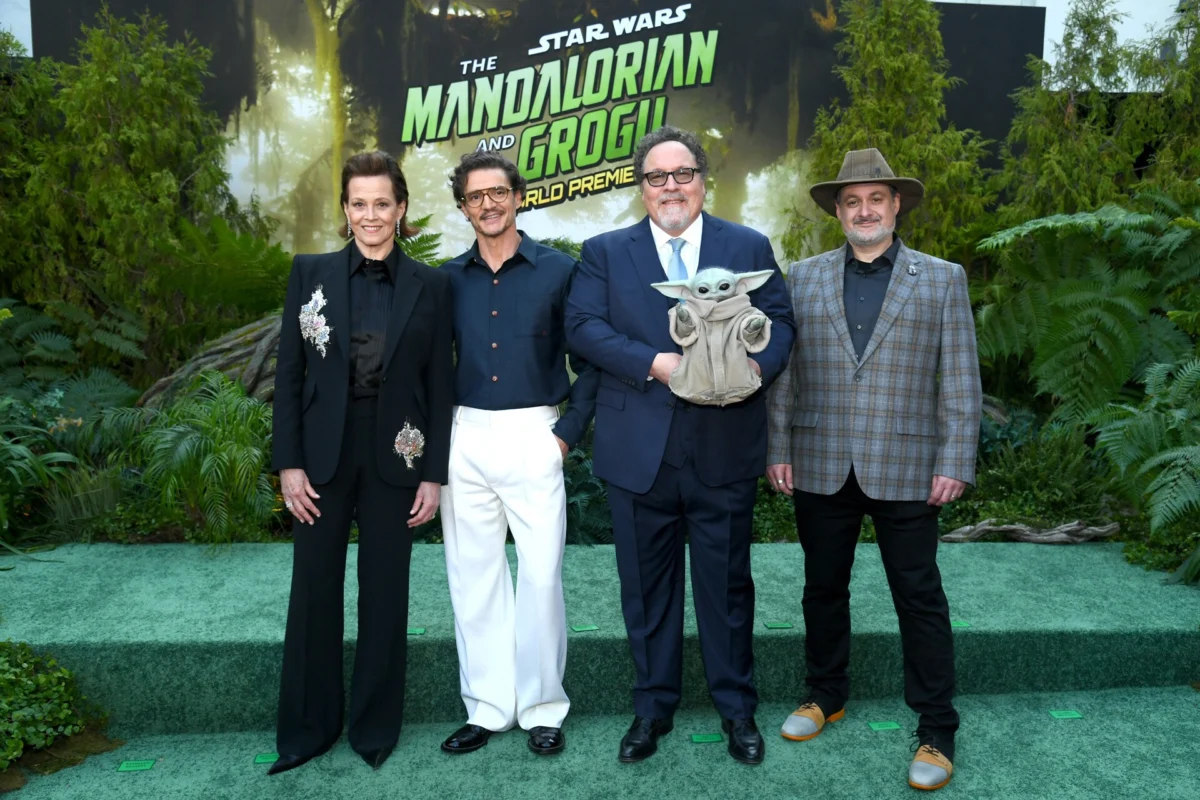
The red carpet of the Hollywood premiere for Star Wars: The Mandalorian and Grogu was a star-studded affair, defined by the presence of industry titans like director Jon Favreau, Pedro Pascal, and Sigourney Weaver. Yet, the flashbulbs and fan fervor were directed primarily at a diminutive, big-eared traveler in a signature brown coat. Grogu, the Force-sensitive sensation that captured the world’s heart in 2019, navigated the media gauntlet with the poise of a seasoned professional. He cooed, he waved, and he struck poses with an uncanny, lifelike charm.
To the casual observer, Grogu is a character. To the team at Legacy Effects and the digital wizards at Industrial Light & Magic (ILM), he is a masterpiece of modern engineering—a testament to the synthesis of physical artistry and cutting-edge technology. As the Star Wars franchise shifts from the small screen to the expansive canvas of IMAX, the evolution of Grogu has become a symbol of how the industry balances traditional puppetry with the limitless potential of computer-generated imagery.
A Legacy of Craft: The Anatomy of a Cultural Icon
The existence of Grogu as a tangible entity is the result of nearly a decade of iterative design. Legacy Effects, the studio responsible for the practical puppet, has treated the character not merely as a prop, but as a living, breathing performer. According to Alan Scott, co-founder of Legacy Effects, the current iteration of Grogu represents a pinnacle of animatronic and robotic achievement.
"The advances in animatronics and robotics combined with the advances in CG just bring new life to characters that might have been handled in a very traditional approach," Scott explains. "But here, they are elevated to the next level."
The creation process is a monumental labor of love. Within the Legacy Effects workshop, a staff of approximately 100 specialists contributes to the character’s development. This is not a task for a single sculptor or designer; it is a holistic studio effort. From initial digital design and 3D printing to the meticulous work of molding, casting, and painting, every micron of Grogu’s form is intentional. The "apple cheeks" and the perfectly tousled, wispy hair are the results of granular attention to detail, ensuring that when the camera rolls, the audience sees a soul, not a plastic chassis.
The Choreography of Performance: Playing the Instrument
If the physical puppet is the instrument, the team of puppeteers serves as the virtuoso orchestra. Operating Grogu is a high-stakes, collaborative performance art that requires intense coordination. On set, a team of seasoned professionals—including Mike Manzel, Dawn Diniger, Jason Matthews, Trevor Hensley, and Victor Broadley—works in total synchronization, often shielded from the cameras, to breathe life into the character.
"It’s easy for it to fall apart," Scott admits. "Basically, it’s like we’ve built this amazing instrument and now we have to learn how to play it."
Because the character’s functionality is distributed across several control systems, a single scene can require four, five, or sometimes more puppeteers working in tandem to execute a singular movement. The "magic" is actually a rigorous discipline. The puppeteers must learn the character’s physical limitations and capabilities, developing an intuitive shorthand that allows them to react to the other actors in real-time.
During the production of The Mandalorian and Grogu, the scale of this operation expanded significantly. When scenes included the film’s four Anzellan characters, the set could host as many as 25 puppeteers at once. It is a bustling, complex ecosystem where the logistics of puppetry mirror the chaotic intensity of a large-scale action film.
Chronology of an Evolution: From Foundling to Protégé
The journey of Grogu from the pilot episode of The Mandalorian to his big-screen debut has been defined by deliberate growth. In the Disney+ series, Grogu was largely a passive observer, a "child" in need of protection. For his transition to the theatrical experience, director Jon Favreau mandated a change.
"He wants Grogu to grow," Scott notes. "He’s got a story to tell."
In the new film, Grogu is no longer just a passenger; he is an active participant in the action. The puppet had to be re-engineered to accommodate more rigorous movement, including swimming sequences and the ability to perch on the Mandalorian’s shoulder during intense, stunt-heavy action beats. The character has moved from the role of a protected ward to a miniature protégé, learning the ways of the galaxy alongside Din Djarin.
This progression poses a unique challenge for the technical crew. How do you keep the character "naïve and child-like" while also making him a functional part of an action-heavy cinematic narrative? The answer lies in the seamless integration of practical and digital elements.
Bridging the Gap: The Synergy of ILM and Legacy Effects
One of the most profound developments in the Star Wars production pipeline is the blurring of lines between practical effects and post-production CG. In years past, a puppet was a puppet, and a CGI character was a CGI character. Today, the collaboration between Legacy Effects and Industrial Light & Magic has created a hybrid, where even the experts often struggle to identify where the physical puppet ends and the digital augmentation begins.
This synergy allows for a full range of articulation and emotional expression that neither technique could fully achieve alone. The practical puppet provides the essential "presence" on set, allowing the human actors—like Pedro Pascal and Sigourney Weaver—to have a physical point of contact. This tactile reality is what makes the interaction feel authentic. The CG then layers on the micro-expressions, the eye movements, and the fluid physics that push the performance into the realm of the extraordinary.
Official Responses and Creative Philosophy
The directorial approach of Jon Favreau has been instrumental in this success. From the very first season of the Disney+ series, Favreau established a standard: he treats the puppet as a fellow actor. He directs the puppet directly, addressing the character by name, which in turn cues the puppeteers to respond as the character would.
This philosophy has fostered a set culture where Grogu is treated with the same professional deference as any human star. "He’s the first one on set. Always on his mark. Always ready for action," the production team notes. By integrating the puppet into the human workflow—complete with the same staging, blocking, and rehearsal time—the team has successfully normalized the presence of an animatronic creature in a high-stakes cinematic environment.
The Implications: A New Era for Practical Effects
The success of Grogu in The Mandalorian and Grogu signals a significant shift in the Star Wars aesthetic. While many franchises have moved toward fully digital character designs, the Star Wars universe continues to double down on the value of "tangible" storytelling.
The implication here is twofold. First, it proves that audiences still crave the weight and realism that practical puppets bring to a frame. There is a perceptible "human" element in a physical performance that digital rendering still struggles to replicate entirely. Second, it demonstrates that the future of VFX is not a replacement of physical craft, but a partnership.
As the film industry continues to grapple with the rise of AI and fully synthetic performances, the story of Grogu stands as a rebuttal to the idea that technology must replace the artisan. Instead, it suggests that the most compelling characters of the future will be those that marry the soul of the hand-crafted with the precision of the digital.
For the audience, the result is simple: they stop seeing the wires, the servos, and the 25 puppeteers sweating in the dark corners of the soundstage. They stop thinking about the 3D printers and the molding labs. When they look at the screen, they see a child, a hero, and a friend. And perhaps that is the ultimate victory for the teams at Legacy Effects and ILM—to have built something so technologically complex that, in the end, it feels entirely, magically human.
Star Wars: The Mandalorian and Grogu is currently in theaters, offering audiences a chance to witness this marvel of collaborative artistry on the largest scale possible. Whether you are a devotee of the Star Wars lore or an enthusiast of the technical evolution of cinema, the film offers a masterclass in how to build a legend—one piece, one wire, and one smile at a time.











No comments yet. Be the first to join the conversation!