Layla Zulfa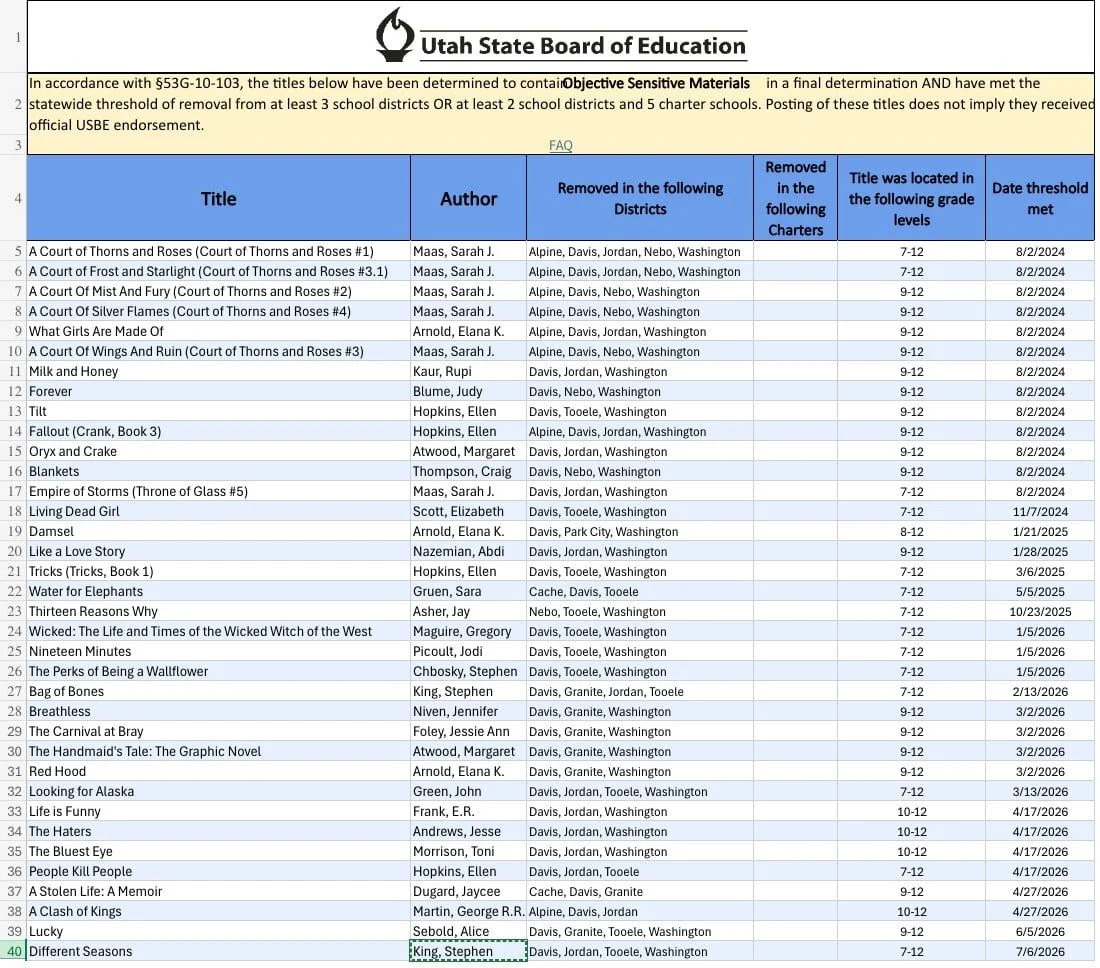
In a move that underscores the widening chasm between educational policy and intellectual freedom, the state of Utah has reached a grim milestone in its ongoing campaign to regulate school library collections. On Monday, July 8, 2026, the state officially designated Different Seasons by Stephen King as the 36th title to be purged from every public school library within its borders.
This latest action brings the total number of books banned in Utah during 2026 to 17, making this the most prolific year for state-sanctioned censorship since the enactment of the controversial House Bill 29 (HB 29). As legal battles mount and the list of prohibited literature grows, the state’s approach to "sensitive materials" has transformed from a localized policy debate into a systematic, statewide removal process that critics argue is fundamentally eroding the right to read.
The Legislative Foundation: Understanding HB 29
To understand the current climate in Utah, one must examine the legal framework that facilitates these removals. Passed in 2024, House Bill 29 represents one of the most restrictive educational policies in the United States regarding library access. The bill introduced a mechanism where parents can challenge books deemed "sensitive" or "pornographic" under state code.
The crux of the law is its broad, mandatory reach: if a book is deemed "objective sensitive material" by three public school districts, or a combination of two districts and five charter schools, it must be removed from every public school in the state. This effectively strips local school boards of their autonomy, forcing a statewide standard based on the most restrictive interpretations found in a minority of districts. The law is retroactive, meaning that works that have occupied library shelves for decades are now subject to immediate scrutiny under these new, stringent criteria.
A Chronology of Escalation
The trajectory of book removals in Utah has been marked by a steady, relentless acceleration. When the law first took effect on July 1, 2024, it launched with an initial list of 13 titles. Since then, the state has systematically worked its way through library catalogs, often targeting older, established works.
- 2024: The implementation of HB 29 set the stage, with 14 titles removed by the end of the year.
- 2025: The momentum continued as the state refined its review processes and encouraged parental challenges.
- 2026 (Year-to-Date): With 17 titles already banned, 2026 has officially surpassed 2024 as the busiest year for censorship in the state’s recent history.
The addition of Stephen King’s Different Seasons—a collection of four novellas first published in 1982—is emblematic of the current trend. Many of the books currently on the chopping block were staple fixtures in libraries when the very individuals now spearheading these challenges were themselves students. This temporal disconnect highlights what advocates call a "manufactured panic," where decades-old literature is suddenly framed as a contemporary threat to student safety.
Data Analysis: The Geography of Discontent
While the legislation is framed as a matter of "local control," the reality of its implementation suggests a highly centralized, top-down enforcement mechanism. Data from the Utah State Board of Education reveals a striking lack of uniformity in where these challenges originate.
Of the 42 public school districts in the state, only nine have been responsible for the reported book bans. Even among those nine, the distribution is highly uneven:
- Davis School District: Responsible for 35 of the 36 bans.
- Washington School District: Responsible for 31 of the 36 bans.
- Jordan School District: 15 bans.
- Tooele: 12 bans.
The fact that two school districts account for the vast majority of statewide bans challenges the narrative of broad, community-wide consensus. Instead, it reveals that a small number of active, organized groups are effectively leveraging state law to impose their preferences on the entire student population of Utah.
Professional and Political Implications
The implications of this movement extend far beyond the loss of specific books. The current environment has created a chilling effect on school librarians and educators, who now operate under the constant threat of legal and professional repercussions.

The Role of Outside Influence
Concerns regarding the integrity of this process were amplified recently when it was revealed that the Davis School District granted access to its library systems to Brooke Stephens, an activist associated with "RatedBooks" and the "National Book Rating Index." These websites, which provide subjective, often biased, ratings of literature, have been criticized by the library community for their lack of professional rigor and clear political agenda. Allowing such individuals to influence public school library collections has raised significant ethical questions about the transparency of the current review process.
The Legal Counter-Offensive
The state is currently embroiled in a significant federal lawsuit challenging the constitutionality of HB 29. Plaintiffs, including various civil rights organizations and the estate of literary figures like Maya Angelou, argue that the law violates the First Amendment and deprives students of their right to access diverse viewpoints.
A pivotal court hearing held in mid-May 2026 marked the first major legal test of the legislation. However, rather than awaiting the court’s decision, the state has, in many ways, accelerated its removal efforts. The message sent by this defiance is clear: the current administration is committed to the purge, regardless of the pending judicial scrutiny.
A Comparative Look: Utah and the National Landscape
Utah’s aggressive posture places it in a small, select group of states that have codified censorship into statewide mandates. South Carolina, which currently retains a list of 21 banned titles, is often cited as a similarly "censorious" state. However, while South Carolina has remained relatively static since May 2025, Utah’s list continues to grow at an alarming rate.
Critics argue that these laws create a dangerous precedent. By exempting private and homeschool institutions, the legislation effectively creates a tiered system of education: one where students in public schools are shielded from certain topics and themes, and another where access to literature remains unrestricted.
The Human Element: What Is Being Lost?
The list of banned books is diverse, yet it shows a clear pattern of targeting works by women and those that explore complex themes of identity, trauma, and coming-of-age. Of the 36 books currently prohibited, 26 were written by female authors. Titles range from classics of contemporary fiction, such as Margaret Atwood’s The Handmaid’s Tale (the graphic novel adaptation) and Toni Morrison’s The Bluest Eye, to young adult staples like John Green’s Looking for Alaska and Stephen Chbosky’s The Perks of Being a Wallflower.
The average publication date of these books is 2008. By systematically removing these works, the state is effectively scrubbing the shelves of the last two decades of literary engagement, replacing complex, challenging narratives with a sanitized, narrowed curriculum that does not reflect the realities of the modern world.
Conclusion: The Fight for the Future of Libraries
As the 2026 school year concludes, there is no indication that the pace of these bans will slow. The state is actively reviewing older titles, suggesting that the campaign is as much about ideological re-alignment as it is about current student safety.
For parents, educators, and students, the situation in Utah serves as a bellwether for the broader struggle over the role of public institutions in American life. The question remains: is the function of a school library to provide a curated, state-approved reflection of a specific ideology, or is it to serve as a marketplace of ideas where students can explore the full, messy breadth of the human experience? As long as the current interpretation of HB 29 holds, the latter appears to be under direct and sustained siege.
The battle for Utah’s libraries is far from over, but with every passing month, the shelves become emptier, and the range of student inquiry grows significantly more narrow. The resolution of the ongoing federal lawsuit will likely determine the fate of these collections for years to come, but the damage to the culture of intellectual curiosity may prove more difficult to reverse.

 Ali Ikhwan
 Laily UPN