

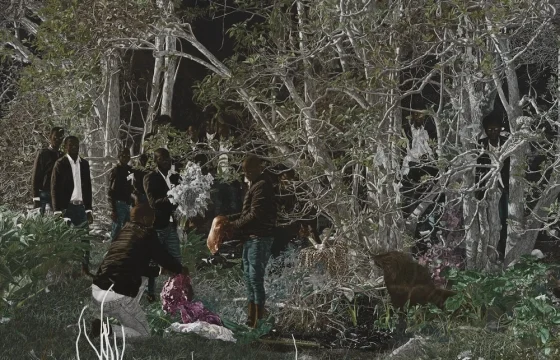
In the contemporary art landscape, few painters command the atmospheric gravity of South African artist Cinga Samson. His latest exhibition, Ukuphuthelwa, is a profound meditation on the limits of representation and the existential weight of the human experience. Through a series of haunting, masterfully executed oil paintings, Samson invites viewers into a nocturnal realm where the familiar becomes mysterious, and the act of seeing is transformed into an act of spiritual communion. The exhibition is currently on view and will remain open to the public through April 18, 2026.
Main Facts: Defining Ukuphuthelwa
The title of the exhibition, Ukuphuthelwa, is derived from the artist’s native isiXhosa. While it translates literally to "unable to sleep," the term sits in stark contrast to the Western clinical diagnosis of "insomnia." Where the latter suggests a disorder—a deficit to be corrected—Ukuphuthelwa signifies a state of heightened spiritual alertness. For Samson, the dark is not a void to be feared or a time for rest, but a canvas upon which a deeper, more sensitive reality is revealed.
Samson’s aesthetic signature is immediately recognizable: an occluded, moody palette dominated by carbon blacks, deep Prussian blues, and near-black tones. Within this dark theater, he populates his scenes with enigmatic, man-like figures, vigilant dogs in overgrown fields, and native South African flora. These are not merely paintings of objects; they are inquiries into the nature of reality, rendered with an existential gravitas that demands slow, contemplative engagement from the viewer.
Chronology of a Creative Quandary
Samson’s artistic journey has long been defined by a singular, persistent question: How does one create a "true and honest" painting? This quest for truth has evolved into a recognition of the inherent limitations of the medium.
- Early Career: Samson’s initial focus on portraiture and figures laid the groundwork for his exploration of the human form as an element of the landscape rather than a detached subject.
- 2025 Development: As he approached the creation of the Ukuphuthelwa series, the artist shifted his focus toward the "gulf" between the painted sign and the lived experience. He began to grapple with the realization that an image can never be the equivalent of the reality it represents—it can only ever be a symbol.
- 2026 Exhibition Launch: The current exhibition serves as the culmination of this philosophical shift. Works such as Intsingiselo II, Umlindo, and Tshee (all 2026) represent a refinement of his technical mastery, where the brushwork serves to point toward that which exceeds the representable.
The Philosophical Implications: The Limits of Representation
Central to Ukuphuthelwa is the tension between the static image and the fluid, ever-moving reality it gestures toward. Samson argues that there is a fundamental disconnect that no image can fully bridge. This is most evident in his use of symbolism.
For instance, the figure of the dog—a recurring motif in his work—is used as a case study in subjective interpretation. A viewer approaching Intsingiselo II might see the Western archetype of the dog as a symbol of loyalty. However, an amaXhosa perspective might read the same figure as a protective, guiding principle tied to ancestral wisdom. By presenting these images, Samson acknowledges that he cannot control the meaning of his work. He accepts that his paintings are relative symbols, and he embraces the inherent "instability of interpretation" that arises when the knowable meets the unknowable.
This instability is mirrored in his use of language. By titling his works with enigmatic isiXhosa phrases—such as Imfihlo (Secret) or Intsingiselo (Meaning)—Samson highlights how meaning is often lost or transformed in translation. Just as the paint struggles to capture the essence of a living thing, the English translation struggles to capture the full weight of the isiXhosa term. In this gap, the work resides.
Supporting Data: Technical Mastery and the "Magic Trick"
The technical execution of these paintings is as much a part of the message as the subject matter itself. Samson employs a unique "flickering" effect, marshalling light across the picture plane like a magic trick. By selectively applying and wiping back layers of glaze, he allows the under-drawing to remain visible, creating moments of transparency that destabilize the viewer’s perception.
In his portraiture, the technique is particularly striking. Samson leaves the pupils of his figures unpainted, allowing the color of the canvas to shine through. This decision strips the figures of individual identity, rendering them "porous." They are not people looking at the world; they are forms enmeshed with the landscape, existing in a state of mutual dependence with the nature that surrounds them.
This creates a sense of "mute enormity." In Sithini ngelilitye, a rocky crag rises from the undergrowth with forensic detail, contrasted against a sky rendered in a barely-there wash. The effect is one of quiet majesty—a reminder that the sublime is not found in grand gestures, but in the ordinary, everyday forms that surround us.
Official Perspectives and Artist Intent
Samson has been vocal about his intentions, emphasizing that he is not interested in the ritual itself, but in what the ritual represents: an opening to the beyond. His paintings function as a "collective need for orientation."
"The sky can be so friendly, but sometimes so heavy, dark, so scary," Samson notes regarding his atmospheric landscapes. "It’s the same energy, but it exists in different forms."
This statement encapsulates the core of the Ukuphuthelwa experience. He does not seek to provide answers; he seeks to cultivate a state of sensitivity. By removing the pupils of his figures, he ensures that they do not look "outward" in a traditional sense. Instead, their knowing comes from within the world they inhabit. They are connected to the bowing foliage, the bird in flight, and the encroaching night.
Broader Implications: The Divine in the Vernacular
Ultimately, Ukuphuthelwa is an invitation to witness the "immanent magic" of the ordinary. In a world increasingly dominated by the superficial, Samson’s work demands a return to the contemplative. He posits that the divine is not found in an elsewhere—a celestial distance—but is present in the vernacular of all things.
The exhibition is a challenge to the viewer. It asks us to consider what happens when we stop trying to name and categorize the world and instead allow ourselves to be "unable to sleep"—to remain perpetually alert to the wonders and fears that exist in the dark.
As the exhibition continues its run through April 2026, it serves as a powerful reminder of the role of the artist: not to mirror the world, but to pry apart the representational motifs that contain us, in service of something larger. For Cinga Samson, that "something larger" is everything. By painting what he cannot fully explain, he links the viewer to the divine, providing a path toward wonder that exists in the interstices of language, the shadows of the night, and the honest labor of the brush.
Ukuphuthelwa is more than an exhibition; it is a spiritual geography of the present moment, one that finds the sublime in the darkness, and the infinite in the everyday.











No comments yet. Be the first to join the conversation!