

New York City has always been a palimpsest—a city of layers where the neon of the present is constantly superimposed over the grit and graffiti of the past. No artist captures this temporal tension quite like Chris “Daze” Ellis. In his third solo exhibition with PPOW, titled Orchid Rain on the Underground, on view through April 25, 2026, Daze presents a sprawling, multi-sensory homage to the New York City of his youth, demonstrating that the rebellious spirit of the 1970s and 80s graffiti movement is not merely a memory, but a living, breathing force.
The exhibition is a comprehensive survey of Daze’s evolution, featuring a new series of paintings, a sprawling multimedia installation, and a site-specific mural that physically brings the urban environment into the gallery space. By weaving together the raw energy of his roots as a subway writer with the technical refinement of five decades of studio practice, Daze invites viewers to reconsider the city as a site of both destruction and profound rebirth.
A Chronology of the Concrete: From Subway Cars to Canvas
To understand Orchid Rain on the Underground, one must look back to the Brooklyn of the 1960s. Born in 1962, Daze came of age during the formative years of the graffiti movement. While attending the High School of Art and Design in the mid-1970s, he was initiated into a world of visual defiance, drawing inspiration from pioneers such as Blade, Lee Quiñones, and PHASE 2.
In those days, the subway system was not merely public transit; it was a rolling gallery, a subterranean canvas that connected the disparate boroughs of New York. For a young Daze, the train car was the ultimate medium. However, as the 1980s dawned, the trajectory of the graffiti artist began to shift. The move from public infrastructure to the gallery space was not just a career pivot—it was a cultural evolution.
Daze became a fixture of the downtown scene, frequenting the legendary institutions that defined the era’s nightlife: the Lit Lounge in the East Village, Danceteria on West 21st Street, and the Mudd Club in Tribeca. These were not just dance floors; they were crucibles of creative experimentation where painters, musicians, and poets collided. It was here that Daze synthesized the frantic pace of the streets with the deliberate, disciplined practice of fine art, effectively transitioning from a clandestine writer to an established studio artist.
The Aesthetic Fusion: Realism, Abstraction, and Urban Decay
One of the most compelling aspects of Orchid Rain on the Underground is Daze’s ability to reconcile seemingly contradictory influences. His work sits at the intersection of early 20th-century American urban realism and mid-century lyrical abstraction.
His compositions often evoke the spirit of John Sloan and the Ashcan School, as well as the WPA-era depictions of New York by Reginald Marsh. Like these predecessors, Daze treats the city’s mundane infrastructure—the stations, the tunnels, the street corners—with a sense of reverence. He elevates the subway car interior from a place of transit to a site of profound human experience.
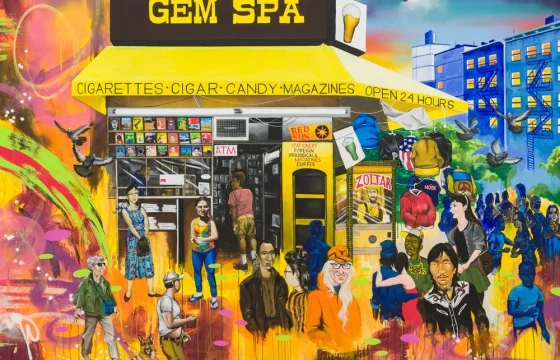
Yet, superimposed over this structural realism are the gestural, emotive strokes reminiscent of Joan Mitchell and Willem de Kooning. This is most evident in works like Gem Spa in the 80s (2025). The painting serves as a centerpiece for the exhibition, immortalizing the iconic St. Mark’s Place candy store that served as a “nerve center” for the city’s counterculture. In the foreground of this vibrant, nostalgic composition, Daze includes figures from his own history, such as critic Carlo McCormick and artist Martin Wong, blending memory with observation.
Perhaps the most striking visual motif in the exhibition is the juxtaposition of urban decay and floral beauty. Technicolor blooms emerge from piles of rubble in several of his canvases—a visual metaphor for the resilience of the creative spirit. These images of tropical flora, mixed with wildflowers native to his current home in upstate New York, serve as a poignant memorial to the city that was, and a hopeful testament to the beauty that continues to emerge from the cracks of the city that is.
The Immersive Installation: A Sensory Time Capsule
Daze moves beyond the frame in this exhibition, utilizing the gallery’s architecture to construct a narrative space. A site-specific mural acts as a bridge, leading the viewer from the formal paintings into a final, immersive room that functions as a composite scene of the artist’s youth.
This multimedia installation is designed to trigger a visceral reaction. It features a light-up dance floor, a disco ball, and authentic subway car seats salvaged from the era. A curated soundtrack—a seamless blend of house, disco, hip-hop, and club music—fills the room, grounding the visual art in the auditory atmosphere of a 1980s nightclub.
By integrating these physical artifacts into the white cube of the gallery, Daze forces a collision between the past and the present. He challenges the viewer to step out of the role of the passive observer and into the environment that fostered his own creative development. It is an act of historical preservation, ensuring that the ephemeral energy of the 1980s downtown scene remains accessible to a new generation.
Official Perspectives: The Legacy of the Street
The curatorial team at PPOW notes that Orchid Rain on the Underground is a celebration of the city’s “cultural heartbeat.” The exhibition highlights the importance of place, arguing that the sites of Daze’s early career were not just locations, but generative forces that shaped the artistic consciousness of a generation.
Daze’s own reflection on the exhibition suggests that his work is less about nostalgia and more about continuity. He posits that the creative spirit of New York City is cyclical. “By revitalizing that foundational energy for the present moment,” the gallery states, “Daze affirms the continued relevance of those figures and places, and their profound influence on the creative spirit that persists throughout the city today.”
In an era where New York is increasingly characterized by rapid development and the erasure of historical markers, Daze’s work serves as a critical counter-narrative. He asserts that the “bygone era” of the 1970s and 80s is not dead; it is embedded in the city’s DNA.
Implications: The Enduring Power of the Urban Narrative
What are the implications of a career-spanning show like Orchid Rain on the Underground? Firstly, it solidifies Daze’s position as a vital chronicler of New York history. While many artists of the graffiti movement remained tethered to the street, Daze’s transition into the gallery world has allowed him to curate a dialogue between the museum and the subway.
Secondly, the exhibition highlights the importance of “site-specific” memory. By depicting Gem Spa or the interior of an old subway car, Daze is performing a form of urban archaeology. He reminds the public that the physical environment is an active participant in the artistic process. The destruction of these sites does not necessarily mean the end of the culture they fostered, provided that artists continue to document and re-contextualize them.
Finally, the success of this exhibition suggests a growing appetite for art that is deeply rooted in local history but elevated by technical mastery. Daze proves that graffiti-influenced art can be both raw and sophisticated, both chaotic and meticulous.
As Orchid Rain on the Underground remains open through the spring of 2026, it serves as an essential destination for those seeking to understand the soul of New York. It is a reminder that beauty is not found in the pristine or the new, but in the layers of paint, the rhythm of the train, and the persistent, orchid-like ability to bloom amidst the concrete of the city.
Whether one is a student of art history, a lover of New York City lore, or simply an admirer of the vibrant, gestural strokes of an artist at the height of his powers, Daze’s latest show is an undeniable triumph. It is, ultimately, a love letter to a city that never stops changing—and to the artist who has spent five decades documenting every iteration.









No comments yet. Be the first to join the conversation!