

Main Facts: A New York Arrival
Mrs. gallery, located at 6040 56th Drive, has officially unveiled The Light That Loses, The Night That Wins, the highly anticipated New York debut solo exhibition by Los Angeles-based painter Molly Bounds. The exhibition, which opened its doors on the vernal equinox, serves as a poignant exploration of the duality between illumination and obscurity.
Following a successful introduction at The Armory Show in September 2025, this presentation marks a significant milestone in Bounds’ career. As the gallery’s second collaboration with the artist, the show establishes a cohesive narrative thread—one that binds the transient nature of light to the psychological weight of the human experience. The exhibition is scheduled to remain on view through May 2, 2026, offering visitors an extended window into the artist’s evolving aesthetic and conceptual framework.
Chronology: From the Armory to the Equinox
The trajectory of Molly Bounds’ rise in the contemporary art world has been both rapid and deliberate. In September 2025, her work garnered considerable attention at The Armory Show, where her ability to capture the "liminal" quality of human existence first caught the eyes of curators and collectors alike. That presentation served as a microcosm of her broader interests: the tension between stillness and urgency, and the way bodies occupy space during moments of transition.
The opening of The Light That Loses, The Night That Wins on the vernal equinox—a date traditionally signifying the balance of light and dark—was a strategic curatorial choice. It mirrors the thematic core of the collection, where the "unrelenting forward movement of time" is not merely a background detail but an active participant in the work. The exhibition tracks a movement from the internal, often claustrophobic, psychological landscapes of winter into the verdant, expansive possibilities of spring.
Supporting Data: An Anatomy of Light and Interiority
Bounds’ practice is defined by her mastery of light as a narrative device. In this series, light is not merely a tool for visibility; it is a protagonist capable of revealing truths while simultaneously concealing the depths of the psyche.
The Psychology of Interior Spaces
A recurring motif in the exhibition is the "slumped" body. In paintings such as The Armchair, Bounds renders figures that appear to be in states of rest, yet the tranquility is deceptive. Through a careful study of composition, the artist highlights a disconnect between the physical body and the active mind. In The Armchair, the juxtaposition of a warm, domestic fireplace against the cold, encroaching blue of an early evening sky creates an immediate tension. This is where Bounds excels: she captures the precise moment where rest curdles into unease. The viewer is invited to consider the inner life of the subject—are they planning, scheming, or simply existing in a state of suspended animation?
The Influence of the Old Masters
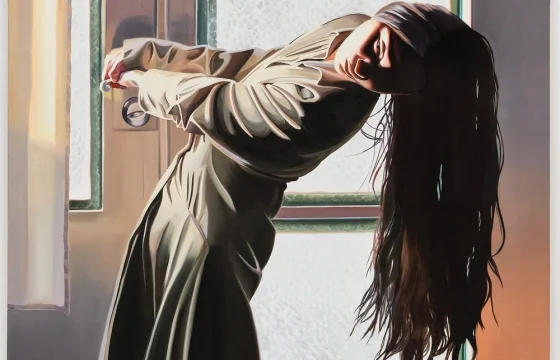
Bounds’ technical execution draws clear, albeit modern, parallels to art history. In Privacy Glass, the interplay between the external light beam and the interior diffusion of the subject’s silhouette evokes the tenebrism of Georges de La Tour. By utilizing light to obscure facial features while accentuating the drape of clothing, Bounds touches upon the tradition of the vanitas. She reminds the viewer of the fleeting nature of life and the inevitability of the encroaching dark, grounding her contemporary subjects in a lineage of profound existential inquiry.
The Escapist Impulse
Contrasting these heavy, interior scenes are the landscapes It Sings in Me and Among of Green, Again. These works serve as a vital counterpoint to the exhibition’s pensive, indoor studies. Here, the figures are no longer tethered by upholstery or glass; they move through lush, rolling hills under a vibrant sun. While the scenes feel almost "overly" bucolic—perhaps even bordering on the surreal—Bounds argues that the distinction between reality and imagination is secondary to the emotional resonance of the work. These pieces represent a conscious pivot toward optimism, exploring the human capacity for rebirth and the radical act of choosing belief in the face of uncertainty.
Official Responses and Curatorial Intent
While the gallery has not released a formal press statement beyond the exhibition announcement, the curatorial decision to frame the show around the vernal equinox speaks volumes about the desired viewer experience. The exhibition is designed to act as a bridge, much like the season it celebrates.
Art critics and curators who attended the opening have noted the "visceral discomfort" present in the portraiture, which is then swiftly alleviated by the "liberating" quality of the landscape works. The gallery’s support of Bounds signals a commitment to artists who are not afraid to interrogate the uncomfortable, psychological "in-between" spaces of modern life. For Mrs. gallery, this exhibition is a testament to the idea that art should function as a mirror to the viewer’s own internal cycles of exhaustion and renewal.
Implications: Why This Exhibition Matters Now
The implications of The Light That Loses, The Night That Wins extend beyond the walls of the 56th Drive gallery. In an era often characterized by digital fragmentation and the constant, relentless pace of the "always-on" culture, Bounds’ focus on stillness and the liminal is a radical act.
The Re-evaluation of Stillness
Bounds forces the viewer to confront the "vacant stare" of her subjects. In a fast-paced society, this stillness is often misinterpreted as laziness or disengagement. However, through her brushwork, Bounds argues that there is profound labor in reflection. The unraveling upholstery in The Armchair becomes a metaphor for the fraying of the modern mind—a subtle critique of the pressure to remain productive even in one’s private, quiet moments.
The Seasonal Allegory
By aligning her exhibition with the transition from winter to spring, Bounds provides a framework for understanding grief and hope. The "darkness of winter" is not portrayed as an end, but as a necessary, if difficult, precursor to the "victory" of spring. This seasonal allegory resonates with the current cultural zeitgeist, where many are navigating their own personal or collective periods of transition. The exhibition provides a space to acknowledge the "night" while holding onto the inevitable return of the "light."
A Future-Facing Practice
As a Los Angeles-based artist debuting in the competitive New York market, Bounds has positioned herself as a voice to watch. Her ability to blend classical techniques with contemporary psychological concerns ensures that her work remains accessible while maintaining a deep, intellectual rigor. The success of this debut—judged by both the turnout at the opening and the initial critical reception—suggests that Bounds is not merely an artist of the moment, but one whose investigation into the human condition will continue to evolve as she matures.
Conclusion: The Persistence of the Light
As The Light That Loses, The Night That Wins continues its run through May 2, 2026, it serves as a timely reminder that the most significant transformations often happen in the quietest, most unnoticed moments. Molly Bounds has successfully created an exhibition that does not just display paintings; it curates an experience of time itself.
Whether the viewer identifies with the slumped figure in the armchair or the wanderer in the green hills, the exhibition demands an emotional investment. It asks us to look at our own "privacy glass," to consider what we hide, what we reveal, and how we move through the darkness toward the next season. In the final estimation, the show is a triumphant exploration of endurance, proving that even when the night wins for a moment, the light is always waiting to return.










No comments yet. Be the first to join the conversation!