

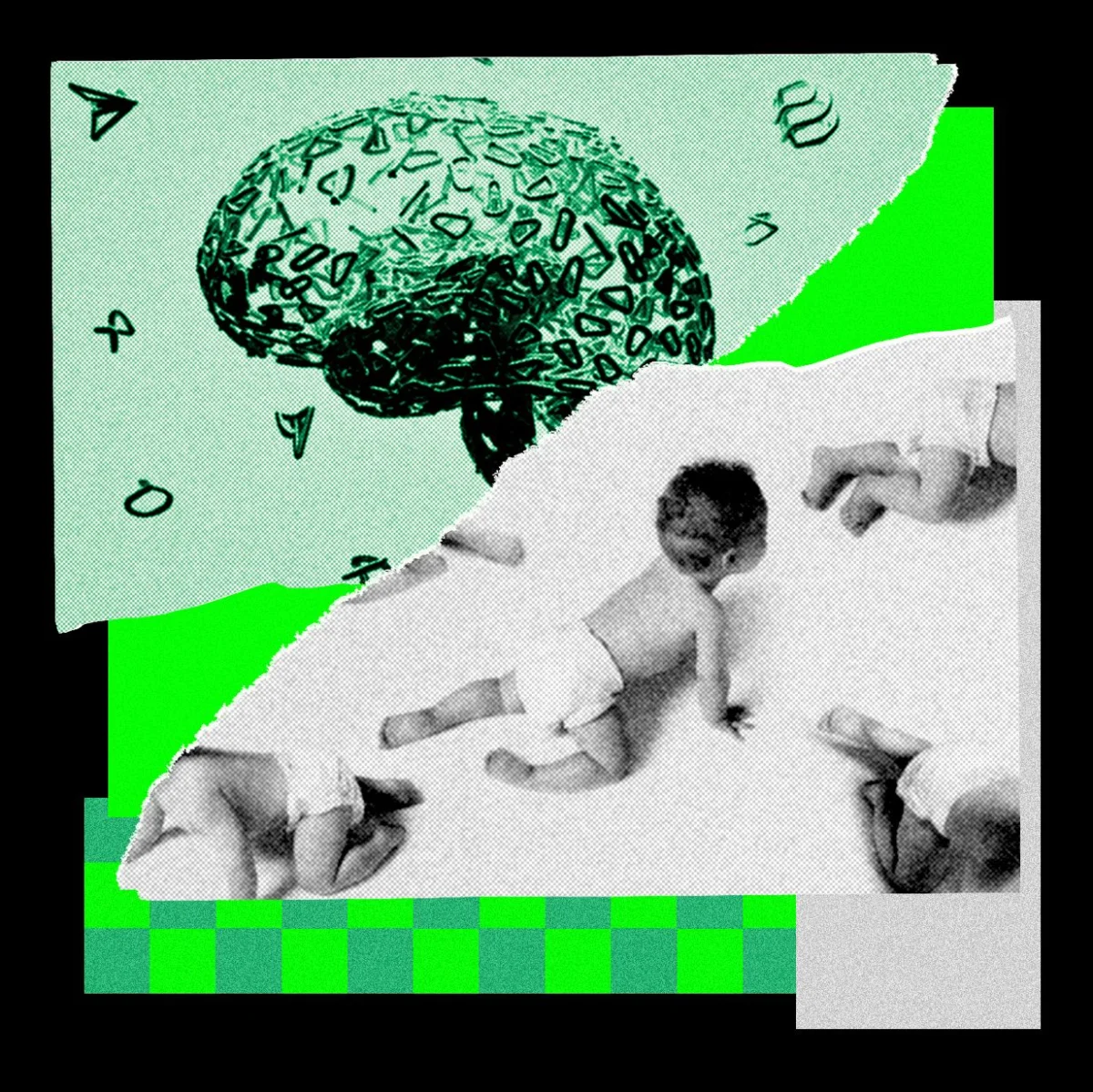
If you were to pit the world’s most sophisticated artificial intelligence model—a behemoth running on thousands of specialized H100 GPUs—against a one-year-old toddler, the outcome might seem obvious. The AI can write complex Python scripts, debug architectural schematics, and synthesize the entirety of Wikipedia in milliseconds. The toddler, by contrast, spends most of its time staring at a set of wooden blocks and occasionally attempting to eat them.
Yet, from an engineering perspective, the toddler is a miracle of efficiency that makes our best silicon-based models look like primitive calculators. While modern AI requires an ocean’s worth of training data and the energy output of a small nation to function, a human child learns to navigate the physical world, decode social cues, and master language with a staggering, almost impossible economy of scale.
Researchers are now pivoting toward this "baby-like" approach to artificial intelligence. By shifting focus from "more data" to "smarter, more biological learning," scientists at Meta, Stanford, and beyond are hoping to create AI that is not only more efficient but fundamentally more capable of reasoning about the world as it truly exists.
The Disconnect Between "Big Data" and Real-World Cognition
The current paradigm of AI development is built on the philosophy of scale: if the model is smart enough, it just needs more data. Consequently, Large Language Models (LLMs) and Vision Language Models (VLMs) have been trained on trillions of tokens—essentially the entirety of the digitized human record.
However, a human child never touches the internet. A child learns from a "kaleidoscopic" stream of experience: parents talking about objects that are no longer in the room, gestures that imply meaning, and the physical, tactile reality of gravity, friction, and resistance.
"When you look at how a child learns, it’s clear that there is much more than just language involved," says Michael Frank, a cognitive scientist at Stanford University. "They learn from rich, multimodal, and tactile experiences. They aren’t just predicting the next word; they are building a model of the world."
The EgoBabyVLM Challenge: A New Benchmark for Intelligence
To test whether AI can truly mimic the human capacity for learning, a coalition of researchers from Meta, Stanford, the University of Tokyo, and France’s École Normale Supérieure have introduced the EgoBabyVLM Challenge.
This benchmark is designed to see how well AI models can make sense of the world through the literal eyes of an infant. Researchers utilized approximately 1,000 hours of video footage captured by cameras mounted on the heads of infants and toddlers. This dataset—messy, chaotic, and filled with the mundane reality of household life—serves as the ultimate test for current-generation AI.
The results, so far, are sobering. The industry’s most advanced models fail to perform at a human level when subjected to this footage. They struggle to identify objects or understand the intent behind a parent’s gesture when the input isn’t a polished, curated image from the internet. This failure suggests that current AI architectures, while powerful at pattern matching, lack the innate "hooks" that allow the human brain to extract high-level concepts from raw, noisy, and sparse data.
Chronology: From Chomsky to the "BabyLM" Shift
The quest to understand human intelligence through the lens of AI has a long and storied history. To understand why the field is currently obsessed with "baby AI," one must look at the evolution of these experiments:
- 1957 – The Chomskyan Era: Linguist Noam Chomsky posited that human language acquisition is supported by an innate, "hardwired" grammar in the brain. For decades, this dominated cognitive science.
- 2023 – The BabyLM Challenge: A team led by Ryan Cotterell at ETH Zurich launched the BabyLM project. They tasked AI with learning language using only the amount of data a ten-year-old would encounter (tens of millions of words, rather than trillions). The success of transformer models in this task stunned many, suggesting that perhaps language isn’t as "hardwired" as Chomsky thought, but rather that human-like learning is possible with far less input.
- 2024 – The Physical Reasoning Gap: Researchers began testing whether VLMs could learn basic concepts, like the existence of a ball or gravity, from single-infant datasets. While they showed progress, the models still lacked the sophisticated reasoning skills of a two-year-old.
- 2025/2026 – The EgoBabyVLM Era: The focus has now moved from simple syntax to "common sense" and physical world modeling. This is the current frontier: building systems that don’t just see pixels, but understand the causal relationships between objects.
The Limitations of "Pure Pattern Matching"
One of the most persistent voices in this field is Joshua Tenenbaum, a cognitive scientist at the Massachusetts Institute of Technology. Tenenbaum has long argued that while transformers are world-class pattern matchers, they are fundamentally limited by their reliance on statistical correlation.
"Transformers are very good at finding patterns in data," Tenenbaum notes. "But it does seem that just pure pattern-learning systems are not able to take the kind of data that a baby or a child receives and learn all the things that they do."
The "mystery" of the two-year-old is that they develop a theory of mind—the understanding that others have thoughts, beliefs, and desires—at an age when they can barely speak. Current AI models can simulate this through language, but they do not possess this understanding in a way that allows them to interact with the world reliably.
Implications: The Path Toward Efficient AI
The implications of successfully building a "baby-like" AI are profound, both for the environment and for the future of robotics.
1. Energy Efficiency
If we can create models that learn from a few thousand hours of experience rather than petabytes of scraped data, the carbon footprint of AI training will plummet. Moving away from the "bigger is better" model is a necessity for the long-term sustainability of the tech sector.
2. Robotics and Physical Interaction
For a robot to be useful in a home environment—doing dishes, folding laundry, or caring for the elderly—it cannot be trained on the internet. It needs to learn from its immediate environment, much like a child does. If an AI can learn to navigate a room by "observing" its surroundings as a baby does, it could revolutionize the deployment of autonomous systems in domestic spaces.
3. Redefining "Intelligence"
The research suggests that intelligence is not just a function of computational power, but of architectural bias. If we can encode "priors"—the biological equivalent of the basic instincts that humans are born with—into AI, we may create machines that are more robust, more reliable, and less prone to the "hallucinations" that plague current LLMs.
Official Perspectives and Future Directions
The research community is largely in agreement that we are reaching the end of the road for the "scale-only" approach. Brendan Lake, a cognitive scientist at Princeton University, remains optimistic about the EgoBabyVLM challenge.
"I’m excited to see what kinds of new architectures, approaches, and ingredients researchers come up with," Lake says. He notes that the next generation of AI will likely require "ingredients" from neuroscience—specifically mechanisms that allow models to pay attention to temporal relationships over long periods and, crucially, to understand the social and physical cues that govern human life.
Stanford’s Michael Frank has already begun exploring this. His team recently developed a model capable of learning causality—understanding that if a block hits another, it moves—using baby-head video data. By focusing on how objects affect one another over time, the model achieved results that were significantly more effective than those of traditional, non-biased models.
Conclusion: The Toddler as the North Star
The shift toward studying infant cognition is more than just a passing academic trend; it is a fundamental realignment of the field of artificial intelligence. We have spent the last decade trying to build a brain by throwing as much information as possible into a digital void. Now, we are learning that the "void" is not the problem—the way we process the world is.
If we can successfully decode the "toddler protocol"—the way a human child turns a fleeting, messy, and limited stream of data into a profound understanding of reality—we will not only unlock the next generation of AI. We will finally be able to build machines that don’t just mimic human output, but share in the human experience of learning. The toddler, it seems, was the prototype all along.











