

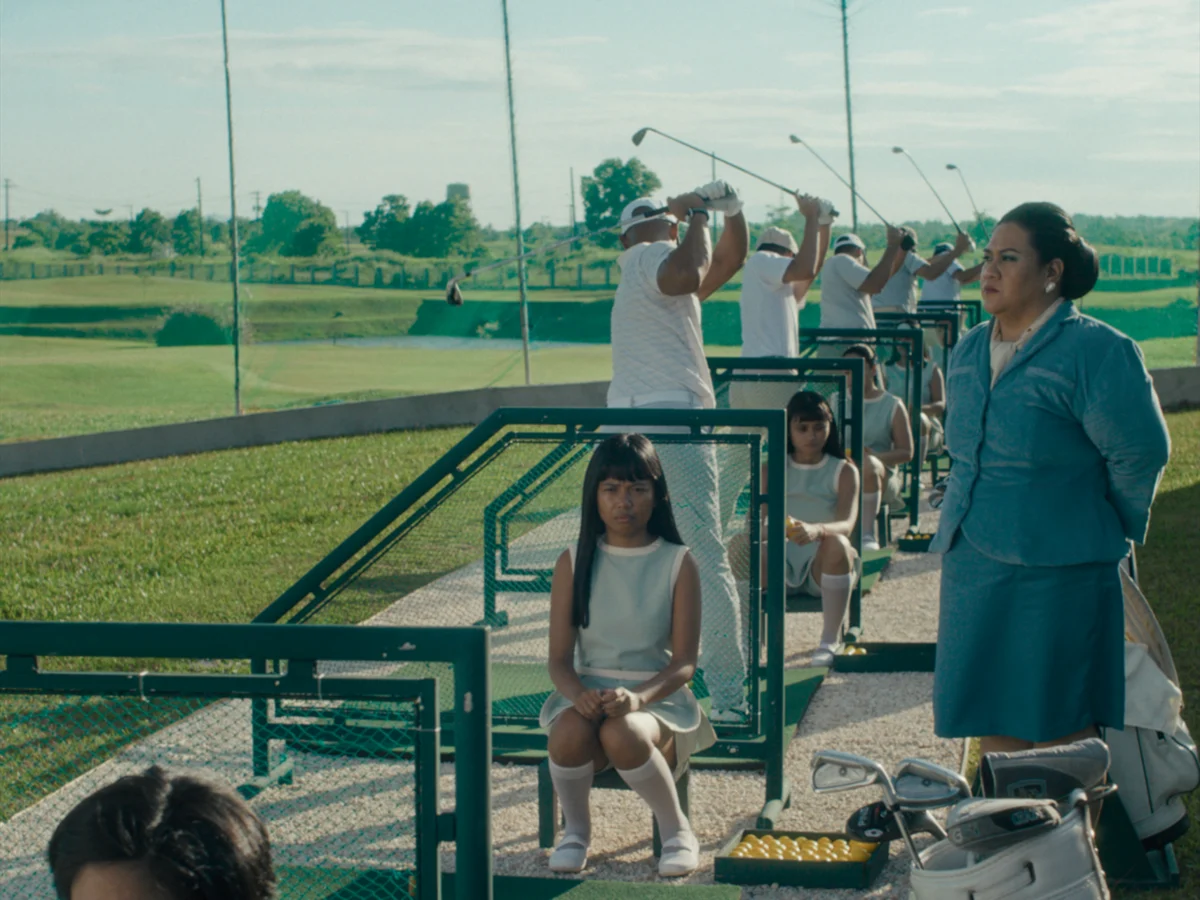
Beneath the manicured, emerald-green blades of a Philippine country club, a dark, suppressed reality pulses. This is the central conceit of Filipiñana, the debut feature film from director Rafael Manuel, which has emerged as one of the most provocative pieces of cinema to surface from the 2026 Sundance Film Festival. A surreal, searing, and visually arresting class critique, the film has officially arrived, set for a national theatrical rollout via Kino Lorber beginning August 28.
Winner of the Special Jury Award for Creative Vision at Sundance’s World Cinema Dramatic Competition, Filipiñana is a feature-length expansion of Manuel’s 2020 short film of the same name, which previously garnered a Silver Bear at the Berlin International Film Festival. By weaving a tapestry of visual influences—ranging from the precise, deadpan humor of Jacques Tati and the clinical observation of Michael Haneke to the sociopolitical depth of his mentor, Jia Zhangke—Manuel has crafted a work that is as aesthetically daring as it is morally challenging.
The Narrative Core: A Portrait of Stifling Privilege
The film centers on Isabel, a 17-year-old girl from the rural north of the Philippines who finds herself working at an ultra-exclusive, gated country club on the outskirts of Manila. In this hermetically sealed environment, the atmosphere is heavy with the dual pressures of relentless heat and a pervasive, lingering drought.
Isabel’s role is one of performative subservience: she lines up golf balls for the country’s elite, watching as they drive them into a verdant, carefully curated horizon that feels increasingly like a stage set. As the plot unfolds, Isabel begins to navigate the liminal spaces of the club during her off-hours. She observes the inhabitants—a revolving cast of powerful industrialists, expatriate guests, and wealthy tourists—as they engage in a complex, ritualistic dance of power with the doting, invisible staff.
The narrative tension snaps when Isabel attempts to return a mislaid golf club to the club’s patriarchal director, Dr. Palanca. This simple, errant act becomes a catalyst for her descent into the club’s hidden, darker corners. As she penetrates deeper into the resort’s private sanctums, she uncovers violent truths not only about the institution itself but about the socio-economic fabric of her home country and the trauma of her own past.
A Chronology of Artistic Development
To understand the weight of Filipiñana, one must look at the trajectory of Rafael Manuel’s career. The transition from the 2020 short film to the 2026 feature represents a maturation of style and intent.

- 2020: The original short film Filipiñana premieres, earning critical acclaim and a Silver Bear at the Berlinale. It establishes the initial visual language of the golf course as a site of colonial and class-based friction.
- 2023–2025: Under the mentorship of renowned filmmaker Jia Zhangke, Manuel develops the script into a feature-length narrative, expanding the cast of characters and deepening the exploration of the club’s "rot."
- January 2026: The feature version of Filipiñana premieres at the Sundance Film Festival to critical acclaim, securing the Special Jury Award for Creative Vision.
- August 2026: Kino Lorber prepares for the film’s theatrical release, marking a significant moment for Filipino independent cinema on the global stage.
Supporting Data: The Architecture of Solipsism
The film’s impact lies largely in its ability to turn the golf course into a character. IndieWire’s Chief Film Critic, David Ehrlich, noted following the Sundance premiere: "More than any other film that comes to mind, Rafael Manuel’s Filipiñana taps into something that I’ve always found inherently sinister about golf courses: Sprawling gardens of solipsism that invite players to compete against themselves… they’re so elegantly imposed upon the land that it’s easy to forget that something else was ever there in the first place."
This sentiment is reflected in the production design and cinematography, which emphasize the artificiality of the resort. By highlighting the contrast between the lush, irrigated fairways and the arid, struggling landscape of the rural Philippines outside the gates, Manuel provides a visual shorthand for the disparity of wealth. The "sinister" nature of the course is not merely metaphorical; it is an architectural reality. The club serves as a fortress of capital, where the "masters of the universe" can broker deals, oblivious to the labor that maintains their pristine paradise.
Official Responses and Cast Dynamics
The film features a strong ensemble cast that brings the hierarchical nature of the club to life. Performers including Jorrybell Agoto, Carmen Castellanos, Teroy Guzman, Carlitos Siguion-Reyna, Isabel Sicat, and Nour Hooshmand navigate the film’s surreal shifts with a grounded commitment that anchors the audience’s experience.
Early reactions from festivals have praised the film for its refusal to provide easy answers. Critics have noted that while the film draws inspiration from masters of European and Asian cinema, it remains distinctly rooted in the Philippine experience. The "Special Jury Award" recognizes specifically this unique vision—a blend of the surreal and the hyper-realistic that forces the viewer to confront the human cost of luxury.
Implications: The Mirror Held to Society
Filipiñana is more than a critique of the wealthy; it is an interrogation of the systems that allow such extreme inequality to persist. The film posits that the "rot" beneath the fairways is not just a localized problem within one club, but a systemic issue that defines the modern Philippine landscape.
The Colonial Legacy
The very name of the film and the setting of the country club invoke the colonial history of the Philippines. By placing a young girl from the rural north at the center of this microcosm of wealth, Manuel highlights the continued exploitation of the working class by an elite that often mirrors colonial-era power structures.

The Environmental Subtext
The "stifling heat and pervasive drought" mentioned in the synopsis serves as a critical environmental backdrop. While the club maintains its lush, green lawns through intensive water usage, the world outside faces ecological collapse. This contrast serves as a haunting reminder of how the wealthy insulate themselves from the consequences of climate change, further widening the gap between the haves and the have-nots.
The Future of Independent Cinema
With the film hitting theaters in New York on August 28 and Los Angeles on September 4, the industry will be watching closely. Filipiñana represents a growing wave of international films that prioritize visual storytelling over traditional dialogue-heavy exposition. If the film’s success at Sundance is any indication, audiences are increasingly hungry for cinema that challenges their perception of the world through a lens of artistic, rather than commercial, urgency.
Conclusion: A Must-See Critique
Rafael Manuel has delivered a work that is as difficult as it is necessary. Filipiñana is a masterclass in atmospheric storytelling, utilizing the eerie, quiet space of a golf course to articulate the deafening silence of systemic oppression. As the film begins its theatrical run, it stands as a testament to the power of the medium to peel back the surface of our reality and reveal the complex, often violent, truths underneath.
Whether it is through the lens of a "garden of solipsism" or a story of one girl’s journey to uncover her own history, Filipiñana demands the viewer’s attention. It is a haunting exploration of what happens when we ignore the rot—and what happens when one person finally decides to start digging.










