

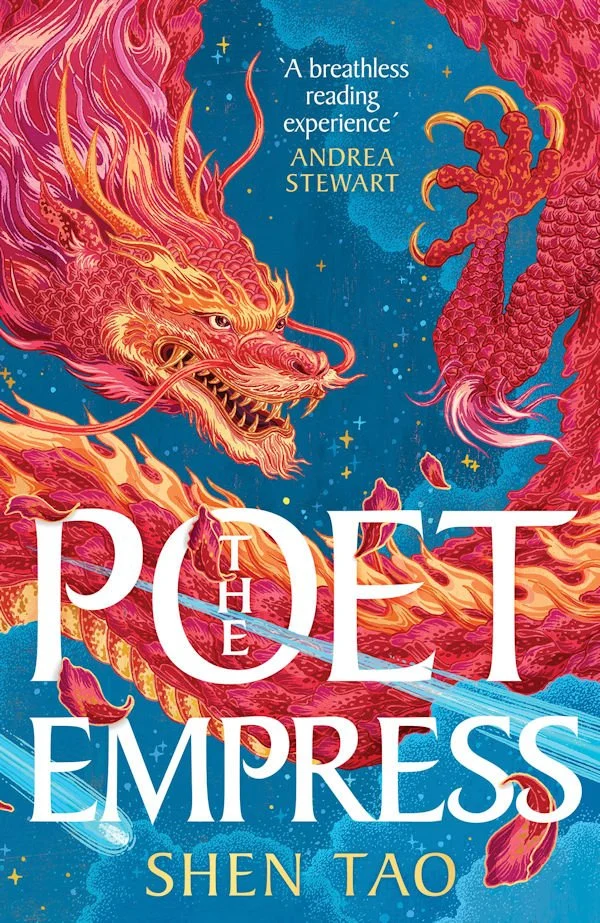
[Content Warning: The following article discusses a novel containing depictions of torture and sexual violence.]
In the landscape of contemporary fantasy, the debut novel is often a tentative step—a trial run for a budding author finding their voice. Occasionally, however, a debut arrives with the seismic force of a masterwork, challenging the conventions of the genre and forcing established authors to re-evaluate their own craft. Shen Tao’s The Poet Empress is one such anomaly. A haunting, intricate, and deeply unsettling standalone novel, it has quickly become the talk of the speculative fiction community, earning a reputation as a story that is as intellectually demanding as it is emotionally devastating.
The Enigma of the Villain: A Narrative Puzzle
At its core, The Poet Empress is an exercise in psychological manipulation, both on the part of its characters and its author. The narrative structure is built upon a foundation of partial recollections and fractured perspectives, intentionally designed to lead the reader down paths that feel logical only to reveal them as traps.
The central tension of the novel revolves around a fundamental, uncomfortable question: Can a reader truly sympathize with a psychopath? Shen Tao masterfully threads the needle between revulsion and empathy, forcing the audience to grapple with the possibility of redemption for a character whose actions are, by any moral standard, reprehensible.
Unlike many genre offerings that rely on predictable tropes or "chosen one" narratives, The Poet Empress is a puzzle. It demands that the reader set aside their preconceptions. Even the most seasoned mystery solvers—the types who predicted the parental lineage in Star Wars or the twist in The Sixth Sense—are reportedly finding themselves blindsided by the novel’s conclusion. It is a rare feat in an age of hyper-analysis to encounter a story that remains genuinely unpredictable until the final page.
World-Building: A Symphony of Power and Poetry
While the psychological weight of the novel is its most lauded feature, the world-building is equally formidable. Set against a backdrop reminiscent of the historical intensity found in Ooku or The Empress of China, the story follows an outsider protagonist thrust into a labyrinthine court.
The setting is one of suffocating control. In this world, literacy is not merely a skill; it is a capital offense. Women caught reading face a terrible, state-sanctioned death. Against this backdrop of systemic oppression, magic—referred to as "Literomancy"—is fueled by the very thing that is forbidden: the written word. This interplay between the power of language and the brutality of a regime designed to silence it creates a compelling study of how power corrupts and how the marginalized reclaim their agency.
The Literomancy System
Shen Tao’s magic system, based on hereditary Seals and the intricate mechanics of Literomancy, stands as a high-water mark for modern fantasy. Critics have drawn direct comparisons to the intricate hard-magic systems popularized by Brandon Sanderson. In a bold assertion that has sparked debate within the fantasy community, many reviewers have noted that Shen Tao achieves a level of world-building depth in a single volume that most authors struggle to attain over the course of a trilogy. The "lived-in" quality of the world—the way the magic informs the culture, the politics, and the daily survival of the characters—is nothing short of masterful.
Literary Style and Audio Performance
Despite the complexity of the themes, Tao’s prose remains refreshingly grounded. There is an absence of flowery, unnecessary ornamentation; instead, the author utilizes a direct, evocative style that perfectly mirrors the internal life of the protagonist. This choice of voice serves to heighten the impact of the darker moments, ensuring that the horror of the violence is felt viscerally rather than obscured by purple prose.
The audiobook edition, narrated by Katharine Chin, has received significant acclaim for its contribution to the narrative experience. Chin’s performance manages to capture the nuance of the protagonist’s descent into the political machinery of the court, adding a layer of vocal texture that enhances Tao’s minimalist writing.
Chronology of Reception
The arrival of The Poet Empress has followed a rapid trajectory of critical success:
- Pre-Release Anticipation: Early buzz within literary circles suggested that Tao’s work was a "career-defining" debut, with editors noting the sheer ambition of the plot.
- Release Week: Following its launch, the novel trended rapidly on social media and independent review platforms, with early adopters praising its refusal to offer easy answers.
- The "Five-Day Review" Phenomenon: A testament to the book’s complexity is the reported struggle of reviewers to articulate their thoughts. Many have described a "period of silence" following the reading, where the weight of the story prevents immediate critical engagement.
- Current Status: The novel has cemented its place as a "must-read" for the year, with a growing consensus that it represents a shift toward darker, more character-driven fantasy.
Implications for the Genre
The success of The Poet Empress poses interesting questions for the future of the fantasy genre. For years, the market has been dominated by long-form series, often stretching into six or seven volumes. Tao’s ability to deliver a standalone epic—one that provides a satisfying, complete, and emotionally resonant conclusion without the need for sequels—may signal a shift in reader preferences.
Furthermore, the novel’s willingness to explore the "gray areas" of morality challenges the traditional dichotomy of hero versus villain. By focusing on generational trauma, sibling rivalry, and the suffocating nature of cutthroat court politics, Tao has elevated the genre, proving that fantasy can serve as a potent vehicle for high-stakes psychological exploration.
Final Verdict: A New Standard
In an industry where ten-star rating scales are often used for professional appraisal, The Poet Empress has shattered the ceiling. It is not merely a good book; it is a transformative experience. For those willing to engage with the darkness—and to accept the trauma depicted within its pages—Shen Tao offers a story that is as rewarding as it is demanding.
The consensus is clear: The Poet Empress is not just a debut to watch, but a benchmark for what fantasy literature can achieve when it refuses to compromise on depth, character complexity, or the courage to lead the reader into the unknown. As one reviewer aptly concluded: "If I could give The Poet Empress more than ten stars, I would. Eleven stars."
In the final analysis, Shen Tao has not just written a book; she has crafted a labyrinth. And once you enter, you will find that you have no desire to find the exit.











No comments yet. Be the first to join the conversation!