

In the landscape of global contemporary cinema, few figures command the intellectual and aesthetic gravity of Lav Diaz. The Filipino auteur, whose career has been defined by long-form examinations of history and the human condition, is currently embarking on a period of profound creative expansion. While the world of film criticism prepares for his latest offering at the Venice Film Festival, Diaz has unveiled a slate of ambitious future projects that aim to further dissect the structural veins of Philippine identity, ranging from the shadows of false prophecy to the foundational literature of the nation’s independence.
Main Facts: A Return to the Venice Spotlight
Diaz’s latest feature, Let Us Through, Dear Ancestors (Makikiraan Po), is set to make its debut in the Venice Open section of the Venice Film Festival. The film serves as a poignant return to the festival for the director, who famously claimed the Golden Lion in 2016 for his masterpiece The Woman Who Left.
Let Us Through, Dear Ancestors is a harrowing, meditative dive into the 16th and 17th-century colonial history of the Philippines, focusing on the Spanish consolidation of power under Miguel Lopez de Legazpi. Following his 2025 Cannes premiere of Magellan—which featured Gael Garcia Bernal as the eponymous Portuguese explorer—Diaz’s new work pivots from the arrival of the Spanish to the brutal consolidation of their rule in Cebu.
Beyond the immediate festival circuit, Diaz has confirmed he is in the developmental stages of two major new works: a film exploring the sociopolitical dangers of false ideologies and modern-day false prophets, and a highly anticipated screen adaptation of José Rizal’s seminal 1887 novel, Noli Me Tangere. The latter, a work that served as a foundational catalyst for the Philippine Revolution of 1896, represents a significant undertaking for a filmmaker who has spent his career re-examining the scars of that very era.
Chronology: From Magellan to the Present
To understand the trajectory of Let Us Through, Dear Ancestors, one must view it as the third movement in a sustained historical symphony. Diaz’s fascination with the Philippine Revolution began with the epic A Lullaby to the Sorrowful Mystery, which explored the 1896 uprising against Spanish rule. With his new film, he pushes the historical aperture even wider, reaching back to the late 16th century.
- 1521: Ferdinand Magellan arrives in the Philippine archipelago, marking the first sustained European contact.
- 1565: Miguel Lopez de Legazpi arrives in Cebu, initiating a brutal, systematic colonization process.
- 1571: King Philip II mandates the encomienda system, effectively institutionalizing land dispossession and forced labor.
- 2016: Lav Diaz wins the Golden Lion at the Venice Film Festival for The Woman Who Left.
- 2025: Magellan premieres at Cannes, starring Gael Garcia Bernal.
- Current Day: Let Us Through, Dear Ancestors premieres at Venice, closing the circle on the initial era of colonial trauma.
The Architecture of Violence: A Re-examination of Heritage
At the core of Let Us Through, Dear Ancestors is a searing critique of the physical structures that define the Philippine landscape. Diaz challenges the common perception of colonial-era churches as mere sites of cultural or religious beauty. Instead, he presents them as monuments to blood, sweat, and systemic subjugation.
Under the Spanish colonial regime, the polo y servicio (forced labor) system required able-bodied Malay men—ranging from teenagers to the elderly—to provide 40 days of unpaid labor annually. This labor was used to construct the very infrastructure of colonial control: roads, bridges, forts, and, most notably, the massive stone churches that remain tourist landmarks today.
"Forgetful Filipinos must learn, must know, must understand, that these structures were built by forced labor, and that they didn’t appear in their midst by some cosmic manifestations," Diaz states with a tone of urgent corrective history. "It’s blood, sweat, tears, and deaths of our ancestors." Historical records cited by the filmmaker suggest a staggering toll: approximately 30% of the male population perished under the weight of this forced-labor system.
Faith as a Mechanism of Subjugation
Diaz’s critique extends beyond the physical architecture of colonization into the metaphysical realm. He argues that organized religion, when weaponized by institutional power, becomes a form of "eternal subjugation."
"Religion is one of the worst forms of violence," Diaz asserts. "Faith can be a form of eternal subjugation, especially for the weak. Oftentimes, it blurs all of rationality; it becomes the truth of existence." By drawing parallels between historical colonial religious mandates and modern-day conflicts—citing the Crusades, the Holocaust, and contemporary humanitarian crises in Gaza, Ukraine, Afghanistan, and Darfur—Diaz positions faith not as a solace, but as a potential site of ideological entrapment.
This perspective deeply informs the film’s title, Makikiraan Po. In contemporary Filipino culture, the phrase is a polite plea used when passing through areas believed to be occupied by ancestral spirits. For Diaz, it is a bridge between the present and the primal. "I still do it, naturally, when I am entering a forest, a zone, when I am thinking of the unattainable," he explains. "It is a connection, a relationship, with the ancient, with the primal, the pure."
Implications: The Legacy of the Encomienda
Perhaps the most significant implication of Diaz’s historical inquiry is his tracing of modern-day Philippine inequality to the 1571 encomienda system. By stripping indigenous communities of land ownership and imposing heavy tributes, the Spanish crown established a blueprint for class stratification that, in Diaz’s view, survives to this day.
"All the old rich families, landlords, hacienderos, political clans, big businesses, have their connection from the encomienda," Diaz observes. By highlighting this lineage, he suggests that the contemporary Philippine socio-economic divide is not merely a modern failure but a continuation of a colonial architecture that was never dismantled.
The Production Process: Filming in the Spirit of the Place
The production of Let Us Through, Dear Ancestors was a deeply personal journey for the director. Shot in black and white in Sampaloc, Quezon Province—the site of three of his previous films—the production occurred against the backdrop of the director’s own health battles. Following the editing of Magellan, Diaz suffered a burst lung due to tuberculosis, followed by severe asthma and COPD.
For Diaz, Sampaloc is more than a location; it is a source of vitality. "The spirit of the place provides the best attributes I needed in my films on issues of truth, vision and transcendence," he notes.
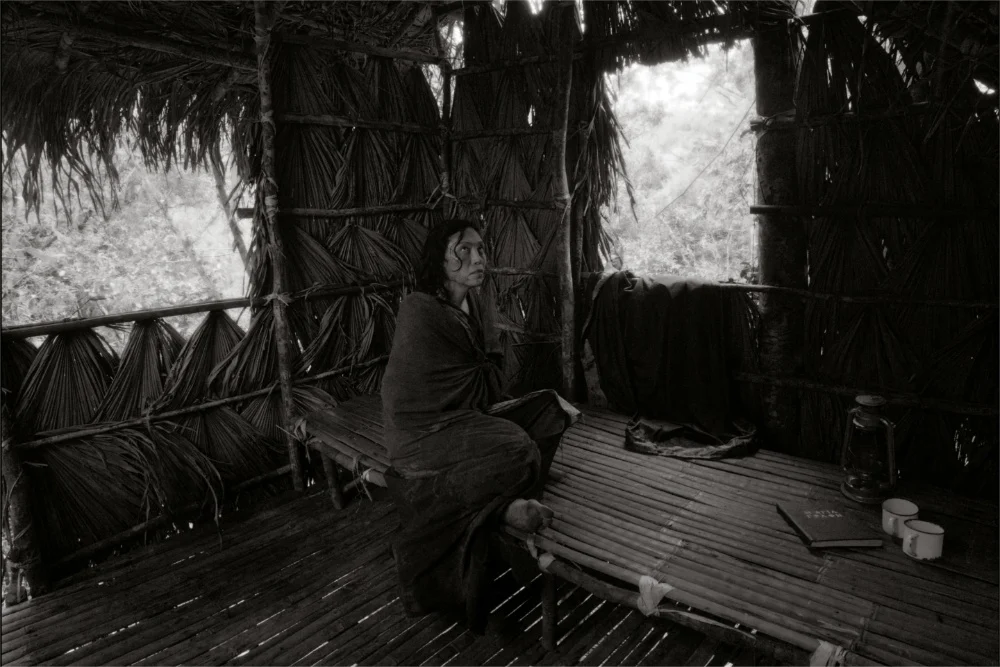
The film features filmmaker Isabel Sandoval, who takes on the role of the Babaylan—a traditional Malay healer. The Babaylan represents a crucial, pre-Hispanic, and pre-Islamic link to the Filipino identity, acting as a spiritual bulwark against the colonial religious imposition. Diaz praises Sandoval’s contribution, noting that her "majestic nuance" brought a necessary depth to the character that balances the film’s heavier, more didactic themes.
A Cinema of Truth
Despite its 151-minute runtime—relatively brief by Diaz’s own epic standards—the director insists that his "praxis" remains unchanged. He rejects the idea of a fixed creative framework, preferring to let the demands of the subject matter dictate the form.
"My principle has always been to work on the demands of the material at hand, to work around the conditions and situations," he explains. "There’s never a fixed setup or framework. It’s just all hard work on the different aspects of the process, really. The struggle to pursue a vision is the most important."
As he looks toward his upcoming adaptation of Noli Me Tangere and his project on false prophets, Diaz remains steadfast in his belief that cinema is not merely entertainment, but a moral responsibility. "Cinema must have the responsibility to commit to the truth," he concludes. "There should be no compromise on that issue given the condition of the world right now. Cinema’s soul is the truth."
Produced by C’est Lovi Prods., Epicmedia Prods., and Sine Olivia Pilipinas, with Heretic handling world sales, Let Us Through, Dear Ancestors arrives at a moment of significant global instability. By anchoring his work in the painful, specific history of the Philippines, Lav Diaz continues to offer a mirror to the world, forcing a confrontation with the ghosts of the past that still haunt the corridors of modern power.










