

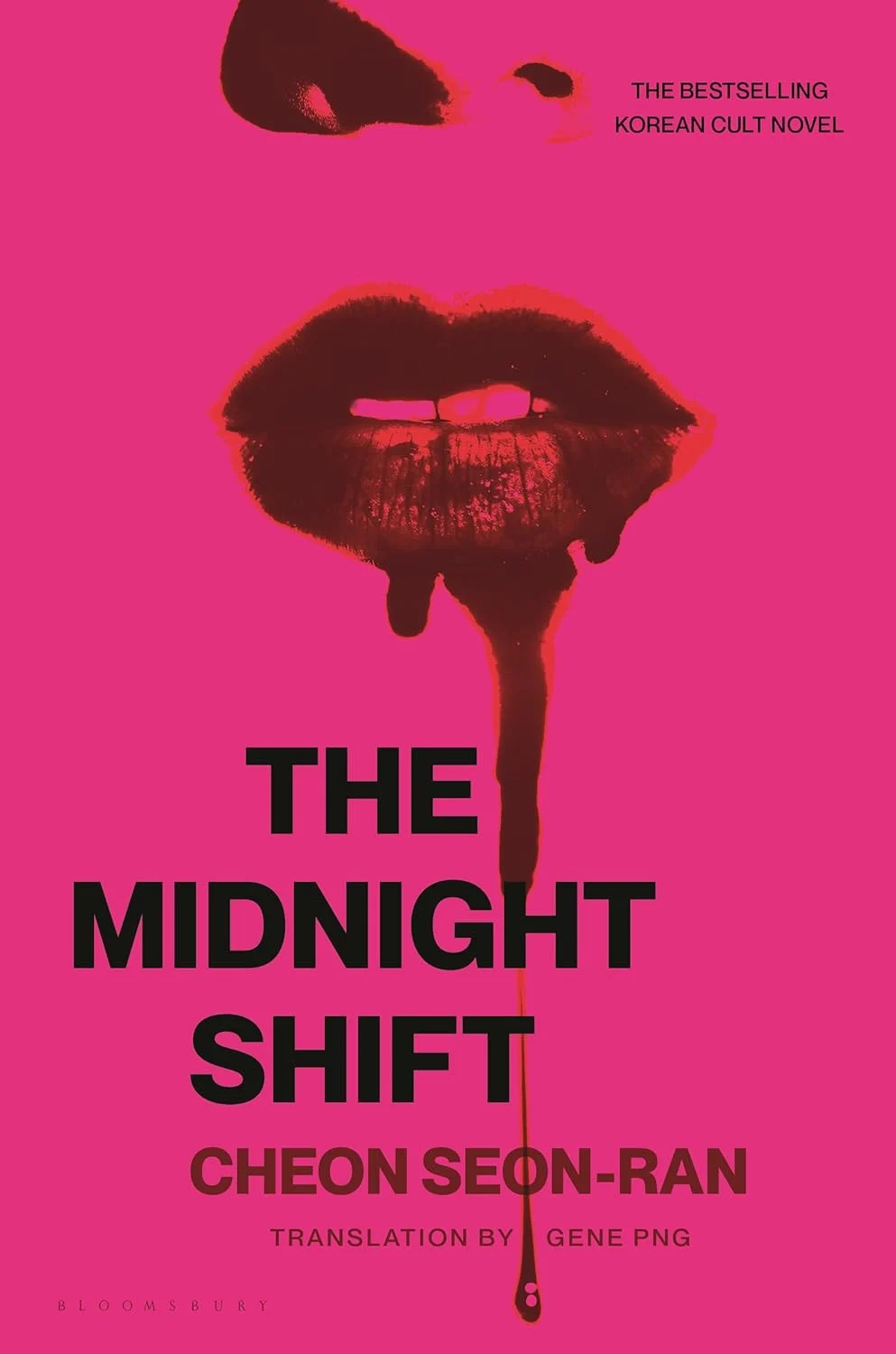
The literary landscape has long been haunted by the silhouette of the vampire. From the Gothic shadows of Joseph Sheridan Le Fanu’s Carmilla (1872) and the aristocratic menace of Bram Stoker’s Dracula (1897) to the modern, often romanticized iterations found in the Twilight saga or the whimsical halls of Hotel Transylvania, these nocturnal predators have served as a malleable vessel for human fears. Yet, in The Midnight Shift—the latest work by acclaimed Korean author Cheon Seon-Ran, translated into English by Gene Png—the vampire myth is stripped of its traditional camp and horror tropes, recast instead as a visceral metaphor for the crushing weight of modern social isolation.
The Premise: Hunting Monsters in Contemporary Seoul
Set against the neon-lit, high-pressure backdrop of contemporary Seoul, The Midnight Shift centers on Suyeon, a young police detective who begins to notice a disturbing pattern: a string of suicides at a local hospital for the elderly. While her department dismisses the deaths as the tragic, predictable outcome of terminal illness and social abandonment, Suyeon suspects a more sinister hand at work.
Her investigation leads her to Violette, a woman who introduces a terrifying reality into Suyeon’s life: these are not suicides, but murders committed by a vampire that feeds not just on blood, but on the “scent of lonely blood.” As the two women form an unlikely alliance to hunt the predator, the narrative expands into a triptych of perspectives. We follow Suyeon’s investigation, Nanju’s complicity as a hospital nurse facilitating the killer’s access, and Violette’s own formative years as an adoptee in 1983 France. Through these shifting lenses, Cheon explores the varying textures of human suffering.
Chronology of a Mythic Investigation
To understand the stakes of The Midnight Shift, one must look at how Cheon interweaves timelines to construct her argument about the nature of isolation:
- 1983 (France): The reader is transported to the childhood of Violette. Isolated as an outsider in a foreign land despite her loving adoptive family, she experiences the profound, aching silence of a life without peers—a void that is only bridged when she encounters Lily, a mysterious, otherworldly figure who challenges her understanding of existence.
- The Present (Seoul): The narrative shifts to the clinical, sterile environment of a hospital for the elderly. Here, the temporal focus is on the rapid depletion of human connection. We witness the lives of the terminal patients—forgotten by families, ignored by the state, and ultimately, targeted by the predatory vampire.
- The Convergence: The novel reaches its crescendo as the past (Violette’s history) and the present (Suyeon’s investigation) collide. The hunt for the killer serves as the mechanical engine of the plot, but the resolution of the narrative is less about the capture of a supernatural entity and more about the internal reconciliation of the protagonists with their own histories of trauma and abandonment.
Supporting Data: The Reality of "Godoksa"
While The Midnight Shift functions as a work of supernatural fiction, its core anxiety is rooted in real-world sociological data. The term "godoksa"—or "lonely death"—has become a focal point of public policy and national concern in South Korea. The demographic shift toward single-person households and the rapid acceleration of urbanization have left a significant portion of the population, particularly the elderly and the young, living in atomized bubbles.
According to a 2022 survey by the Seoul Institute, 62% of single-person households in the capital reported experiencing significant levels of loneliness. Furthermore, city estimates suggest that approximately 130,000 young people in Seoul suffer from severe social isolation, often withdrawing from the workforce and human contact entirely. The Guardian reported in July 2025 that the city government is actively experimenting with "mind-convenience stores" and increased counseling services to combat this, acknowledging that the lack of community is a public health crisis equivalent to chronic physical illness.
Cheon Seon-Ran utilizes these statistics to frame her vampires. They are not merely blood-drinkers; they are scavengers of the socially discarded. The novel argues that in a society where one can pass away without a single person noticing, the "vampire" is simply the ultimate manifestation of a community that has already ceased to look after its own.
Official Responses and Literary Critiques
The reception of The Midnight Shift has been nuanced, reflecting the tension between its thematic depth and its execution as a thriller. Critics have lauded Cheon for her poignant, philosophical exploration of the "will to live." In one of the novel’s most striking passages, Violette explains the mechanics of the vampire’s hunt:
"People who are driven to the edge of loneliness and solitude don’t cry. They’ve forgotten how… Crying when you are sad, that is, being able to cry, is a testament to the fact that your will to live still exists… And since they [vampires] are creatures with an inconceivably keen sense of smell, they can discern the scent of lonely blood."
However, literary analysis of the work also points to uneven pacing. While Violette is rendered with profound, three-dimensional complexity, other characters—most notably Nanju—often feel like "cardboard figures" serving the plot rather than existing as fully realized individuals. Critics have noted that while the novel succeeds as a meditation on the human condition, the middle chapters suffer from a sag in momentum, and the final resolution feels hurried, leaving readers wanting more clarity on the lore of the vampires themselves.
Implications: The Vampire as a Social Symptom
The broader implication of The Midnight Shift is a call to collective responsibility. By framing loneliness as a scent that attracts predators, Cheon transforms an emotional state into a vulnerable, physical reality. The novel posits that the "monster" is not necessarily the vampire, but the societal structure that allows individuals to be so thoroughly isolated that they become prey.
The Sapphic Lens and Human Connection
The relationship between Violette and Lily adds a layer of sapphic yearning that functions as a counter-narrative to the loneliness of the rest of the book. In this relationship, the "other" is not a predator, but a source of connection. This suggests that the solution to the vampire—to the epidemic of isolation—is the cultivation of deep, meaningful bonds that defy traditional categorization.
The Moral Imperative
Suyeon’s final realization is the cornerstone of the book’s message: "The only way we can protect ourselves is by making sure no one is left alone."
In an era where technology promises connection while often delivering only the illusion of it, The Midnight Shift serves as a sobering reminder of the necessity of presence. The novel moves beyond the tropes of its genre to suggest that the battle against the "vampires of loneliness" cannot be fought with weapons or investigations alone. It requires a systemic and personal commitment to ensuring that the elderly, the marginalized, and the isolated are reintegrated into the social fabric.
Conclusion
Cheon Seon-Ran’s latest work is a challenging, melancholic, and deeply timely contribution to contemporary Korean literature. While it may occasionally stumble in its structural pacing or character development, its thematic power is undeniable. By elevating the vampire from a creature of myth to a symbol of modern apathy, The Midnight Shift demands that the reader look at the empty chairs at the table, the silent apartments in the neighborhood, and the aging faces in the hospitals with a renewed sense of urgency. In the end, the book serves as a mirror; if we are horrified by the monsters in the story, we are forced to ask ourselves what we are doing to ensure that no one in our own reality is left to be hunted by the silence.









No comments yet. Be the first to join the conversation!