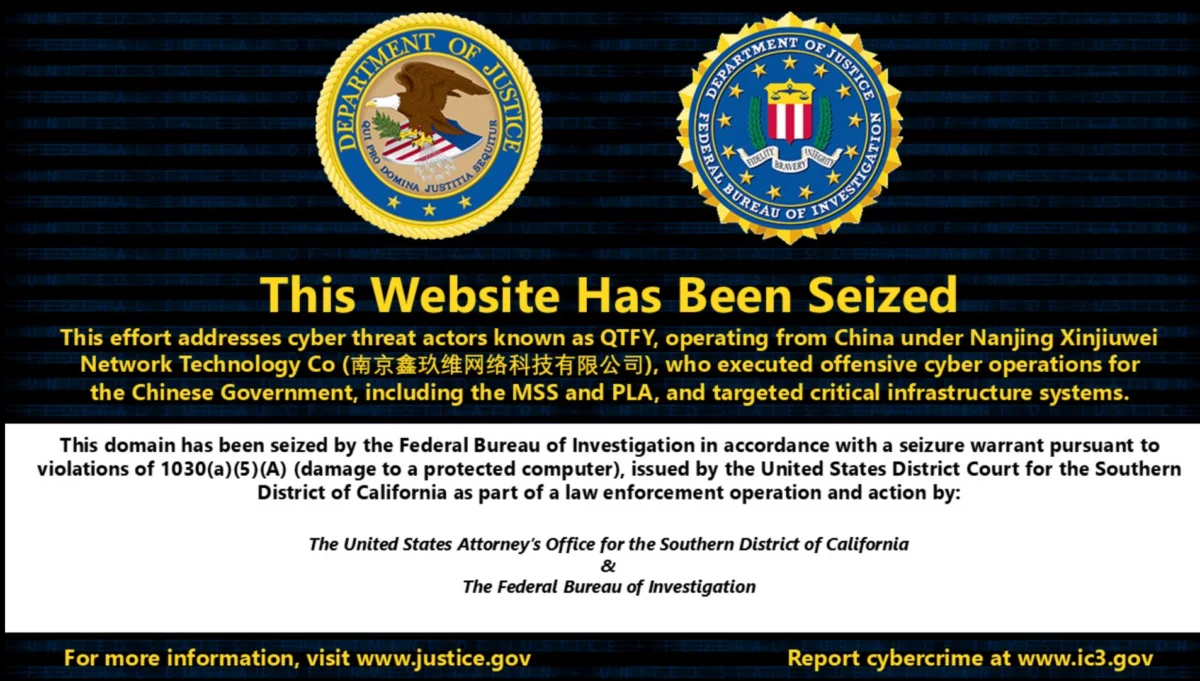
In a significant blow to state-sponsored digital espionage, the U.S. Department of Justice (DOJ) and the Federal Bureau of Investigation (FBI) have successfully seized a network of domains utilized by a Chinese hacking collective to infiltrate sensitive U.S. government systems. The operation marks a tactical escalation in the ongoing "cat-and-mouse" game between American cybersecurity agencies and threat actors linked to the People’s Republic of China (PRC).
The seized infrastructure was reportedly used to facilitate unauthorized access to high-value targets, including the Federal Reserve, the Department of Energy, the Department of Justice, the Department of Health and Human Services, the National Institutes of Health (NIH), NASA, and the U.S. Senate. The scope of these intrusions underscores the persistent and pervasive nature of foreign intelligence gathering against critical U.S. national infrastructure.
The Anatomy of the Intrusion: QTRouter and QScan
According to newly unsealed court documents, the primary actor behind these operations is a state-sponsored group identified as "QTFY." The group’s efficacy rested on two sophisticated pieces of custom malware: QScan and QTRouter.
How the Malware Functions
The QScan tool acts as a global automated reconnaissance engine. It is designed to continuously scan the public-facing internet to identify and automatically infect vulnerable Internet of Things (IoT) devices. Once a device is compromised, it is folded into the QTRouter network—a massive, distributed botnet that serves as a tactical "obfuscation layer."
By routing malicious traffic through this network of hijacked IoT devices, the QTFY group effectively masked the geographic origin of their commands. This architecture allowed them to conduct reconnaissance, move laterally through secure networks, and exfiltrate data while appearing to originate from legitimate, benign IP addresses scattered across the globe.
The DOJ affidavit reveals that the QTFY group has been actively leveraging this infrastructure to compromise U.S. systems since at least 2018. While investigations have linked the operation to a shadowy entity known as the "Nanjing Xinjiuwei Network Technology Company," information regarding this firm remains sparse, suggesting it may function as a front or a shell organization designed to provide plausible deniability for the Chinese government.
Chronology of the Investigation
The discovery of this infrastructure was not a singular event but the result of a multi-year intelligence effort by federal authorities.

- 2019: The FBI initiated a formal investigation following a suspicious system intrusion at NASA. The incident was traced back to the exploitation of CVE-2019-11510, a vulnerability in Pulse Secure VPNs. While the vulnerability was eventually patched, the digital breadcrumbs left by the attackers—specifically two Gmail accounts and a phone number utilizing the +86 country code (assigned to the PRC)—provided the initial intelligence lead.
- 2020–2022: As the FBI expanded its surveillance, it noted a pattern of behavior where the group rented infrastructure from commercial hosting providers. This activity triggered a wave of abuse complaints from platforms like Hostwinds, as the malicious traffic began to disrupt standard network operations.
- 2022–2024: The QTFY group refined its operational security. During this window, they registered three specific domains—
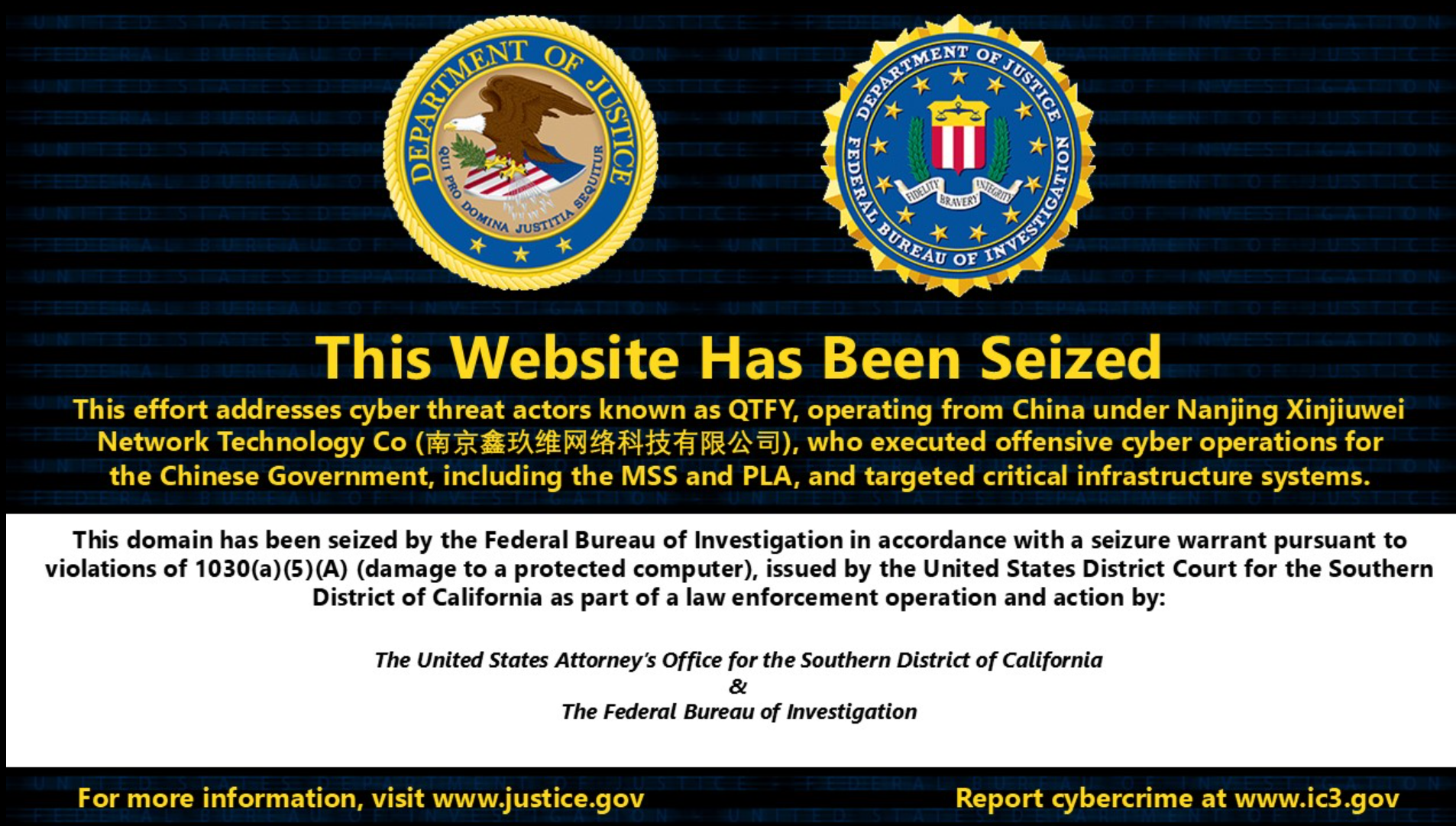
qtproxy.xyz,qt-proxy.org, andqt-team.com—via the registrar Namecheap. Payments were processed through PayPal, a move that ultimately assisted federal investigators in linking the domains to the broader QTFY operation. - October 2024: The culmination of the investigation resulted in a federal court order authorizing the seizure of the three aforementioned domains. The sites now display a standard U.S. government notice indicating that the infrastructure has been taken over by law enforcement.
Supporting Data and Technical Context
The sophistication of the QTFY operation highlights a growing trend in state-sponsored cyber warfare: the move away from centralized command-and-control (C2) servers toward decentralized, obfuscated networks.
By leveraging IoT devices, the attackers capitalized on the notoriously weak security posture of smart-home appliances, industrial controllers, and network gateways. Because these devices often lack robust update mechanisms or security monitoring, they provide a "forever-home" for threat actors looking to hide in plain sight.
The DOJ’s investigation confirmed that the PRC’s Ministry of State Security (MSS) was among the paying customers of the QTFY group. This confirmation is critical; it bridges the gap between private criminal hacking-for-hire services and formal state intelligence operations. It suggests that the Chinese government is increasingly outsourcing its "dirty work" to private, local technology firms to insulate the state from direct attribution.
Official Responses and Diplomatic Friction
The U.S. government’s seizure of the domains is a calculated act of "defend forward" strategy—an approach that seeks to disrupt adversary operations before they can cause catastrophic damage.
However, the diplomatic landscape remains fraught. While the PRC government routinely issues blanket denials regarding its involvement in state-sponsored hacking, the reality behind closed doors is significantly different. Reports from late 2023 indicated that in private diplomatic meetings, Chinese officials implicitly acknowledged their role in persistent, low-level intrusions into U.S. infrastructure.
The tension was further exacerbated in 2024 following reports that Chinese-backed attackers had successfully compromised decades-old wiretap systems used by U.S. telecom providers. These systems, designed to assist law enforcement in legal intercept operations, were turned against the U.S. government, allowing foreign adversaries to potentially monitor sensitive, court-authorized surveillance data.
In response to the current seizure, the FBI and DOJ have reiterated their commitment to "aggressive" action. A spokesperson for the Department of Justice noted that while the seizure of these three domains is a victory, it is merely one component of a much larger, ongoing campaign to dismantle the digital architecture used by hostile foreign powers to threaten U.S. sovereignty.
Implications for National Security
The ramifications of the QTFY operation are twofold: they demonstrate both the vulnerability of American critical infrastructure and the evolving nature of global cyber espionage.
1. The Fragility of IoT
The reliance on IoT devices as an "obfuscation layer" serves as a wake-up call for the cybersecurity industry. As billions of devices connect to the internet, they are increasingly being weaponized as proxies. The QTRouter network proves that a botnet does not need to be inherently malicious in its intent—it only needs to be large enough to hide the traffic of a targeted state actor.
2. The Shift to "Cyber Mercenaries"
The use of the Nanjing Xinjiuwei Network Technology Company suggests that the PRC is utilizing a "contractor model" for its intelligence gathering. This makes attribution significantly more difficult, as the state can claim that these are independent actors, despite evidence of state funding and high-level requirements gathering.
3. A Call for Hardened Defenses
The fact that the U.S. Senate, the Department of Energy, and NASA were all targeted suggests that the attackers were not looking for financial gain, but rather for strategic intelligence. The long-term implication is that the U.S. must adopt a "zero-trust" architecture, not just for its sensitive data, but for the very infrastructure that manages its communications and energy grids.
As the geopolitical rivalry between the U.S. and China intensifies, cyber operations will continue to serve as the primary tool for sub-threshold conflict. While the DOJ’s seizure of qtproxy.xyz and its counterparts is a tactical success, it is a reminder that in the digital age, the borders of national security are no longer defined by geography, but by the integrity of the code that powers the modern world.
The investigation remains ongoing, and federal agencies continue to encourage private sector partners to review their network logs for any historical traffic associated with the QTRouter network. As the digital landscape continues to evolve, the resilience of the U.S. government will depend on its ability to identify, isolate, and disrupt these unseen, state-backed threats before they transition from reconnaissance to sabotage.