Muslim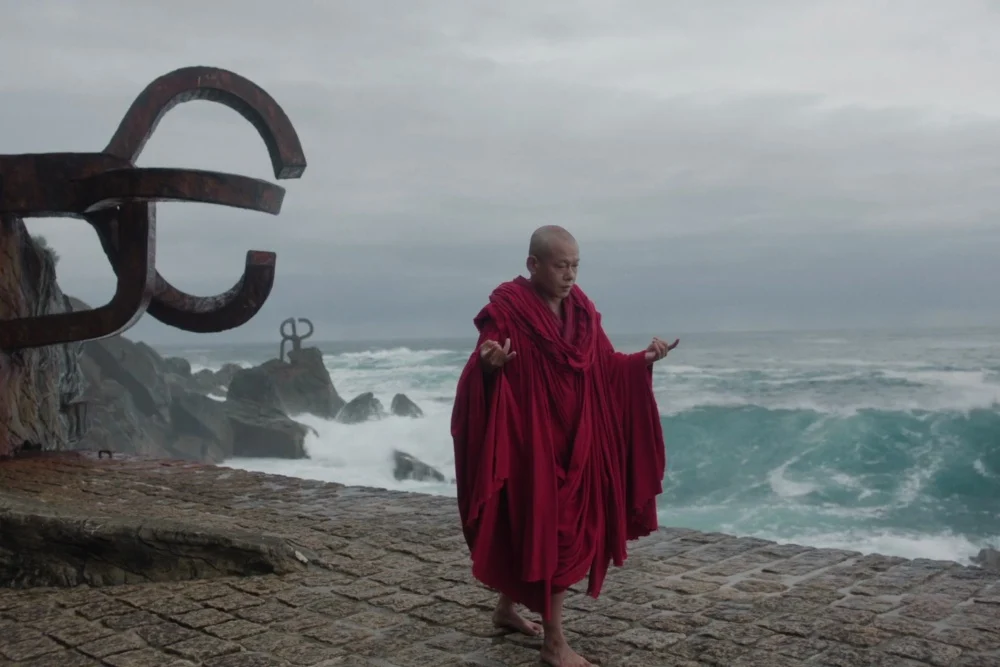
In the bustling landscape of contemporary global cinema, where the pace of editing has accelerated to match the frenetic digital age, director Tsai Ming-liang remains a steadfast, defiant anomaly. His latest project, Dust—the 11th installment in his long-running "Walker" series—arrives at the Venice Film Festival and the San Sebastian Film Festival not as a narrative offering, but as a meditative intervention. Featuring his longtime muse, Lee Kang-sheng, as a barefoot Buddhist monk traversing the rugged Basque landscape, Dust challenges the very foundations of how audiences consume visual media.
The Architecture of the Journey: Main Facts
Dust is a singular cinematic experience that eschews traditional plot, dialogue, and character development in favor of pure, observational aesthetics. The film follows the iconic "Walker"—Lee Kang-sheng—clad in a vibrant, saffron-red robe, moving through the coastal city of San Sebastian with a deliberate, agonizingly slow gait. His journey takes him from the sweeping shores of La Concha to the monumental, industrial concrete structures of the Chillida Leku museum, culminating at the edge of the Peine del Viento (Comb of the Wind), where the raw power of the Atlantic Ocean crashes against Eduardo Chillida’s steel sculptures.
Produced through a collaboration between Vitrine Filmes, Homegreen Films, and support from the Basque regional government’s culture and language department, the Taiwan Public Television Service Foundation, and Tabakalera, the project is a testament to international artistic cooperation. It represents a decade-plus commitment to capturing the intersection of human endurance and the architectural permanence of urban spaces.
A Chronicle of Stillness: The Evolution of "Walker"
The "Walker" project originated in 2012, born from a moment of creative exhaustion. Tsai, an auteur who gained international acclaim for narrative masterpieces like Vive L’Amour—which earned the Golden Lion at Venice in 1994—found himself weary of the constraints of conventional storytelling.
"At the time, I had grown tired of making narrative films," Tsai reflects. "Lee’s slow walk gave me the idea of making something non-narrative, a form of pure visual expression. The way he walks is extraordinarily beautiful, and the idea of ‘slowness’ itself has great power."
What began as an experiment has transformed into a global pilgrimage. Over the last 15 years, the Walker has traversed diverse topographies:
- The Beginning: Taipei and Hong Kong (2012).
- Expanding Horizons: Exhibitions in Yunlin, Taiwan, followed by journeys to Kuching, Malaysia; Marseille, France; and Tokyo, Japan.
- The Global Path: Subsequent installments took the project to the Yilan coast of Taiwan, Paris, and Washington, D.C.
- The Current Horizon: San Sebastian, Spain (2024), with future plans already set for Jeonju, South Korea.
Each location serves as more than a backdrop; it is an active participant in the film. In San Sebastian, Tsai was particularly captivated by the local light, noting, "The sunlight constantly shifting between brightness and shadow, falling across enormous sculptures, forests, streets, pedestrians and the Walker’s red robe. It is very beautiful."
The Physicality of Time: Supporting Data and Observations
At the core of the "Walker" series is the enduring partnership between Tsai and Lee Kang-sheng, a collaboration that has spanned more than three decades. For Tsai, these films serve as a poignant, unvarnished document of the aging process.
"We have watched Lee Kang-sheng’s body, appearance, and even his skin change," Tsai notes. "Only through looking at someone over a long period of time can the reality of a life be fully revealed. To have been able to keep filming Lee Kang-sheng is the greatest gift heaven has given me."
The physical discipline required of Lee is immense. Maintaining a consistent, near-still pace for years, while traversing varying terrains and weather conditions, requires a level of control that borders on the ascetic. Tsai remarks that even after 15 years, Lee maintains the same "extraordinary power" he possessed at the project’s inception. This physical endurance becomes a mirror for the audience; as Lee moves through the world, the viewer is forced to align their own biological clock with the rhythm of the screen, fostering an environment of deep, quiet contemplation.
The Director’s Philosophy: Cinema as Rebellion
Tsai’s rejection of narrative structure is a calculated move against the "information-processing" habits of modern cinema. He argues that modern audiences have been trained to treat images as data to be digested rather than experiences to be lived.
"Slowness may simply be a method: it allows you to become quiet, to really look and to feel—to gaze at a face, an object, an event," Tsai explains. "Slowness, in fact, is also a form of rebellion."
By removing the "narrative hook," Tsai strips cinema down to its base elements: light, shadow, sound, and the human form. He challenges the notion that a theater must only house traditional fiction or documentary. "The ‘Walker’ series is clearly neither fiction nor documentary. It is simply a form of cinema, and it deserves to be seen in a cinema."
Despite his critique of the industry’s conservative tendencies, Tsai remains surprisingly optimistic about his audience. He observes that his films are finding a growing, younger demographic—viewers who are seeking an escape from the relentless pace of digital content and are willing to engage with work that demands patience and emotional vulnerability.
Implications: The Future of the Auteur
As Dust premieres in Venice, it signals a full-circle moment for Tsai. While his return to the festival that launched his international career with Vive L’Amour might be viewed by some as a homecoming, Tsai views his trajectory not as a return to the past, but as an ongoing, evolving argument with the medium.
"In fact, I have never stopped making films," he asserts. "I have been searching for the possibilities of cinema: what else can cinema express, besides telling stories?"
For the production of Dust, Tsai utilized a local Spanish crew, integrating his longtime Taiwanese collaborators with international cinematographers. This synthesis of perspectives—the Taiwanese eye for stillness meeting the Basque sense of place—further validates the universality of his project.
Looking toward the future, Tsai’s ambitions are becoming increasingly refined. He acknowledges the physical limitations of age but retains a desire for one last, grand collaborative gesture. "I am getting older now, and I do not have the same energy I once had," he admits. "The one thing I still very much hope to do is to work once more with all the actors I have collaborated with over the years. Perhaps I will make one more narrative film that is not really a narrative film."
Regarding the "Walker" series itself, Tsai remains unconcerned with a formal conclusion. He views the project as a life’s work, a continuous thread tied to the existence of its two primary creators. "I think it will end only when either Lee Kang-sheng or I am no longer here," he states.
In a world that celebrates the instantaneous, Tsai Ming-liang’s Dust stands as a monument to the eternal. It suggests that cinema, at its highest level, is not merely a tool for storytelling, but a vessel for presence—a way to stop, to breathe, and to truly witness the shifting light on the face of the world. As the monk in the red robe continues his slow, rhythmic march through the streets of the world, he invites us to abandon the noise and find, in the dust of our everyday lives, a quiet, profound grace.


 Azzam Bilal Chamdy
 Layla Zulfa