

In a significant push to reshape the user experience on its platform, the social media giant formerly known as Twitter, now simply X, has unveiled a robust "Custom Timeline" feature. By leveraging the advanced analytical capabilities of the xAI-developed chatbot, Grok, X is offering its Premium subscribers a level of content curation previously unavailable on the platform. This development marks a pivot toward a more modular, interest-driven interface, echoing the sophisticated organizational tools once synonymous with the platform’s professional-grade iterations like TweetDeck (now X Pro).
As the digital landscape becomes increasingly saturated with noise, X’s latest move is a strategic attempt to provide users with a "surgical" approach to their feeds, allowing them to isolate specific topics and interests into distinct, algorithmically curated streams.
The Mechanics of Personalization: How It Works
The core of this new feature lies in the synergy between user intent and artificial intelligence. Unlike traditional lists or search filters, these custom timelines are dynamic entities. According to Nikita Bier, the Head of Product at X, the engine behind these feeds is Grok’s deep semantic understanding of individual posts.
A Sophisticated AI Engine
When a user defines a topic for a custom timeline, they are not merely initiating a keyword search. Instead, Grok scans the platform’s vast repository of content, filtering posts through the algorithm’s personalization layer to ensure the resulting feed is highly relevant to the user’s specific preferences. Bier emphasized that this was a "huge undertaking" that spanned months of development, aiming to move beyond the rigid, static feeds of the past.
Current Availability and Future Rollout
As of this week, the feature is exclusive to X Premium subscribers on iOS. For those on Android or desktop web platforms, the wait is expected to be short. The company has confirmed that a broader rollout is currently in progress. To ensure the feature functions as intended, the development team has urged users to ensure their applications are fully updated to the latest version, as legacy versions may not support the new API architecture.
Chronology: From Concept to Deployment
The path to this release has been defined by X’s broader strategy to integrate xAI’s tools into the core fabric of the user interface.
- Initial Development (Early 2024): Internal testing began on ways to leverage Grok’s Large Language Model (LLM) to categorize and sort content more effectively than traditional hashtags.
- Announcement (Early Week): Nikita Bier formally announced the rollout via a post on X, inviting the community to begin experimenting with the feature.
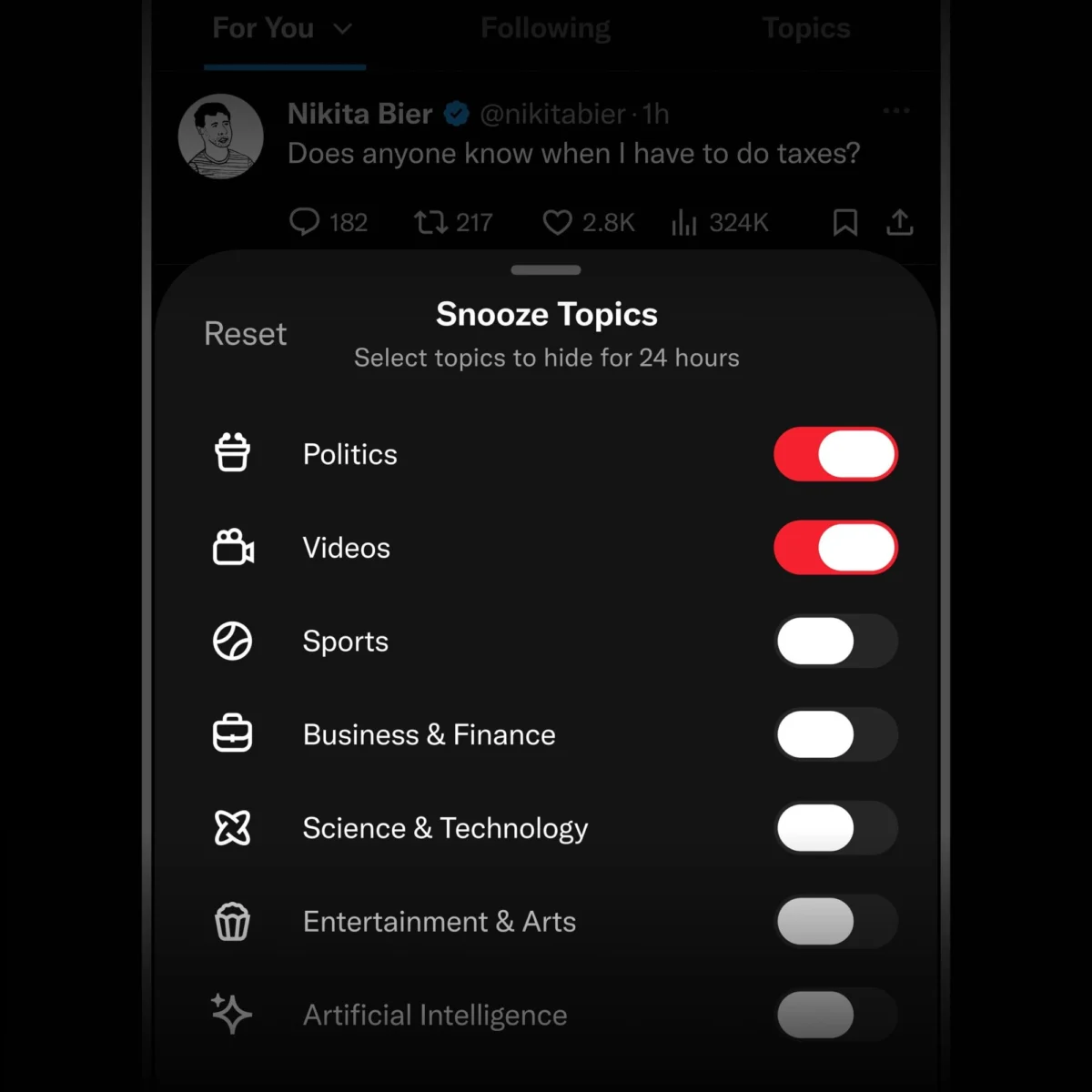
- The "Snooze" Integration: Alongside the custom feeds, X quietly deployed a "Snooze Topics" feature. This was a critical addition, as it allowed users to manage the "bleeding" effect—where unwanted or tangential topics invade a clean timeline.
- Community Feedback Loop: Within 48 hours of the release, the platform began receiving a deluge of user reports regarding content quality, edge-case limitations (such as religious topic filtering), and interface bugs.
- Immediate Iterations: In response to user concerns about gaps in category support (specifically regarding religious topics), the product team pledged to refine the categorization algorithms within a two-week timeframe.
Supporting Data: Capacity and Utility
The granularity provided by this update is substantial. Early adopters and power users, such as podcaster and creator Aakash Gupta, have noted that users can create up to 75 individual custom timelines. This is a massive expansion in utility for those who manage multiple personas or distinct professional interests.
The Implications for AI Training
The introduction of 75-timeline capacity is more than just a convenience for the end-user; it is a massive data-generation engine for xAI. By observing which topics users choose to aggregate and, more importantly, which content they reject or "snooze" within those custom feeds, the company is gathering high-fidelity data on human interest structures. This feedback loop allows the Grok model to improve its understanding of topical relevance, effectively using the user base to "train" the AI on what constitutes a high-quality, relevant feed.
Official Responses and Strategic Pivot
The rollout has not been without its friction points. The most notable official response came from Nikita Bier, who acted as the primary liaison between the development team and the community during the launch phase.

Addressing the "Religion" Gap
One of the most vocal critiques came from users attempting to create timelines around sensitive or specific cultural topics, such as Catholicism. Some users reported that the AI-driven categorization was not yet sufficiently nuanced to distinguish between relevant community discussions and lower-quality or irrelevant content. Bier’s response was characteristically transparent: he acknowledged that the feature was previously tested but removed due to quality concerns, promising that a more mature version would be available within a fortnight.
The Snooze Feature: A Crucial Counterbalance
The launch of the "Snooze Topics" feature is an admission that AI curation is rarely perfect. By giving users the ability to manually silence specific keywords or topics, X is effectively allowing users to "tune" their algorithmic feeds. This hybrid approach—AI-suggested content tempered by human-defined constraints—is the hallmark of the new X experience.
Implications: The Future of the "For You" Feed
What does this mean for the long-term health of the platform?
1. Fragmentation vs. Focus
For years, social media platforms have pushed a "monolithic" feed—a single, infinite scroll meant to hold the user’s attention at all costs. X’s move toward custom timelines signals a pivot toward "Modular Social Media." By allowing users to compartmentalize their experience, X is acknowledging that a power user’s interest in "Bitcoin" and "Global Politics" are fundamentally different consumption experiences that shouldn’t necessarily occupy the same space.
2. The "Bleeding" Problem
The skepticism voiced by early adopters, such as user @Hoxygo, highlights the biggest hurdle for the feature: boundary integrity. If a "Sports" timeline begins to show "Tech" news because the algorithm deems it popular, the value proposition of the custom feed evaporates. The "real test," as users have pointed out, is whether the platform can maintain strict topical boundaries. If the algorithm fails to respect these silos, the feature will quickly become redundant.
3. A Competitive Edge for Premium
By gating this feature behind a Premium subscription, X is attempting to solve its ongoing challenge of monetization. This is no longer just about blue checkmarks; it is about providing professional-grade tools that justify a monthly recurring expense. Whether or not this succeeds will depend on the maturity of the AI. As @syssignals noted, "I am still on my ‘For You’ timeline," suggesting that while the custom feature is an interesting experiment, it has yet to fully replace the core algorithmic experience that brought users to the platform in the first place.
Conclusion: A Work in Progress
The launch of Custom Timelines represents a bold, if early-stage, attempt to modernize the social media experience. By offloading the burden of curation to Grok, X is betting that users want more control over their digital environment.
However, the path forward is clear: the feature must move beyond its current "beta" feel. The success of this tool hinges on three pillars: the expansion of supported topics, the refinement of the AI to prevent "topic bleeding," and the seamless integration of these timelines across all hardware platforms.
As X continues to iterate, the community will be watching closely to see if this is a genuine evolution in how we consume information, or merely a temporary distraction from the platform’s core challenges. For now, the ability to split one’s feed into 75 distinct, Grok-powered streams is a significant, if imperfect, leap toward a more user-centric future. Whether the average user finds the effort of building these timelines worth the reward remains the definitive question of the coming months.











No comments yet. Be the first to join the conversation!