

In a significant move to reshape the user experience, the social media platform X (formerly Twitter) has officially rolled out a new custom timeline feature. This development marks a pivotal shift in how users consume information on the platform, moving away from the monolithic "For You" algorithm toward a more granular, interest-based architecture. By leveraging the advanced analytical capabilities of the xAI tool Grok, X is attempting to provide a hyper-personalized content delivery system that mirrors the utility of the platform’s legacy power-user tools, such as the rebranded X Pro (formerly TweetDeck).
As the rollout gains momentum among Premium subscribers on iOS, the tech community is closely monitoring how this integration of generative AI will affect user retention, content discovery, and the underlying data economy of the platform.
The Core Innovation: What Are Custom Timelines?
At its most fundamental level, the new custom timeline feature allows users to curate specific, algorithmically-generated feeds dedicated to niche topics. Unlike static lists, which typically require manual curation or rely on simple keyword filtering, these new timelines are "intelligent."
Powered by Grok, xAI’s sophisticated large language model, these feeds analyze the semantic meaning of every post on the platform. By assessing context, sentiment, and subject matter, the feature constructs a timeline that is uniquely tailored to the individual user’s preferences. As Nikita Bier, the Head of Product at X, noted, the system is designed to be self-optimizing: the more a user engages with a specific topic, the more precise the timeline becomes.
This represents a major departure from the traditional "For You" feed, which often suffers from "content bloat"—the tendency for unrelated viral content to crowd out niche interests. By isolating specific topics, X is effectively allowing users to build their own "mini-platforms" within the larger ecosystem.
Chronology of the Rollout and Development
The introduction of this feature was the result of a multi-month, high-intensity development cycle. The project, which has been under wraps for some time, represents one of the most significant engineering undertakings by X’s product team since the company’s acquisition by Elon Musk.
- The Development Phase: For several months, the X engineering team worked to integrate Grok’s backend with the platform’s real-time feed architecture. The objective was to move beyond simple keyword matching and toward true conceptual understanding of posts.
- The Official Announcement: Earlier this week, Nikita Bier confirmed the rollout in a post on X. The announcement was accompanied by a short video tutorial demonstrating the creation process, which emphasizes ease of use—a common criticism of previous "list" features.
- Current Status: As of this writing, the feature is available exclusively to X Premium subscribers on iOS. While this restricts the initial testing group, it serves as a powerful incentive for the platform’s subscription-based monetization strategy.
- The Roadmap Ahead: During the rollout, Bier addressed user questions regarding device and platform support, confirming that an Android version is currently in development and expected to arrive in the near future.
Implications for Data Training and AI Evolution
One of the most profound, if somewhat subtle, aspects of this update is the relationship between the feature and the training of Grok itself. As noted by podcaster Aakash Gupta, the ability for users to create up to 75 individual custom timelines creates a massive feedback loop for xAI.
A Data-Rich Environment
When users categorize their own interests into 75 distinct streams, they are essentially providing the AI with high-quality, human-labeled data. Every time a user interacts with a post within a specific custom timeline, they are signaling to the model exactly what content belongs under a particular subject heading. This creates a powerful training set that could significantly refine Grok’s ability to understand human intent and content taxonomy.
Algorithmic Precision
The shift from a general-purpose algorithm to a topic-specific algorithm is a milestone in the "personalization wars" between social media giants. By decentralizing the "For You" experience, X is essentially testing whether a collection of specialized feeds is more valuable to the user than one broad, catch-all feed. If successful, this could reduce the "doomscrolling" fatigue many users report, potentially increasing the total time spent on the platform.
Official Responses and User Interaction
The rollout has been characterized by a high degree of transparency from X’s leadership, particularly through Nikita Bier’s active engagement with the user base. This direct dialogue has been crucial in mitigating the confusion that typically accompanies such sweeping interface changes.

Addressing Feature Limitations
When users expressed frustration regarding missing categories—such as religion-specific feeds—Bier’s responses provided a clear view into the "quality control" aspect of the rollout. He explained that some categories had been omitted because they did not yet meet the platform’s standard for content quality. "We’re working on supporting religions in the next two weeks," Bier stated, highlighting that the platform is prioritizing the maturity of the algorithm over a hasty, low-quality launch.
The "Snooze" Integration
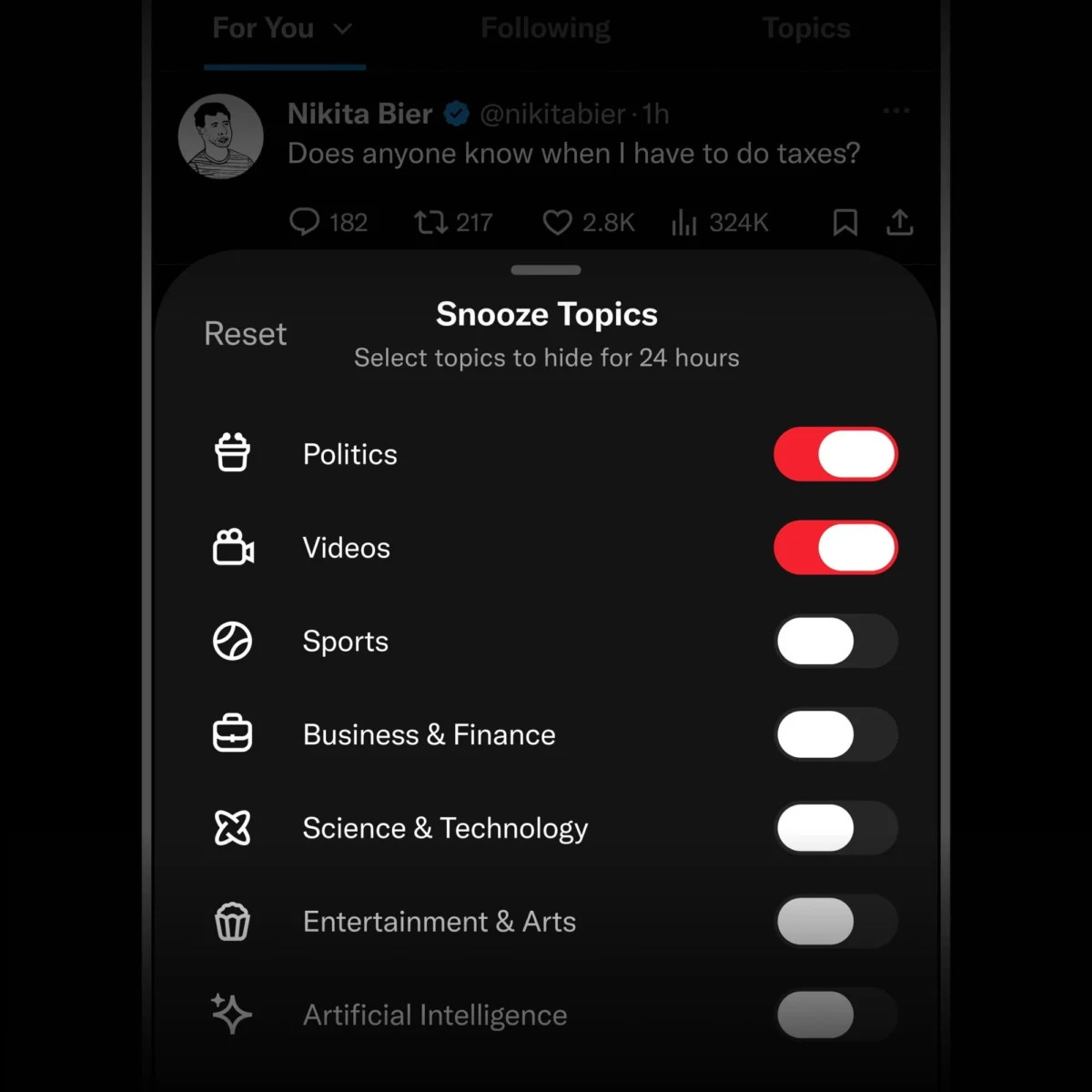
Recognizing that some users want to curate their feeds by subtraction rather than addition, X also launched a "Snooze Topics" feature. This allows users to mute specific subjects that they find intrusive. The simultaneous release of both "Custom Timelines" and "Snooze Topics" suggests a cohesive strategy: give users total control over what they see, whether through active curation or active filtering.
Early User Feedback: The Reality Check
While the technical reception has been largely positive, the real-world application has revealed both the potential and the limitations of the current iteration.
Positive Sentiment
Many power users have expressed relief at the ability to separate professional interests from personal ones. User @Hoxygo noted the utility of separating "tech from sports" without the need to maintain multiple, cumbersome accounts. This sentiment suggests that the feature is successfully addressing the fragmentation problem that has long plagued social media.
Skepticism and "Bleeding" Issues
However, the user experience is not yet perfect. Some early adopters have reported that the feeds still exhibit a degree of "bleeding," where the primary "For You" algorithm seems to influence the custom feeds, leading to repetitive content or the intrusion of unwanted topics. As @syssignals noted, "I saw overlapping in between AI, Software and Tech."
These reports suggest that the algorithm is still in a "learning" phase. The challenge for the X engineering team will be to enforce strict boundaries around these custom timelines so that they remain distinct from the platform’s broader, more chaotic content stream.
Conclusion: Is This the Future of Social Media?
The release of custom timelines powered by Grok marks a turning point for X. By shifting the power of algorithmic control into the hands of the user, the platform is attempting to solve the fundamental problem of modern social media: the loss of focus.
The success of this feature will ultimately depend on three factors:
- Algorithmic Maturity: The ability of Grok to distinguish between nuanced topics without "bleeding" content from one feed to another.
- User Adoption: Whether the average user finds the effort of setting up custom timelines to be worth the reward of a more focused experience.
- Cross-Platform Parity: The speed at which Android and Web users can access the feature to ensure a consistent experience across all devices.
As X continues to iterate on this feature, it is clear that the platform is betting on the idea that "intelligence" is the key to longevity. By turning every user into an editor of their own experience, X is not just changing its interface—it is attempting to redefine the relationship between the user, the algorithm, and the vast sea of data that constitutes the digital public square.
Whether these custom timelines mature into the power-user tool that users have been craving, or remain a experimental feature for the tech-savvy, remains to be seen. However, one thing is certain: the era of the one-size-fits-all timeline is rapidly coming to an end.











No comments yet. Be the first to join the conversation!