Ammar Sabilarrohman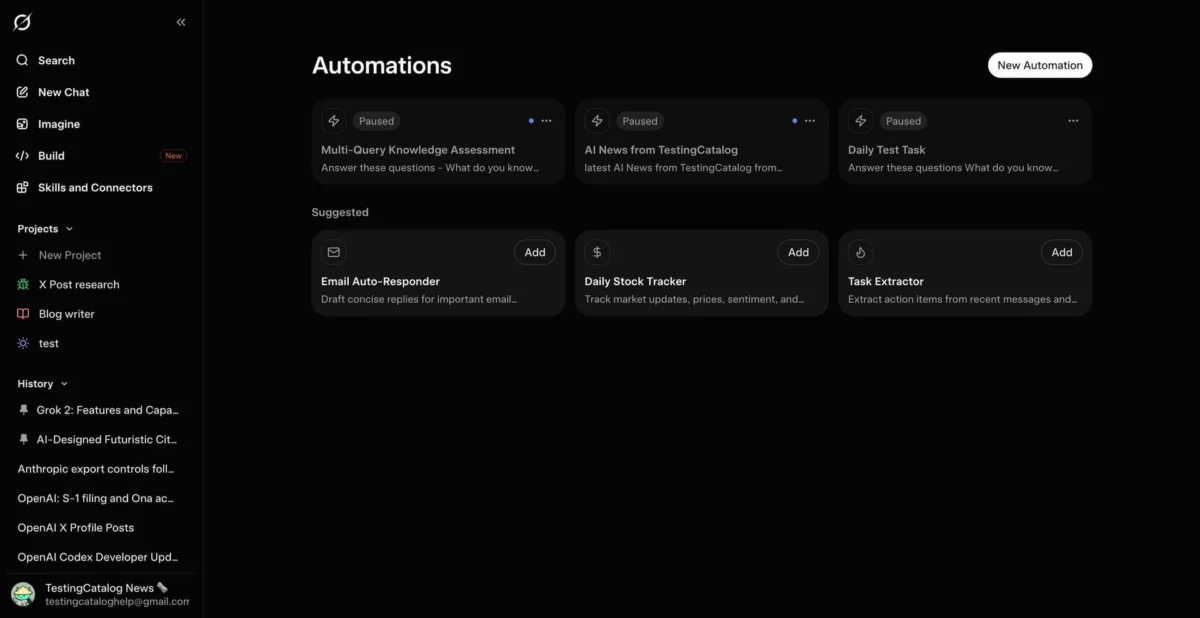
Despite the massive allocation of computational resources at xAI’s parent company, SpaceX, toward external partners—including high-profile collaborations with Google and Anthropic—the development of xAI’s flagship generative AI, Grok, remains a top priority. Recent discoveries within the application’s underlying code reveal that xAI is preparing a significant overhaul of its automation capabilities. This shift represents more than a mere feature update; it signals a transition toward a more modular, agentic, and user-defined AI experience that could reshape how enterprise and power users interact with large language models (LLMs).
The Core Transformation: From Simple Tasks to Complex Automations
For months, Grok users have utilized the "Tasks" feature to schedule basic interactions. However, intelligence discovered by TestingCatalog indicates that xAI is planning to sunset this rudimentary system in favor of a robust, comprehensive "Automations" suite. This new framework is designed to move beyond simple, time-based prompt execution, evolving into a sophisticated workflow manager.
At the heart of this evolution is the ability to maintain the existing functionality of time-based scheduling while layering in complex, conditional logic. Users will no longer be confined to static, repeating prompts. Instead, the new system aims to integrate "Grok Skills"—a feature introduced in mid-May—into an automated loop. These skills, which function as reusable packages of instructions, scripts, and data, will allow Grok to perform repetitive, multi-step tasks with high consistency. By tethering specific skills to automated schedules, xAI is effectively turning Grok into an autonomous agent capable of executing complex business processes without the need for manual oversight.
Chronology of Development: A Rapid Iteration Cycle
To understand the gravity of these changes, one must look at the velocity at which xAI has operated since its inception.
- Mid-2023: xAI is founded by Elon Musk with the goal of creating a "maximum truth-seeking AI."
- Late 2023: Grok is introduced to X (formerly Twitter) Premium+ subscribers, distinguishing itself with real-time access to the platform’s data stream.
- Early 2024: The "Tasks" feature is rolled out, allowing for basic, recurring prompts.
- May 2024: xAI introduces "Skills," allowing for the modularization of AI capabilities.
- Q3 2024: Reports emerge of massive supercomputer leasing to Google and Anthropic, sparking rumors that xAI’s internal progress is slowing.
- Present: Discovery of code strings indicating the transition from "Tasks" to a full-fledged "Automations" engine, refuting claims that Grok’s development has stagnated.
This rapid-fire release schedule suggests that xAI is not merely competing on the size of its models, but on the utility and accessibility of its interface. By iteratively improving the "how" of interaction, xAI is attempting to lock in a user base that prioritizes workflow efficiency.
The Strategic Importance of Model Selection
One of the most consequential changes hinted at in the latest updates is the shift toward "Model Choice." Historically, the Grok ecosystem has operated on a tiered system where an "Expert Mode" automatically routed complex requests to the most powerful underlying model. The new proposed architecture, however, appears to grant the user granular control over which model is utilized for specific automated workflows.
This is a strategic departure from the industry standard, where companies typically obfuscate the model versioning to ensure a "consistent" experience. By allowing users to choose the model based on the specific task, xAI is addressing three critical pain points:
- Cost Efficiency: Users can assign simple, repetitive tasks to smaller, lower-latency, and cheaper models.
- Performance Optimization: Complex analytical tasks can be reserved for the flagship, high-parameter models.
- Result Quality: Users gain the ability to troubleshoot their own automations by adjusting the underlying model if the output consistency is not meeting requirements.
This level of transparency and control is a major value proposition for professional users who find current "black box" AI services too unpredictable for enterprise deployment.
Supporting Data: Infrastructure and Market Positioning
The narrative that xAI is neglecting its own product because of its massive compute-sharing deals is, upon closer inspection, a misinterpretation of modern AI business models. While xAI is leasing significant capacity to competitors like Anthropic—reportedly worth nearly a billion dollars monthly in some contexts—this capital influx serves as a war chest for further infrastructure expansion.
The "Grok Build" desktop application, which has recently surfaced in various testing environments, acts as the primary hardware-software bridge. By diversifying its revenue streams through infrastructure leasing, xAI is effectively subsidizing the training and inference costs of its own ecosystem. The data suggests that xAI is building a vertically integrated stack:
- Compute: Managed via the massive Memphis cluster (the "Gigafactory of Compute").
- Distribution: Integrated directly into the X platform, providing a moat of real-time, proprietary data.
- Product: Now evolving from a chatbot into an agentic automation platform.
Implications for the AI Ecosystem
The introduction of an advanced automation suite has profound implications for the competitive landscape. As OpenAI (with its GPTs) and Anthropic (with its "Projects") push toward agentic workflows, xAI’s move to make its "Skills" system the centerpiece of its automations creates a distinct product identity.
1. The Death of the "Prompt Engineer"
By shifting to reusable "Skills," xAI is signaling that the era of manual, ad-hoc prompt engineering is coming to an end. In the new workflow, the "expert" is the individual who creates the initial skill package. Once refined, that skill becomes a modular asset that can be deployed across the organization or the user’s personal workflow indefinitely.

2. Enterprise Integration
For businesses, the ability to schedule and automate Grok-driven processes using specific models opens the door for real-time monitoring of social sentiment, automated content generation for marketing, and complex internal data analysis—all without the need for custom API development in the early stages.
3. The "Grok Build" Desktop Factor
The uncertainty surrounding the "Grok Build" application is a key point of interest. If xAI successfully integrates these automations into a native desktop application, it would move Grok from a web-browser novelty to a permanent fixture in the user’s operating system. This would allow for local file access and system-level automation, potentially outperforming web-only competitors.
Official Stance and Future Outlook
While xAI has maintained its characteristic silence regarding specific release dates, the company’s recent trajectory suggests that these features are nearing the testing phase. Musk’s philosophy, which often prioritizes rapid deployment and iterative feedback loops, suggests that we may see a public beta of these automation features before the end of the year.
The "How" remains the most intriguing question. Whether the automation dashboard will be a side-panel in the existing web interface or a dedicated window within the "Grok Build" desktop client will determine how easily everyday users adopt these new powers. If xAI manages to lower the barrier to entry for setting up these automated skills, they could capture a significant portion of the "power user" demographic currently served by more complex, less accessible tools like Zapier or custom LangChain implementations.
Conclusion
The evolution of Grok from a conversation-focused chatbot to a sophisticated automation engine underscores a critical trend in the AI industry: the transition from "what can the AI say?" to "what can the AI do?" By layering programmable skills and model-selection transparency over its robust computational foundation, xAI is positioning itself to be more than just another LLM provider. It is positioning itself as an essential operating layer for the next generation of digital work. While the competition for raw compute power remains fierce, the true battle in the coming year will be fought in the interface—and xAI is clearly preparing for that war.


 Nana Muazin
 Nana Wu