

As the temperate breeze of spring settles over the Kanto Plain, the allure of the outdoors becomes impossible for Tokyo residents to ignore. While the legendary Mt. Fuji remains inaccessible to the general public until its official climbing season commences in mid-summer, a closer, more manageable, and culturally rich alternative stands ready for those seeking an alpine escape: Mt. Tsukuba.
![Let’s hike a Japanese mountain (that isn’t Mt. Fuji) – Mt. Tsukuba[Photos]](https://soranews24.com/wp-content/uploads/sites/3/2026/05/mt-0.jpg?w=1000&h=525&crop=1)
Located in the heart of Ibaraki Prefecture, Mt. Tsukuba (877 meters) provides a quintessential Japanese hiking experience without the logistical nightmare or physical toll of a high-altitude expedition. Whether you are an experienced alpinist looking for a quick leg-stretcher or a family seeking an introductory hike, Mt. Tsukuba offers a customizable adventure that fits perfectly into a single day.
![Let’s hike a Japanese mountain (that isn’t Mt. Fuji) – Mt. Tsukuba[Photos]](https://soranews24.com/wp-content/uploads/sites/3/2026/05/mt-1.jpg?w=640)
The Geography and Significance of Mt. Tsukuba
Mt. Tsukuba is a dual-peaked mountain, consisting of the 877-meter Nyotaisan (Female Peak) and the 871-meter Nantaisan (Male Peak). This unique formation creates a geological and spiritual centerpiece for the region. Historically, the mountain has served as a site of profound religious significance, home to the Tsukubasan Shrine and various rock formations that folklore claims were once used by the gods to divide the world.
![Let’s hike a Japanese mountain (that isn’t Mt. Fuji) – Mt. Tsukuba[Photos]](https://soranews24.com/wp-content/uploads/sites/3/2026/05/mt-2.jpg?w=640)
For the modern traveler, the mountain serves as a perfect microcosm of Japanese topography. It features a diverse range of terrain, from well-maintained, paved steps to rugged, root-strewn forest trails and high-altitude rocky scrambles that offer panoramic views of the surrounding countryside.
![Let’s hike a Japanese mountain (that isn’t Mt. Fuji) – Mt. Tsukuba[Photos]](https://soranews24.com/wp-content/uploads/sites/3/2026/05/mt-3.jpg?w=640)
A Chronological Account of a Family Ascent
To understand the accessibility of the mountain, one must look at the recent journey of our reporter, Natsuno Futon, who took on the challenging "Otatsuishi Trail" with two elementary school-aged children.
![Let’s hike a Japanese mountain (that isn’t Mt. Fuji) – Mt. Tsukuba[Photos]](https://soranews24.com/wp-content/uploads/sites/3/2026/05/mt-4.jpg?w=640)
11:40 a.m. – The Starting Point
The journey began at the Tsutsujigaoka Parking Area. At an altitude of approximately 500 meters, hikers are granted an immediate advantage, skipping the grueling base-level elevation gain. The proximity of the trailhead to Tokyo—accessible via a combination of the Tsukuba Express train and regional shuttle buses—means travelers can reach the mountain in roughly two hours from central Tokyo.
![Let’s hike a Japanese mountain (that isn’t Mt. Fuji) – Mt. Tsukuba[Photos]](https://soranews24.com/wp-content/uploads/sites/3/2026/05/mt-5.jpg?w=640)
11:45 a.m. to 12:30 p.m. – The Transition
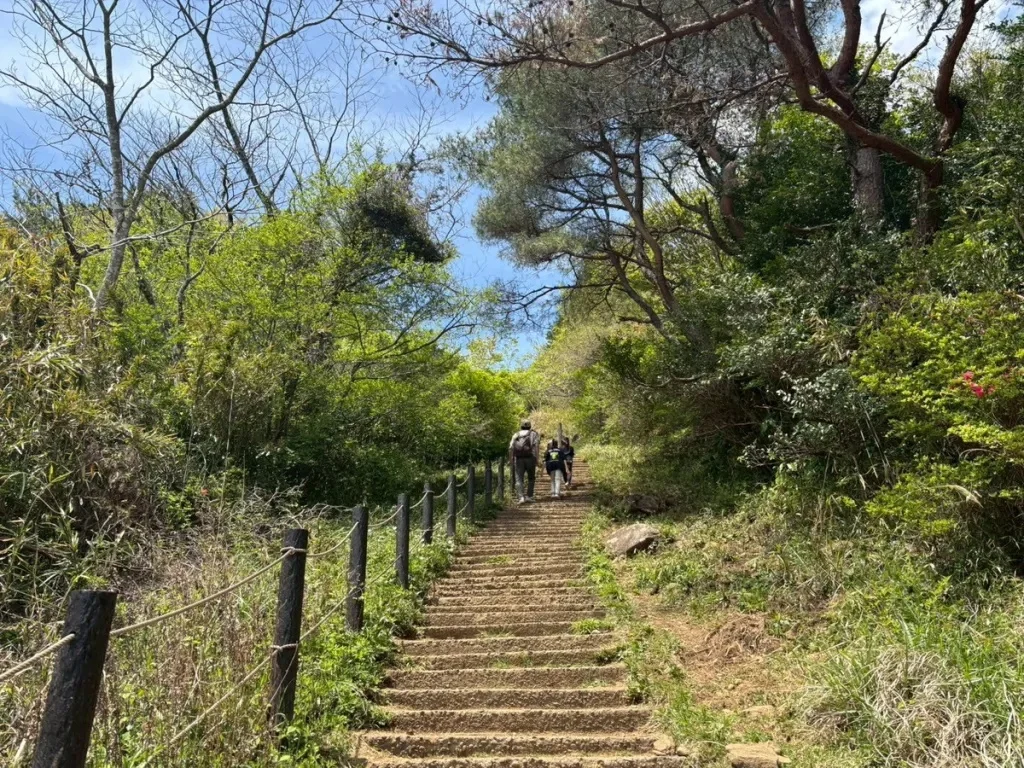
The initial section of the Otatsuishi Trail is deceptive; it begins as a series of comfortable, paved stone steps. Within five minutes, hikers are treated to expansive vistas. However, by the 15-minute mark, the pavement gives way to a genuine forest trail. As with any mountain, fitness levels vary; for younger children, this is the point where the first fatigue sets in, necessitating short, strategic breaks.
![Let’s hike a Japanese mountain (that isn’t Mt. Fuji) – Mt. Tsukuba[Photos]](https://soranews24.com/wp-content/uploads/sites/3/2026/05/mt-6.jpg?w=640)
12:30 p.m. to 1:24 p.m. – The Ascent and the "Obstacle Course"
The trail soon enters a more demanding phase. Hikers must navigate sections characterized by exposed tree roots and significant rocky outcrops. This terrain is not merely a path but an obstacle course that requires focus and proper footwear. At 12:30 p.m., the group reached the site of the former Benkei Chaya, a historical teahouse location that now serves as a vital rest stop.
![Let’s hike a Japanese mountain (that isn’t Mt. Fuji) – Mt. Tsukuba[Photos]](https://soranews24.com/wp-content/uploads/sites/3/2026/05/mt-7.jpg?w=640)
As the trail approaches the summit, it passes by sites of mythic importance:
![Let’s hike a Japanese mountain (that isn’t Mt. Fuji) – Mt. Tsukuba[Photos]](https://soranews24.com/wp-content/uploads/sites/3/2026/05/mt-8.jpg?w=640)
- Benkei Nanamodori: A narrow passage formed by a boulder wedged between two others, historically considered a threshold between the divine and human realms.
- Takamagahara: A sacred area housing a shrine to the sun goddess Amaterasu.
- Kuniwari Ishi: The "Kingdom-splitting Rock," where legend suggests the gods drew borders for their domains.
- Debune Irebuni: Rock formations resembling ships, serving as a site of worship for maritime safety.
The final ascent tested the group’s endurance, with the trail narrowing significantly. While traffic congestion near the peak is common on holidays, the group navigated the final, rock-strewn path to reach the summit of Nyotaisan at 1:24 p.m., completing the climb in one hour and 40 minutes.
![Let’s hike a Japanese mountain (that isn’t Mt. Fuji) – Mt. Tsukuba[Photos]](https://soranews24.com/wp-content/uploads/sites/3/2026/05/mt-9.jpg?w=640)
Supporting Data: Logistics and Customization
The beauty of Mt. Tsukuba lies in its "pick-your-own-adventure" nature. While the Otatsuishi Trail is a popular choice, the mountain offers a network of paths that vary in difficulty and duration.
![Let’s hike a Japanese mountain (that isn’t Mt. Fuji) – Mt. Tsukuba[Photos]](https://soranews24.com/wp-content/uploads/sites/3/2026/05/mt-10.jpg?w=640)
Transit Data
- Train Access: Tsukuba Express from Akihabara to TX Tsukuba Station (45 minutes).
- Bus Connection: Shuttle buses from TX Tsukuba Station to Tsutsujigaoka (approx. 50 minutes).
- Driving: Direct access to the Tsutsujigaoka Parking Area is available, though parking lots can fill quickly on weekends and public holidays.
Trail Data
- The Ascent: An adult hiker can complete the Otatsuishi Trail in as little as 40 minutes.
- The Descent: For those with tired legs, the ropeway provides a seamless 10-minute descent back to the parking area, operating between 9:20 a.m. and 5:00 p.m.
- Inter-peak travel: The two peaks are connected by a trail that takes approximately 35 minutes to traverse on foot, allowing hikers to experience both summits in one trip.
Official Guidance and Safety
Local authorities and park management emphasize that despite the mountain’s "beginner-friendly" reputation, it remains an alpine environment. The following safety protocols are advised:
![Let’s hike a Japanese mountain (that isn’t Mt. Fuji) – Mt. Tsukuba[Photos]](https://soranews24.com/wp-content/uploads/sites/3/2026/05/mt-11.jpg?w=640)
- Footwear: Sturdy hiking boots are essential. Even on well-marked paths, the rocky nature of the terrain can lead to ankle injuries.
- Weather Awareness: Temperatures at the 877-meter summit are significantly lower than in the valley. Layers are highly recommended.
- Supplies: While there are vending machines and snack stalls at the base and some rest areas, hikers are strongly encouraged to bring sufficient water and high-energy food, as mountain prices and availability can fluctuate.
- Peak Congestion: During peak holiday seasons, the final approach to the summits can become bottle-necked. Hikers should budget for potential delays and maintain patience, as the final rocky sections require single-file movement.
Implications for Tourism and Recreation
The success of a casual hiker, such as our reporter, highlights a shift in Japanese recreational trends. There is an increasing demand for "micro-adventures"—trips that provide a sense of wilderness and accomplishment without requiring professional-grade gear or multi-day commitments.
![Let’s hike a Japanese mountain (that isn’t Mt. Fuji) – Mt. Tsukuba[Photos]](https://soranews24.com/wp-content/uploads/sites/3/2026/05/mt-12.jpg?w=640)
Mt. Tsukuba serves as an ideal training ground for those who might eventually wish to tackle larger peaks, such as Mt. Fuji or the Japan Alps. By integrating history, moderate physical exertion, and efficient infrastructure (like the ropeway), the mountain remains a sustainable model for outdoor tourism in the Kanto region.
![Let’s hike a Japanese mountain (that isn’t Mt. Fuji) – Mt. Tsukuba[Photos]](https://soranews24.com/wp-content/uploads/sites/3/2026/05/mt-13.jpg?w=640)
For the urbanite, the mountain offers more than just a view; it offers a necessary reprieve from the concrete density of Tokyo. Whether you choose to descend on foot to keep your heart rate up or take the ropeway to enjoy the scenery while snacking on local delicacies like age-manju or meat-wrapped rice balls, Mt. Tsukuba stands as a testament to the fact that you do not need to travel far to find the sublime.
![Let’s hike a Japanese mountain (that isn’t Mt. Fuji) – Mt. Tsukuba[Photos]](https://soranews24.com/wp-content/uploads/sites/3/2026/05/mt-14.jpg?w=640)
For real-time updates on trail conditions and ropeway operating hours, visitors are encouraged to consult the official Mt. Tsukuba website before departure.












No comments yet. Be the first to join the conversation!