


You likely pride yourself on your agency’s efficiency. You have mastered the art of campaign strategy, you keep a pulse on emerging trends, and your creative output is top-tier. Yet, there is a silent, creeping tax on your business that rarely appears on a balance sheet. It’s the "Approval Tax"—the hours your team spends playing digital tag, chasing feedback, and reconciling fragmented notes across email, Slack, and WhatsApp.
If you haven’t billed a client for the hour you spent hunting down their approval on a Tuesday, you aren’t alone. But perhaps you should be. This article explores the hidden reality of agency operations, the staggering cost of inefficient workflows, and how the industry is finally moving toward a more sustainable, automated future.
The Anatomy of an Approval Bottleneck: A Case Study in Friction
Imagine the scenario: It’s Monday. Your team has finalized a batch of high-quality content for three separate clients. You hit "send," expecting a quick turnaround. By Wednesday, two clients have gone silent. One client offers a vague approval via WhatsApp but neglects to mention they have a specific tweak for the caption, which they send separately via email. Another client leaves a comment in a Google Doc, but because they didn’t tag you, the notification is buried in a sea of other alerts.
By Thursday, the content intended for a Wednesday launch is still languishing in draft status. You send your third follow-up of the week. This isn’t just a "client management" headache; it is a structural failure.

The Chronology of a Failed Workflow
To understand why this is a systemic issue, one must look at the typical lifespan of an approval cycle:
- The Handoff (0–8 minutes): The initial composition of the email or message to the client.
- The Waiting Period (Variable): The silent, non-productive phase where work sits idle.
- The Follow-Up (10–15 minutes): The "checking in" phase, which often involves multiple touchpoints.
- The Reconciliation (10–15 minutes): Manually aggregating feedback from Slack, email, and native document comments.
- The Final Confirmation (5–10 minutes): Verifying that the correct version is ready for publish.
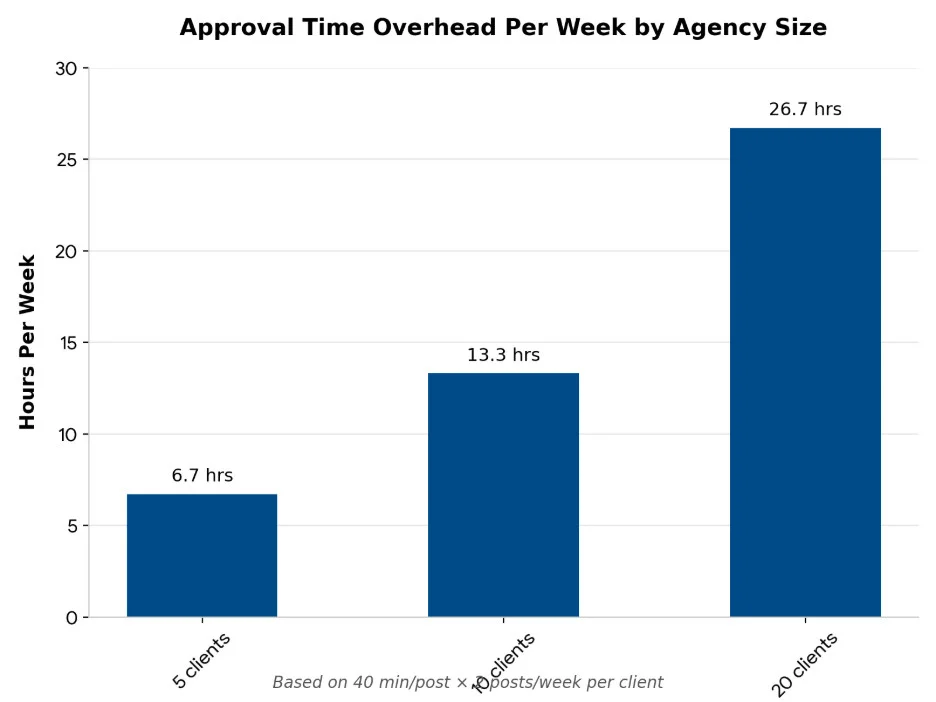
In total, this sequence consumes approximately 35 to 45 minutes of non-billable labor per post. When extrapolated across a client roster, the math becomes startling. On average, a social media post takes eight days to travel from submission to approval. This delay is rarely due to client incompetence; it is a consequence of an unmanaged, fragmented process.
Supporting Data: The Scale of the Crisis
The problem of "work about work" is well-documented, yet few agencies treat it as a critical business risk. According to a landmark survey by Ziflow, which polled over 500 marketing professionals, 80% of marketers report frequent delays in feedback loops. Perhaps most damning is the statistic that creative teams spend a mere 19% of their working hours actually creating. The remaining 81% is consumed by administrative friction.
The "Work About Work" Phenomenon
Asana’s "Anatomy of Work" report, which surveyed over 10,000 knowledge workers globally, highlights a disturbing trend: the average professional spends 60% of their day on coordination—status updates, chasing information, and managing task logistics—rather than the skilled work they were hired to perform.
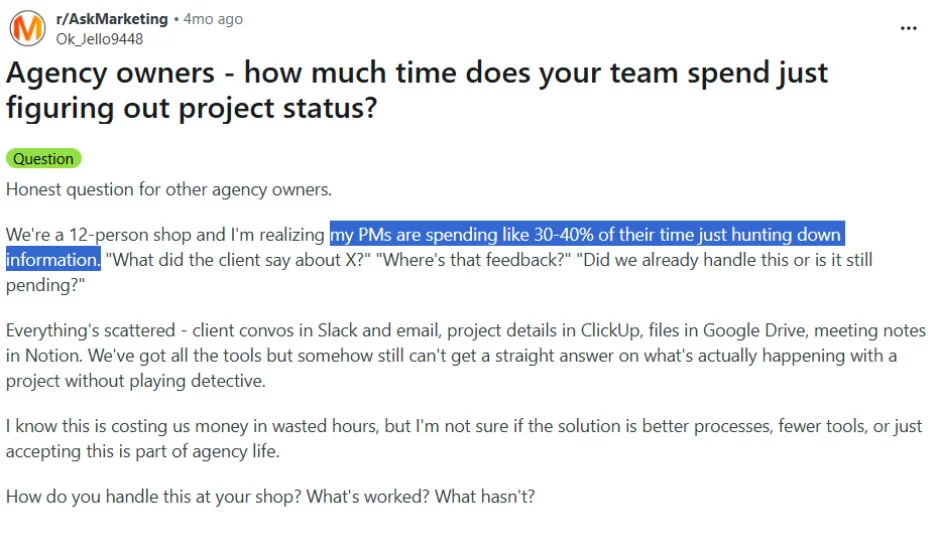
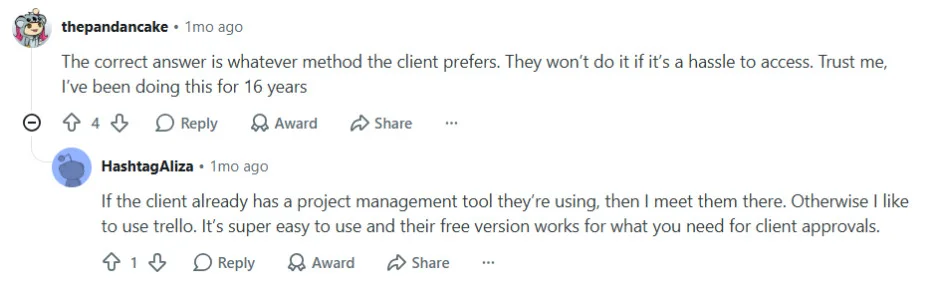
On platforms like Reddit, agency owners have been increasingly vocal about this "invisible overhead." Threads in communities like r/AskMarketing and r/SocialMediaManagers consistently reveal that teams are allocating 30–40% of their total capacity to chasing approvals. When you aggregate this across a mid-sized agency with 20 clients and two posts per week per client, the time lost is equivalent to having a full-time employee dedicated exclusively to administration, with no creative output to show for it.
The Financial Implications: Calculating the "Approval Tax"
The approval tax remains hidden because it is rarely tracked. Agencies lump it into "account management" and treat it as the "cost of doing business." However, by applying a simple formula, the financial drain becomes impossible to ignore:
The Formula:
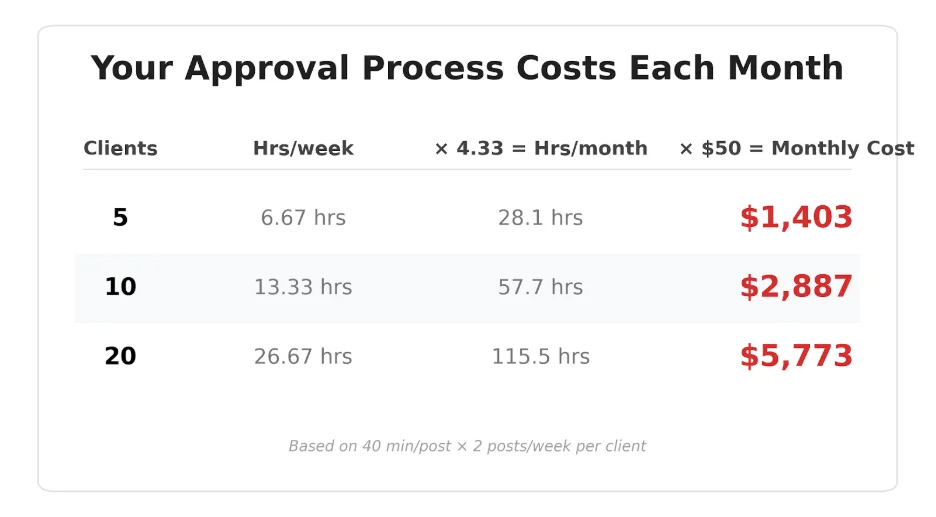
(Average minutes per post ÷ 60) × Posts in approval per week × 4.33 weeks × Hourly rate × Number of clients = Monthly Approval Cost.
If we assume a conservative internal rate of $50 per hour and 40 minutes spent per post, the costs compound rapidly:
- For 5 Clients: ~$433/month in lost productivity.
- For 10 Clients: ~$866/month in lost productivity.
- For 20 Clients: Over $1,700/month in lost potential.
These figures represent pure profit erosion. When you factor in the opportunity cost—what those hours could have generated if spent on billable strategy or business development—the true impact is significantly higher.
Beyond the Balance Sheet: Morale and Retention
The cost of inefficient workflows extends beyond dollars and cents. It infiltrates the culture and creative output of the agency.
1. The Death of Creative Ambition
When creators operate under the assumption that every post will take over a week to approve, their creative process changes. They stop pitching high-risk, high-reward, or trend-focused content because they know the "approval cycle" will kill the momentum. The creative spirit becomes stifled by the bureaucracy of the feedback loop.
2. The Burnout Epidemic
According to the Chartered Institute of Marketing, 56% of marketers cite burnout as a primary concern. Approval loops are consistently identified as a root cause. When employees are forced to act as "follow-up machines" rather than strategic thinkers, their engagement wanes. By the time an agency owner notices the team is "feeling flat," the process has likely been eroding morale for months.
3. Client Satisfaction
Late launches, missed trends, and fragmented communication ultimately damage the agency-client relationship. Clients may not know why a project is delayed, but they feel the inconsistency. This leads to churn, which is far more expensive to mitigate than the cost of implementing a better workflow.
Why Conventional Fixes Fail
Agencies often attempt to patch these holes with "quick fixes" that inevitably fall short:
- The Spreadsheet Method: While using a Google Sheet or Notion page centralizes data, it does nothing to fix the pressure of the process. The client still ignores the request, and the agency is still stuck sending the same manual follow-up emails.
- The Strict Email Template: Enforcing "reply-by" dates in email subjects works for about a month. Eventually, a key client misses a deadline, the agency makes an exception, and the entire system collapses back into disarray.
These methods fail because they rely on human accountability rather than systemic accountability. They don’t change the behavior; they only change the container in which the behavior happens.
The Path Forward: Moving Toward Systemic Accountability
To reclaim these lost hours, agencies must move from a model of "manual coordination" to "systemic pressure." The goal is to remove the agency from the follow-up loop entirely.
Five Pillars of a Modern Approval System:
- Direct Access: Clients must have a "magic link" to their pending content, removing login barriers and the "where do I find this?" friction.
- Defined Windows: Establish a non-negotiable 48-hour response window at the point of onboarding.
- Automated Reminders: Use software to trigger follow-ups. When the system sends the reminder, it removes the personal friction between the account manager and the client.
- The "Single Source of Truth": Eliminate fragmented feedback. If it isn’t in the portal, it doesn’t count.
- The Auto-Approve Safety Net: Implement an "auto-approve" feature for posts that remain untouched. This forces the client to engage, as the stakes are clear: if they don’t provide feedback, the content goes live.
Industry Implications and Technology Integration
Modern scheduling and management platforms, such as SocialPilot, have begun to bake these workflows directly into their architecture. Unlike legacy tools that treated approvals as an afterthought, these platforms are designed for the high-volume, multi-client reality of the modern agency.
By utilizing features like "Approvals On-The-Go," which allows for link-based, login-free reviews, and "Auto-Approve Toggles," agencies are seeing dramatic results. One notable case study, documented by HeyOrca, reported that a single agency saved 60 hours and approximately $4,000 in its first month after centralizing its approval workflow.
Conclusion: Stop Paying for a Problem You Created
The "Approval Tax" is not an inevitable expense of doing business. It is a symptom of a process that has failed to scale. When you have 10, 20, or 50 clients, your process must evolve from personal follow-ups to automated systems.
The math is clear: every hour spent chasing a status update is an hour stolen from your agency’s growth. By implementing a system that mandates client accountability and leverages automation, you aren’t just saving time—you are reclaiming your agency’s potential to create, innovate, and thrive. The fix isn’t a total overhaul; it is a strategic shift toward tools that allow your team to do what they were hired for: producing world-class work.











No comments yet. Be the first to join the conversation!