

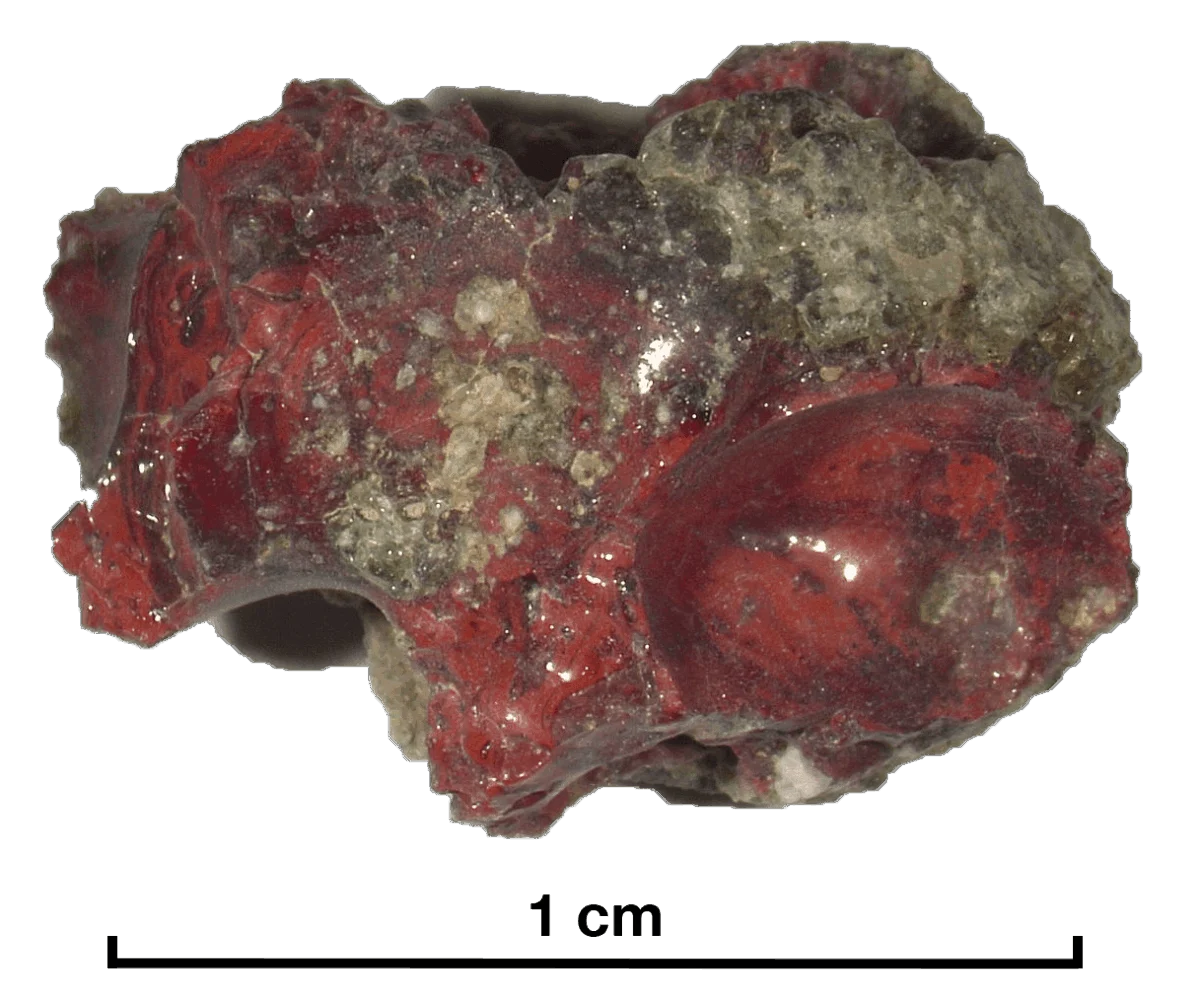
On July 16, 1945, at 5:29 a.m. local time, the Jornada del Muerto desert in New Mexico was transformed into a landscape of unimaginable violence. As the “Gadget”—the world’s first atomic device—detonated, it unleashed a thermal pulse equivalent to 21 kilotons of TNT. In that microsecond of unprecedented fury, the heat liquefied the desert sand, fusing it into a radioactive, jade-green glass known as trinitite.
For decades, trinitite was viewed primarily as a grim souvenir of the dawn of the nuclear age. However, a groundbreaking discovery by an international research team, led by geologist Luca Bindi of the University of Florence, has revealed that the desert glass holds secrets far more complex than previously imagined. Deep within the matrix of this scorched earth, scientists have identified a novel clathrate—a material composed of calcium, copper, and silicon—that has never been observed in nature or synthesized in a laboratory.
This discovery challenges our fundamental understanding of materials science and suggests that the most destructive human-made events may act as unintentional, high-energy "natural laboratories" for the creation of exotic matter.
The Anatomy of an Accidental Discovery
The identification of this new clathrate was not a sudden stroke of luck, but the culmination of rigorous, multi-year analysis. The research team, specializing in the crystallography of rare materials, focused their attention on "red trinitite"—a specific variety of the glass that contains rare metallic inclusions.
Using advanced analytical techniques, including high-resolution X-ray diffraction, the team scrutinized microscopic copper-rich metal droplets embedded within the silicate glass. It was here that they identified a "type I clathrate." Clathrates are crystalline structures defined by a cage-like atomic lattice that can physically trap other atoms or molecules within their voids. These "cages" grant the host material unique chemical and physical properties that are highly prized in modern technology.
The structure identified by Bindi’s team—a synthesis of calcium, copper, and silicon—defies traditional thermodynamic expectations. Under standard laboratory conditions, the chemical bonding required to organize these specific elements into a stable clathrate is either energetically unfavorable or outright impossible. Yet, the extreme environment of the Trinity detonation provided the exact, fleeting conditions required to force these elements into a new, stable configuration.
Chronology of the Atomic Aftermath
To understand the magnitude of this discovery, one must look at the timeline of the Trinity site and the subsequent development of material science.
- July 16, 1945: The Trinity test occurs. The intense thermal radiation, estimated at several thousand degrees Celsius, vaporizes desert sand and metallic components of the test apparatus, creating trinitite.
- 1945–2010s: Trinitite is collected and studied primarily for its radioactive content and its role in confirming the yields of the first atomic bomb. It is categorized into "green" (common) and "red" (rare, metal-rich) varieties.
- 2021: A team led by Luca Bindi identifies a silicon-rich quasicrystal in red trinitite—a discovery that made international headlines for demonstrating that quasicrystals could be formed in non-meteoritic, terrestrial explosions.
- 2024: Following further analysis of the same samples, Bindi’s team confirms the presence of the calcium-copper-silicon clathrate, marking the second "impossible" material discovered within the remnants of the 1945 blast.
Supporting Data: The Physics of the "Cage"
Clathrates are at the vanguard of modern materials engineering. By trapping "guest" atoms inside the "host" cage, scientists can manipulate the electronic and thermal conductivity of the material.
The specific clathrate discovered in the Trinity glass is a type I, which typically features a 46-atom unit cell. The inclusion of copper within the silicon-calcium framework is particularly striking. In standard semiconductors, copper is often considered a contaminant that degrades performance; however, in this clathrate structure, the copper is integrated into the very scaffolding of the cage.
The research suggests that the rapid "quench" of the molten material—the near-instantaneous cooling from thousands of degrees to ambient temperature—effectively "froze" the atoms in this high-energy configuration. This process, often referred to as "shock-induced synthesis," allows for the creation of metastable states that would otherwise decay or fail to form under slower, more controlled manufacturing processes.
Scientific Perspectives and Implications
The discovery has sent ripples through the geological and materials science communities. If nuclear explosions can forge materials that we cannot replicate, what else have we missed?
Natural Laboratories
The term "natural laboratory" has been adopted by the research team to describe environments that provide extreme pressure and temperature profiles. These include:
- Nuclear Detonations: Providing rapid, high-energy plasma environments.
- Lightning Strikes (Fulgurites): Creating intense electrical pathways through geological media.
- Meteoritic Impacts: Delivering colossal shock pressures that rearrange crystal lattices in an instant.
The Quasicrystal Connection
The fact that this clathrate was found alongside a silicon-rich quasicrystal is significant. Quasicrystals possess aperiodic, non-repeating structures that defy the classical definition of a crystal. As Bindi noted in his earlier research, these structures create symmetries that lead to "amazing physical properties" that are difficult to predict. The presence of both a quasicrystal and a clathrate suggests that the Trinity test site is a unique mineralogical archive, perhaps containing a plethora of other as-yet-undiscovered phases.
Future Technological Applications
While the material was formed in a dark chapter of human history, its potential applications are forward-looking. Scientists are currently investigating how to replicate the conditions of the Trinity explosion to produce these materials on a larger scale.
- Energy Conversion: Clathrates are prime candidates for high-efficiency thermoelectric materials, which convert waste heat directly into electricity. A stable, copper-silicon clathrate could significantly improve the efficiency of industrial heat recovery.
- Next-Generation Semiconductors: The unique cage structure allows for the "tuning" of electronic bandgaps, potentially leading to faster and more energy-efficient microchips.
- Gas Storage: Because of their cage-like architecture, some clathrates are exceptionally effective at storing gases, including hydrogen, which is vital for the transition to a green-energy economy.
A Legacy of Destruction and Creation
The discovery of this new material invites a profound philosophical reflection. The Trinity test was designed to produce death and destruction, yet it simultaneously birthed a physical structure that may one day contribute to the advancement of human technology.
Critics and ethicists argue that we must be cautious when treating the site of a nuclear disaster as a "treasure trove." The radioactivity of trinitite serves as a permanent reminder of the human cost of the atomic bomb. Nevertheless, the scientific consensus is clear: the history of our planet—and our impact upon it—is etched into the very atomic structure of the materials we create.
As Luca Bindi and his team continue their work, the international community watches with keen interest. By understanding the "why" and "how" of this clathrate’s formation, we are not only learning about the past but also opening a window into the future of materials science.
The Trinity test, once a symbol of the end of an era, has become a bridge to a new frontier. In the silent, fused glass of the New Mexico desert, the atoms tell a story of destruction, yes—but also one of the strange, resilient, and beautiful ways that nature and humanity interact when pushed to the absolute limits of existence. We are only just beginning to read the fine print of that story.












No comments yet. Be the first to join the conversation!