Muslim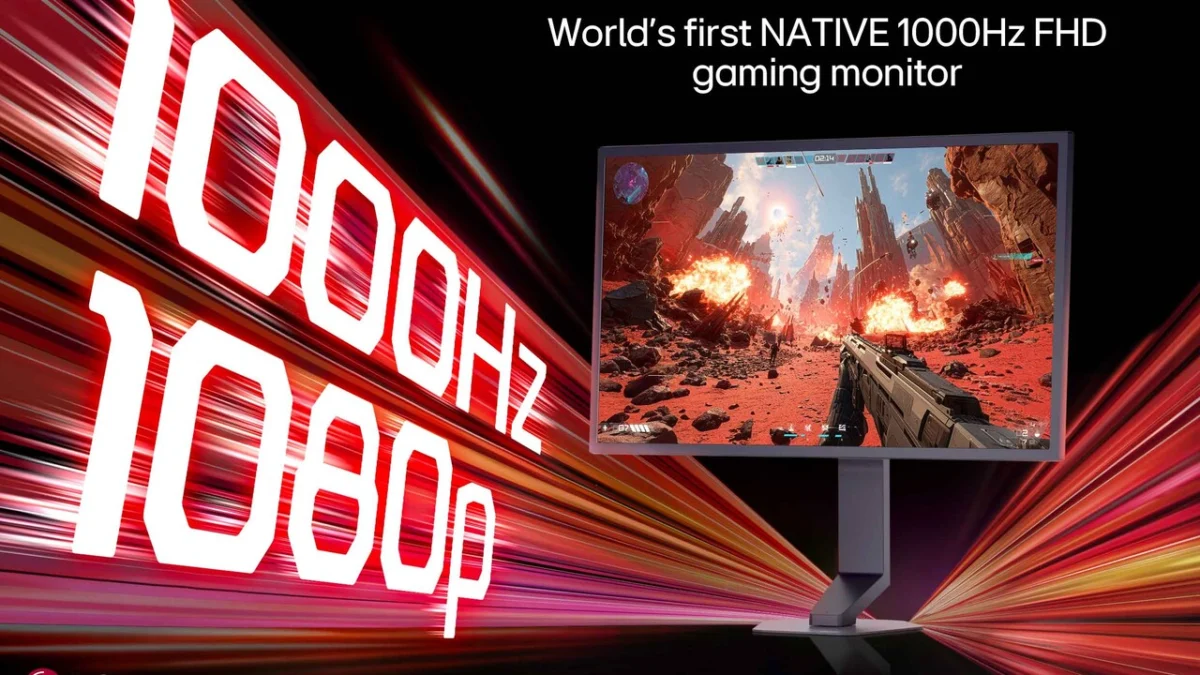
In the rapidly evolving landscape of high-performance gaming hardware, the pursuit of fluid motion has long been the primary objective for competitive eSports players. For years, the industry has pushed the boundaries of refresh rates, moving from the standard 60Hz to 144Hz, then 240Hz, and eventually reaching the 500Hz threshold. However, LG Electronics has now shattered the current ceiling, announcing the UltraGear 25G590B, the world’s first gaming monitor to deliver a native 1,000Hz refresh rate at a full 1080p resolution.
While competitors like AOC and Acer have flirted with the 1,000Hz milestone, their implementations have relied on "Dual-Mode" technology—a compromise that forces users to drop their resolution to 720p to reach that extreme frame throughput. LG’s new flagship represents a paradigm shift: pure, native 1,000Hz performance at 1,920 x 1,080 pixels, signaling a new frontier for professional gaming.
The Technical Breakthrough: Native 1,000Hz Performance
The core appeal of the UltraGear 25G590B lies in its defiance of the "Dual-Mode" compromise. In the current market, high-end monitors like the Acer Predator XB273U F6 provide impressive 500Hz+ speeds, but achieving the 1,000Hz mark requires a drastic reduction in pixel density. LG has bypassed this limitation, ensuring that the 1,000Hz experience is delivered at the monitor’s native Full HD resolution.
Why 1,000Hz Matters
For the average user, the jump from 144Hz to 240Hz is noticeable; the jump to 1,000Hz is, for most, imperceptible. However, in the realm of professional eSports—where milliseconds equate to victory or defeat—this technology is designed to eliminate even the slightest trace of motion blur.
LG’s "Motion Blur Reduction Pro" technology works in tandem with the 1,000Hz panel to ensure that, even during high-velocity camera pans or rapid character movement, in-game menus, UI elements, and fast-moving objects remain razor-sharp. By updating the display 1,000 times per second, the latency between a mouse click and the corresponding visual confirmation on screen is pushed to a theoretical minimum.
Chronology of the High-Refresh Race
The road to 1,000Hz has been a gradual, intense technological arms race between the industry’s largest display manufacturers.
- The Early 2020s: 144Hz became the standard for competitive gaming, with 240Hz established as the "pro-tier" benchmark.
- The 500Hz Milestone: Manufacturers like ASUS, Acer, and Alienware began breaking the 500Hz barrier, utilizing TN and specialized IPS panels to push the boundaries of liquid crystal response times.
- The "Dual-Mode" Era (2025): Brands introduced monitors capable of switching between 4K/240Hz and 1080p/480Hz or 1440p/500Hz and 720p/1,000Hz. This allowed for versatility, but sacrificed fidelity for speed.
- The April 2026 Shift: Microsoft officially updated Windows 11 to support 1,000Hz refresh rates, a necessary software prerequisite for hardware manufacturers to even consider bringing such panels to market.
- July 2026: LG announces the 25G590B, the first monitor to offer a sustained 1,000Hz experience without resolution downscaling.
Supporting Data and Hardware Specifications
While a full technical data sheet is currently pending, LG has provided a glimpse into the architecture of the 25G590B.
Core Specifications
- Display Type: IPS (In-Plane Switching)
- Panel Size: 24.5 inches (the industry-standard size for eSports, favored for its focus-friendly ergonomics).
- Resolution: 1,920 x 1,080 (Full HD).
- Pixel Density: Approximately 90 PPI (Pixels Per Inch).
- Motion Tech: Motion Blur Reduction Pro.
- Ergonomics: Adjustable height, tilt, and swivel with a slim-profile base designed to maximize desk space for large mousepad movements.
The AI Integration
LG has leaned heavily into the "AI" trend, incorporating two distinct AI-driven features:
- AI Scene Optimization: This feature automatically adjusts contrast, brightness, and color saturation based on the specific game genre (e.g., boosting visibility in dark "horror" corridors or sharpening colors in vibrant "hero shooters").
- AI Sound: When paired with compatible headsets, the monitor utilizes onboard processing to enhance spatial audio cues, ensuring that footsteps and directional audio are prioritized in the sound mix.
Official Responses and Industry Context
LG’s official press release emphasizes that this monitor is not meant for the casual gamer, but for the "high-speed scenario" expert.
"In the high-stakes world of competitive shooters, a split-second is the difference between a headshot and a respawn. The 25G590B delivers our peak performance of 1,000Hz natively, ensuring that our users have the ultimate competitive advantage, free from the compromises of scaling or mode-switching." — LG Spokesperson.
Industry analysts note that while the hardware is impressive, the bottleneck remains the GPU. Even with the most powerful graphics cards on the market, maintaining a constant 1,000 frames per second (FPS) in modern, graphically intensive titles is currently impossible. The 25G590B is likely intended for games like Valorant, Counter-Strike 2, or Overwatch 2, where engines are optimized to run at extremely high frame rates on low-to-mid-range graphical settings.
Implications: The Future of the Gaming Monitor Market
The release of the LG UltraGear 25G590B raises several questions about the future of visual technology.
1. The OS Barrier
For years, the operating system was the limitation. With Windows 11’s recent updates, the OS is finally capable of handling the bandwidth required for 1,000Hz signals. This paves the way for a broader ecosystem of ultra-high-refresh-rate peripherals.
2. Diminishing Returns
Critics argue that we have hit a point of diminishing returns. After 360Hz, human perception of "fluidity" is largely mitigated by the limitations of the human eye and the latency of human reaction time. However, the technical achievement of 1,000Hz is less about the human eye and more about the input-to-photon latency—the time it takes for a click to translate into movement on screen. By pushing refresh rates to 1,000Hz, manufacturers are effectively reducing the "display lag" component of system latency to a near-zero state.
3. Pricing and Availability
The price tag of 999 Euro places this monitor in the premium tier, targeting professional eSports athletes and dedicated enthusiasts. The decision to launch pre-orders on July 30, 2026, suggests that LG expects a robust market demand from the competitive gaming scene.
4. The End of "Dual-Mode" as a Standard?
If LG succeeds with the 25G590B, it may render the "Dual-Mode" marketing strategy obsolete. If gamers realize they can achieve 1,000Hz at a native, sharp resolution, the demand for monitors that require a resolution "downgrade" to reach high speeds will likely crater.
Conclusion
The LG UltraGear 25G590B is a testament to the relentless pace of display engineering. By solving the native-resolution puzzle at 1,000Hz, LG has created a device that is as much a statement of intent as it is a consumer product. While the average gamer may not require such extreme refresh rates, the 25G590B serves as the new gold standard for competitive gaming.
As we look toward the second half of 2026, the question is no longer whether we can hit 1,000Hz, but how the rest of the industry will respond to LG’s feat. For now, the UltraGear 25G590B stands alone at the summit, offering a glimpse into a future where the line between digital input and visual output is thinner than ever before. Whether this leads to a new era of eSports dominance or simply sets a record that stays on the shelf, one thing is certain: the refresh rate race is far from over.

 Asep Darmawan
 Iffa Jayyana