

The Branding of the Devil: A Stylistic Evolution
The first time I witnessed Nicolas Winding Refn flash the sign of the horns on a red carpet—sometime in the mid-2010s—it struck a chord of genuine intrigue. It felt like a deliberate, albeit edgy, subversion of the expected decorum from a prestige filmmaker. At the time, Refn possessed a distinct aesthetic that felt fresh, even if it signaled an increasingly outré set of values. On the surface, the Danish director appeared civilized, a man of refined European sensibilities; yet, on the silver screen, he had successfully cultivated the persona of a punk transgressor, a provocateur who delighted in flouting narrative conventions and the rules of good taste.
By the time he unveiled Only God Forgives at the 2013 Cannes Film Festival—a premiere where the film was met with a chorus of audible boos—the fact that he had crafted a work so purple, garish, and brazenly solemn in its pop vulgarity became an essential component of his professional mystique. He dressed with an impeccable sense of style, yet he had clearly signaled that he had moved past the need for respectability, or perhaps, he had simply outgrown the desire for it entirely.
However, as the years progressed, the gesture began to lose its potency. At every subsequent photo op, Refn would reach for the sign of the horns, and each time, it felt less like a genuine act of rebellion and more like a rehearsed gimmick. Allegiance to the devil, one assumes, shouldn’t be a corporate brand. This performative mischief—frequently paired with a staged boxer’s stance—began to feel entirely of a piece with his later films. Refn was no longer just a director; he was transforming into the cinematic equivalent of a punk showoff, prioritizing the posture of rebellion over the substance of storytelling.
The Grand Folly: From Narrative Mastery to Pretentious Art-Trash
To observe the trajectory of Nicolas Winding Refn’s career is to witness a profound, and perhaps tragic, evolution. The central irony of his filmography lies in the fact that he has cemented his reputation as a maker of luridly pretentious art-trash curiosities, while the foundations of his early success were built upon his willingness to be a masterful teller of conventional tales.
Before the neon-drenched obsession took hold, Refn proved himself a formidable talent. Drive (2011) remains a towering achievement in modern cinema, a classic urban Western thriller that masterfully synthesized synth-pop aesthetics with hard-boiled tension. It looks better today than it did upon its release. Furthermore, his greatest achievement arguably remains the Pusher trilogy. Those three early films—raw, visceral, and narratively disciplined—serve as a poignant reminder of a filmmaker who once commanded the screen with grit and human truth. For those who have only encountered the "Refn Brand" of the last decade, revisiting the Pusher films is a mandatory education in the director he once was.
A Decade of Stagnation: The Her Private Hell Disappointment
My hopes for Her Private Hell, Refn’s first feature since the polarizing The Neon Demon (which premiered at Cannes a decade ago), were perhaps unfairly high. The Neon Demon generated moments of moody power before eventually collapsing into a collection of surrealist-horror shards. Unfortunately, Her Private Hell does not course-correct; it starts exactly where The Neon Demon—or perhaps even the most baffling reaches of Twin Peaks: The Return—left off.
The film functions as a pastiche of David Lynch at his most impenetrable, crossed with the hellscape fetishism of Gaspar Noé, all wrapped in the aesthetic of an avant-garde perfume commercial. Given that directing high-fashion, abstract commercials is now a significant portion of how Refn earns his living, the influence is both logical and detrimental.
Anatomy of a Non-Movie: Structure and Style
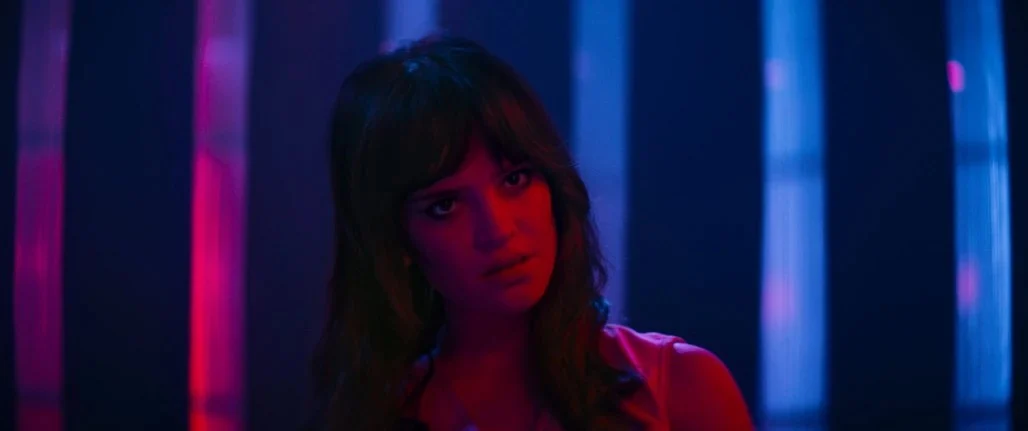
Her Private Hell lacks the fundamental architecture of a traditional narrative. Instead, it relies on lavish set pieces—principally a hotel adorned with gold-gilded drapes and a barren, minimalist representation of hell. The film is populated by a collection of actresses cast as models, draped in bejeweled eye makeup, who spend their screen time posing and snarling rather than interacting in a human capacity.
The only tether to reality in the film is the score. Composed by the legendary Pino Donaggio, the music is a gorgeous, absurdly old-fashioned romantic symphony. It is as if Bernard Herrmann were channeled through the emotional weight of Rachmaninoff. The score plays relentlessly under every inch of the film, and while it might sound like an overwhelming choice, the audience finds themselves clinging to it. Without the emotional gravity of Donaggio’s music, the film would be entirely unmoored, drifting into an even more impenetrable state of hellish abstraction.
Mythology vs. Coherence
What, precisely, is Refn attempting to accomplish in a work that refuses to be a movie in any conventional sense? He describes his work as a "mythology," an abstract situation where Elle (played by Sophie Thatcher) attempts to reconnect with her father, Johnny Thunders (Dougray Scott), a character who functions as a caricature of an ironic, middle-aged Lynchian greaser.
The plot, such as it is, involves Elle arriving at the Tower Hotel—a structure that literally pokes into the clouds—where she meets Hunter (Kristine Froseth), an influencer-cum-brat who is ostensibly there to collaborate on a project. Dominique (Havana Rose Liu), the stepmother, completes the trio as a dominatrix figure. Yet, because all three are framed and lit as high-fashion models, the illusion of them "playing characters" never takes hold. They remain objects of aesthetic contemplation rather than figures of drama.
The film’s second act shifts to a depiction of hell that mirrors the Asian underworld landscapes of Only God Forgives, albeit with significantly less set design. Charles Melton appears as Private K, an American GI searching for his daughter, a quest that inevitably leads him into a series of bloody, repetitive altercations. The fusion of violence and rapture, a staple of Kenneth Anger’s experimental works, is filtered through a Lynchian lens and ultimately reduced by Refn to a shallow form of fashionista subversion.
Refn also relies heavily on the recycling of his own motifs: the torn-out eyeball, the severed hand, and the recurring Lynchian archetype of a sadomasochistic monster—here called the "Leather Man." This figure, who exists solely to rip open chests and toss bodies from plate-glass windows, serves as the ultimate distillation of the film’s nihilistic, surface-level preoccupations.
Implications: The Delusion of the Auteur
It is painfully obvious that these images cohere in Refn’s mind. He has crafted a private language that he expects the audience to decode. However, he has become dangerously deluded regarding the expectations of his audience. Her Private Hell is a disaster by any traditional metric, yet the film seems to wear its failure as a badge of honor—a "hipster factor" that suggests the work is simply "too cool" to be coherent.
During the Cannes press circuit, Refn spoke at length about a near-death experience in a hospital, claiming he was clinically dead for 25 minutes before his revival. While it is undeniably good news that he survived, one cannot help but feel that, as a filmmaker, he has yet to return to the land of the living. He remains trapped in a purgatory of his own making, where the obsession with style has completely cannibalized the art of storytelling.
Ultimately, Her Private Hell stands as a cautionary tale for the modern auteur. When a director stops engaging with the audience and starts creating exclusively for the reflection in the mirror, the result is rarely genius—it is almost always an echo chamber of the director’s own vanities. Nicolas Winding Refn may still be flashing the sign of the horns, but the gesture no longer signals a daring rebel; it signals a filmmaker who has traded his narrative soul for a neon-lit, hollow brand.











No comments yet. Be the first to join the conversation!