

This post was sponsored by Victorious. The opinions expressed in this article are the sponsor’s own.
One year into the industry-wide pivot toward AI-integrated search, the marketing landscape is saturated with confident, often contradictory advice regarding how to achieve visibility in AI responses. From “keyword stuffing for bots” to “semantic entity optimization,” consultants have been quick to prescribe solutions. Yet, until now, the industry has operated in a vacuum, lacking empirical data to support these common assumptions.
To bridge this gap, Victorious conducted an extensive, data-driven study in early 2026 to measure the actual correlation between traditional search engine optimization (SEO) performance and AI-driven visibility. The findings reveal a startling reality: the race for AI dominance is not just in its infancy—for most brands, it hasn’t even begun.
The Methodology: Deconstructing the AI Black Box
To determine how brands perform across both traditional search engines and AI-powered interfaces, the research team established a rigorous, four-phase methodology designed to isolate variables and ensure longitudinal accuracy.
Phase 1: Curating the Brand Set
The study selected a representative cross-section of 177 distinct brands. These were segmented into five critical verticals: healthcare, SaaS (Software as a Service), financial services, ecommerce/retail, and legal services. This diversity allowed researchers to identify whether AI behavior is universal or industry-specific.
Phase 2: Capturing the AI Signal
The team tested vertical-specific prompts across eight major AI platforms: ChatGPT, Perplexity, Gemini, Google AI Overview, Google AI Mode, Microsoft Copilot, Claude, and Meta AI. This resulted in a massive dataset of 107,011 individual AI responses. For every response, the team tracked two primary metrics:
- Mention: Did the AI identify the brand by name?
- Citation: Did the AI link to the brand’s domain as a primary source?
Phase 3: Organic Performance Mapping
For those same 177 brands, the team tracked domain-level organic performance data via Semrush during the first quarter (Q1) of 2026. This included monitoring traffic trends and Authority Scores, providing a clear baseline for how these companies fare in the "traditional" search environment.

Phase 4: Cross-Referencing
The final step involved integrating the AI visibility dataset with the organic search data. By aligning mention rates, citation rates, and Authority Scores, the study was able to look for correlations—or the lack thereof—between standard ranking signals and the unpredictable nature of AI-generated answers.
Why Separate Mentions and Citations?
A critical insight from the study is the necessity of separating "mentions" from "citations." In the early days of AI experimentation, many analysts attempted to create a single "AI Visibility Score." The researchers found this to be a reductive approach.
A brand can be mentioned frequently by an AI but rarely cited, or conversely, it may be used as a source (cited) without being explicitly named in the prose of the answer. By tracking these as separate signals, the researchers uncovered nuances that would have been lost in a aggregate metric—specifically, how different platforms treat trust, brand identity, and source verification.
Finding 1: The "Absentee" Majority
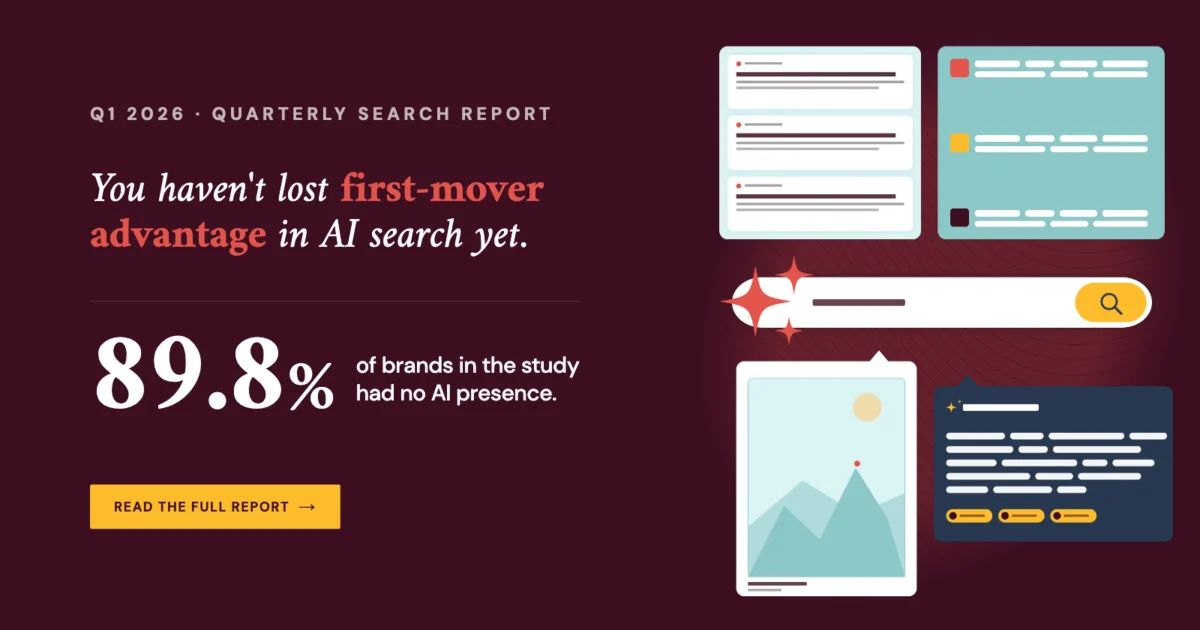
Perhaps the most significant revelation from the Q1 2026 data is the sheer scale of the "AI gap." Of the 177 brands analyzed, only 18 registered an AI mention rate above zero.
This means that 89.8% of the brands tested were essentially invisible in the AI search ecosystem.
For the vast majority of companies, the current "AI search race" is a misconception. While industry chatter suggests that brands are fighting for scraps in a crowded field, the data suggests otherwise. For nearly nine out of ten brands, there is currently no competition at all. This presents a massive opportunity for early adopters: by beginning the process of optimizing for AI visibility now, brands are not competing against a saturated category—they are building foundational authority in a space where incumbents have yet to establish a footprint.
Finding 2: Patterns of Visibility by Vertical
The research indicates that AI visibility is not a "one size fits all" game. Instead, it follows distinct behavioral patterns dictated by the sector.

The "Mentioned & Cited" Group: Healthcare, SaaS, and Financial Services
These industries demonstrate the most balanced performance. Healthcare brands benefit from strong entity identifiers—names, physical locations, and medical specialties—that help AI models map them as authoritative entities.
SaaS companies, meanwhile, benefit from their prevalence on third-party platforms like G2, Reddit, and LinkedIn. AI models, which rely heavily on community consensus, treat these mentions as "social proof."
Financial services provide an interesting outlier: this was the only vertical where the citation rate actually exceeded the mention rate. This suggests that AI platforms are beginning to treat financial brands as reliable "fact sources," even if they aren’t explicitly highlighting the brand name in the conversational text.
The "Mentioned but Uncited" Group: Ecommerce and Retail
Ecommerce brands face a specific hurdle. AI models often identify these brands, but they prefer to pull source material from massive marketplaces (like Amazon) or aggregators rather than the brand’s own domain. The challenge for these retailers is to move from being a "product mentioned" to a "brand cited." To do this, they must produce content that offers more value to the AI than the generic landing pages currently favored by the algorithms.
The "Cited but Rarely Mentioned" Group: Legal Services
Legal services show the inverse trend. AI platforms frequently scrape legal websites to answer queries, but they often fail to credit the firm that authored the content. This is a classic "attribution gap." Firms that successfully close this gap—by improving their entity signals—will likely see a disproportionate increase in traffic as AI models become more adept at identifying the specific source of their legal knowledge.
Supporting Data: The Platform Divide
A recurring theme throughout the study is that AI platforms are not monolithic. Each model (ChatGPT, Gemini, Perplexity, etc.) has a unique "personality" and a preferred set of sources.
For instance, some platforms favor long-form documentation, while others prioritize community-driven forums. The full Victorious Q1 2026 Quarterly Search Report provides a granular breakdown of these platform preferences. For marketers, the implication is clear: you should not optimize for "AI" as a broad concept; you should optimize for the specific platforms your high-intent buyers are using.

Implications: The Personalization Loop
One of the most concerning—and fascinating—implications of the study involves Google’s "Personal Intelligence" updates. By integrating signals from a user’s personal data (such as Gmail or Photos) into AI Mode responses, Google is creating a feedback loop.
If a user frequently interacts with a brand in their personal inbox, the AI is more likely to bias its responses toward that brand. This suggests that the "first-mover advantage" in AI search could become a self-compounding cycle. Once a brand establishes itself as a primary source for a user’s queries, the personalization layer makes it increasingly difficult for new competitors to break into that user’s AI-generated results.
Official Recommendations and Future Outlook
The data suggests that the "AI search era" is not a sprint, but a long-term shift in how information is discovered. The key takeaways for stakeholders are as follows:
- Don’t panic: The vast majority of your competitors are not yet present in AI search. You have significant "white space" to claim.
- Optimize for Entities, not just Keywords: AI models are moving toward entity-based recognition. Ensure your brand is clearly defined through structured data, consistent NAP (Name, Address, Phone) information, and authoritative third-party mentions.
- Audit your Sources: Understand which AI platforms are actually driving traffic to your competitors. If your target demographic is using Perplexity, prioritize your visibility there, rather than spreading your resources too thin across all eight platforms.
- Claim your Ownership: If you are in the legal or ecommerce space, you must work to connect your content to your brand identity. Without clear, consistent branding, you are providing the information that trains the AI, but you aren’t receiving the credit for it.
As we move into the second quarter of 2026, the focus must shift from "trying to be everywhere" to "being where the AI trusts you." The brands that succeed in the coming years will be those that treat AI platforms as a new type of search engine—one that requires as much strategic, technical, and content-based rigor as traditional search ever did.
To view the full, detailed breakdown of the 107,011-response study, you can access the Victorious Quarterly Search Report here. The race for the future of search is officially on, and for those who act now, the field is wide open.












No comments yet. Be the first to join the conversation!