Basiran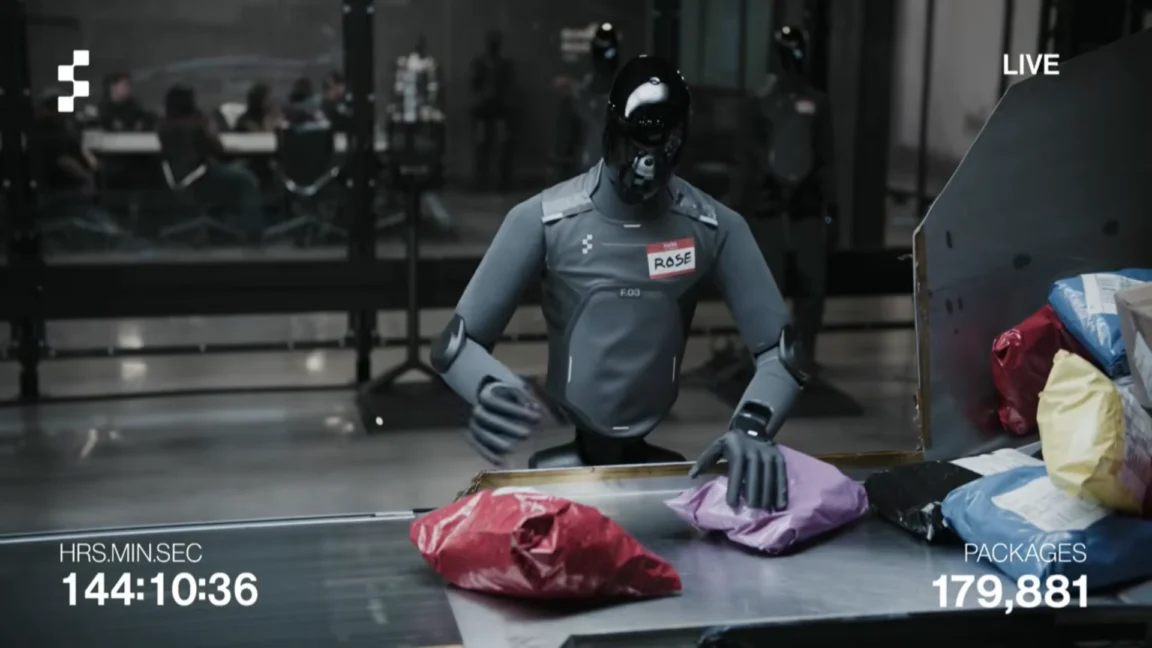
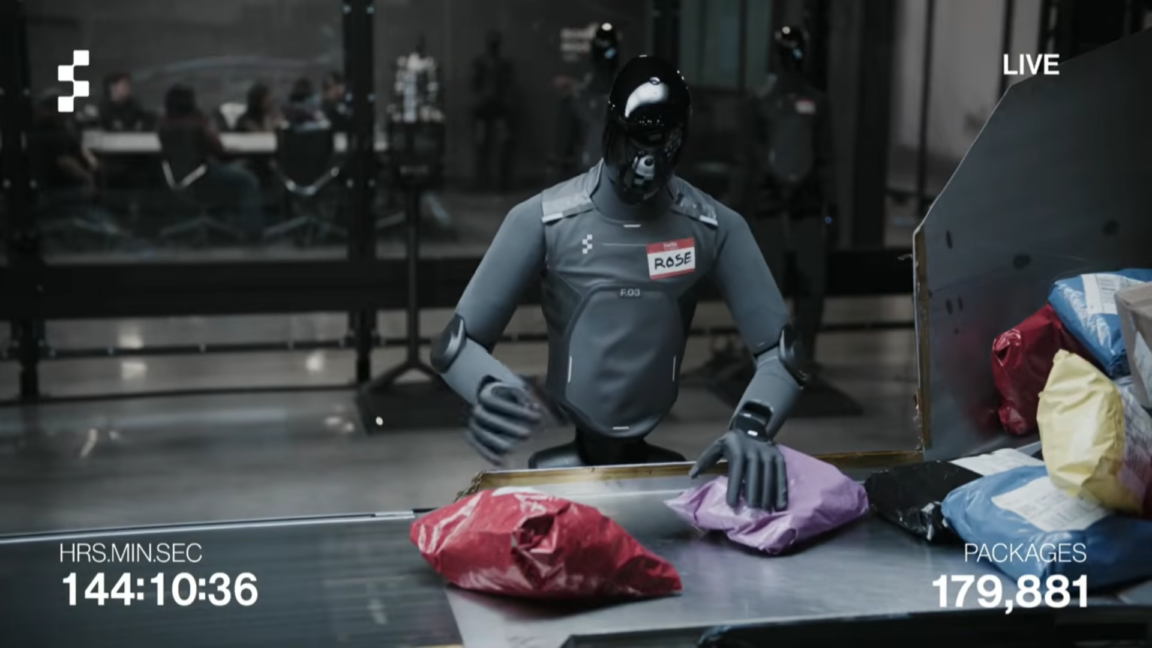
In the high-stakes arena of robotics, where corporate secrecy often obscures progress, the startup Figure AI has chosen a radical path: total transparency. For over a week, the company has broadcast a continuous, 24/7 livestream of its latest humanoid robots, the Figure 03, performing a mundane but technically complex task: inspecting and sorting thousands of packages onto a conveyor belt.
This endurance demonstration has not only captivated the tech world but has sparked a cultural phenomenon. Observers on X (formerly Twitter) have compared the event to the legendary “one more thing” product launches of Steve Jobs, while a community of dedicated followers has begun naming the individual machines—Bob, Frank, Gary, and Rose—treating them less like industrial equipment and more like members of a burgeoning robotic workforce. However, behind the viral marketing and the naming conventions lies a serious, calculated effort to prove that humanoid robotics has moved beyond the realm of science fiction into the harsh, unforgiving reality of the warehouse floor.
A Chronology of the "Endurance Run"
The event began on May 13 with modest expectations. CEO Brett Adcock initially announced an eight-hour demonstration, a significant jump from the one-hour tests that had characterized previous company milestones. Adcock, clearly aware of the volatility of robotic hardware, cautioned his followers on X, noting that there were "high odds something breaks."
The task was straightforward yet demanding: the Figure 03 robots were required to identify barcodes on a variety of objects—ranging from rigid cardboard boxes to inconsistent, soft-padded envelopes—and orient them face-down on a moving conveyor belt. Unlike many staged industry demos, Figure AI claimed the process was entirely autonomous, requiring no human intervention or remote control.
By the end of the first eight hours, the robots had not only survived; they were thriving. Adcock announced that the livestream would continue indefinitely. What followed was a demonstration of "long horizon autonomy." As batteries depleted, the robots—communicating via a networked system—would autonomously signal for a replacement, allowing a fresh unit to swap into the station. By May 14, the collective operation surpassed 30 hours. By May 15, the machines had clocked 48 hours of continuous, unsupervised labor.
The spectacle peaked on May 17 with a “Man vs. Machine” challenge, pitting a human intern, Aimé Gérard, against the robots in a ten-hour sorting competition. Despite the novelty, the results were sobering: the human worker, bound by California labor laws and mandated rest breaks, eventually outpaced the machines, sorting 12,924 packages compared to the robots’ 12,732. Yet, the margin was razor-thin—a mere fraction of a second per package—leading Adcock to boldly proclaim on social media, "This is the last time a human will ever win."
The Engine Under the Hood: Helix 02
The technological backbone of this performance is the Helix 02 neural network. According to Figure AI, this system provides full-body control, allowing the robots to navigate not just the task at hand, but the spatial awareness required to operate in a dynamic environment.
Crucially, Figure AI emphasizes that the AI inference is performed "entirely onboard." This is a significant claim in an era where many roboticists rely on powerful cloud-based processing to manage the heavy computational load of computer vision and motor control. By keeping the intelligence local, the robots avoid the latency issues that could otherwise lead to dropped items or sluggish movement.
The training regimen for the Helix 02 system is equally intensive. The robots were trained on over 1,000 hours of human motion data, a technique known as imitation learning, and supplemented this with over 200,000 parallel simulation environments. This massive scale of training is intended to help the machines generalize their behavior. While they are currently sorting packages, the hope is that this "whole-body controller" will eventually be transferable to a wide variety of manual labor tasks, from construction to hospitality.
Professional Skepticism and the "Teleoperation" Debate
Despite the fanfare, the demonstration has not been without its critics. In the world of robotics, the "ghost in the machine" remains a persistent concern. When companies showcase humanoid robots, the question of whether a human is secretly controlling the movements—a process known as teleoperation—is always at the forefront.
While Figure AI insists that the robots are fully autonomous, the lack of independent, third-party verification on the ground has led some observers to maintain a healthy skepticism. This caution is well-founded. The robotics industry has been marred by instances where companies, most notably Tesla with its Optimus project, were revealed to have utilized human teleoperators to assist in demonstrations that were marketed as fully autonomous.
Furthermore, the livestream has provided an unvarnished look at the limitations of current technology. Viewers have pointed out moments where the robots struggled, mishandled packages, or repeatedly grabbed at empty air. While some see these as failures, roboticists often view them as necessary data points. By showcasing the errors in real time, Figure AI is arguably providing a more honest assessment of their progress than the highly edited, "highlight reel" videos that have become standard in the industry.
Implications for the Global Labor Market
The broader vision behind Figure AI is the realization of the general-purpose humanoid worker. If successful, these machines would not be designed for a single task, but would be flexible enough to handle the same diverse range of chores that a human employee performs in a warehouse or factory.
The economic implications are immense. If a robot can operate for 24 hours a day, with only short intervals for battery swaps and minor maintenance, the productivity gains would be staggering. However, the path to widespread adoption is fraught with obstacles. For these robots to be viable, they must prove themselves to be more cost-effective than the current alternatives: humans, and highly specialized, non-humanoid industrial robots.

Specialized machines (such as pick-and-place arms) are already incredibly fast and reliable in static environments. The advantage of the humanoid form is its ability to operate in environments built for humans—using existing stairs, doorways, and tools. But the "cost-per-unit-of-work" remains the ultimate metric that will decide whether Figure AI and its competitors become fixtures of the 21st-century economy or remain expensive curiosities.
A Proven Track Record: From BMW to the Warehouse Floor
This is not Figure AI’s first foray into the real world. In 2025, the company deployed its previous iteration, the Figure 02, at the BMW Group Plant in Spartanburg, South Carolina. Over an 11-month period, those robots were integrated into the production line, handling the physically exhausting task of removing sheet-metal parts from racks and placing them on welding fixtures.
The deployment was a success, contributing to the production of 30,000 BMW X3 vehicles. By working alongside human workers in a high-pressure manufacturing environment, Figure proved that its robots could handle the "demanding speed and accuracy" required by automotive assembly.
The current Figure 03 demonstration, while seemingly less complex than welding, is a stress test of a different kind: endurance. By keeping the machines running for days on end, the company is attempting to prove the reliability and robustness of its hardware—a critical hurdle before any large-scale commercial rollout.
The Verdict: A New Era of Transparency
The internet’s obsession with "Frank," "Rose," and their peers is a testament to the human affinity for humanoid design. We are hardwired to anthropomorphize machines that move like us, and Figure AI has masterfully leaned into this to build brand loyalty.
However, once the novelty of the 24/7 livestream fades, the company will face the same pressure as any other enterprise hardware firm: the pressure to deliver a product that is not just cool, but indispensable. With nearly $2 billion in backing from industry titans like OpenAI, Microsoft, Nvidia, and Amazon, Figure AI has the resources to endure its own testing phase. Whether these robots will eventually replace the human worker or serve as their most capable colleagues remains to be seen. For now, the world is watching, one package at a time.

 Siti Muinah
 Ammar Sabilarrohman