Raul Delapena Setiawan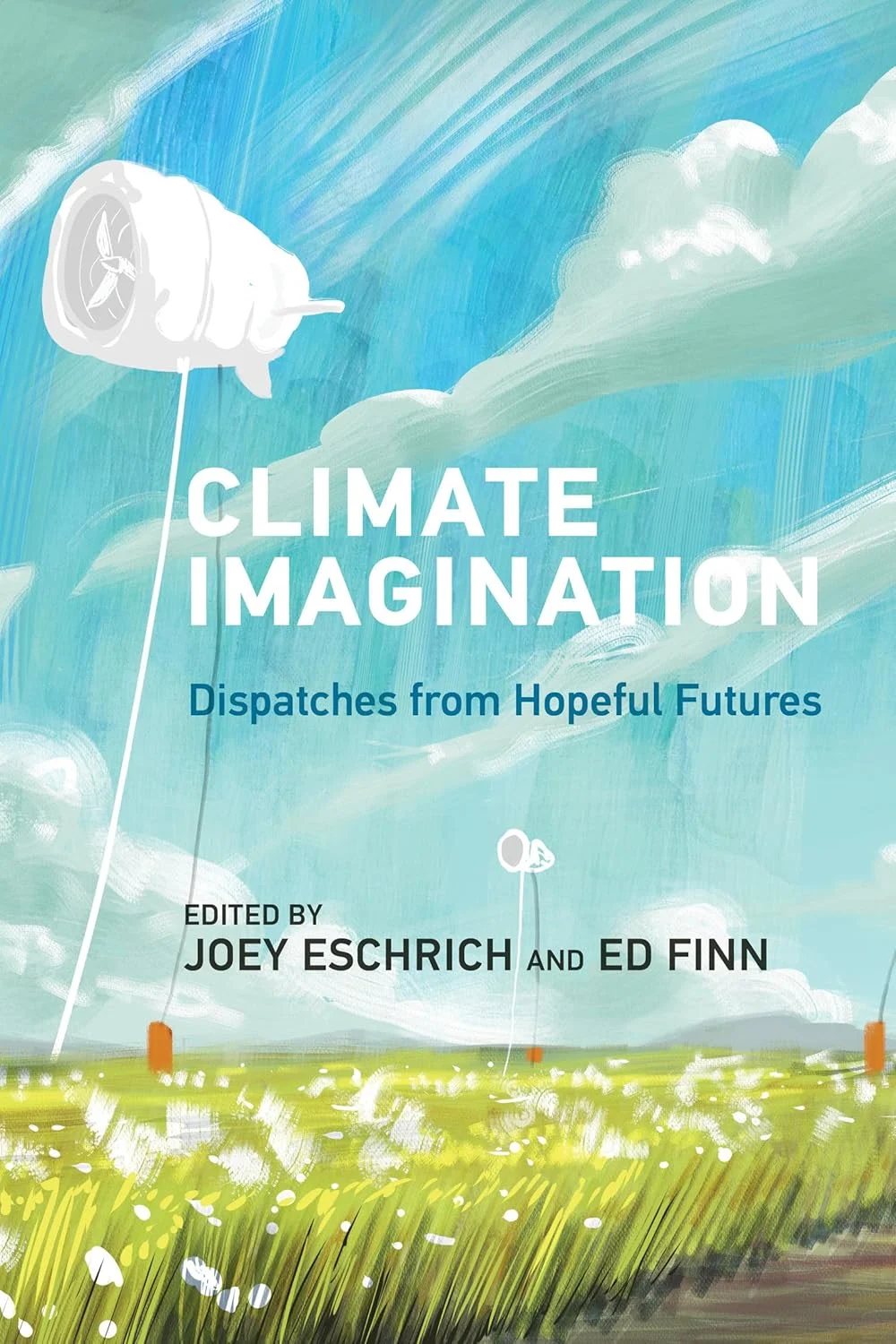
In the introduction to the 2021 Tor Essentials edition of Gene Wolfe’s The Book of the New Sun, Ada Palmer offers a poignant analogy for our engagement with monumental, complex systems. She likens Wolfe’s work to an incomplete jigsaw puzzle, observing that we are granted only a few hundred pieces to glimpse an image so vast that it would take 100,000 to truly complete.
This observation serves as the thematic bedrock for Climate Imagination: Dispatches from Hopeful Futures, an ambitious new anthology edited by Joey Eschrich and Ed Finn. The collection posits that the climate crisis—a catastrophe so sprawling and multifaceted that it defies traditional narrative framing—must be understood and addressed through these very "puzzle pieces": localized, fragmentary, and deeply personal perspectives. By marrying speculative fiction with rigorous analytical essays, Climate Imagination attempts to bridge the chasm between the cold, utilitarian logic of global policy and the visceral, lived reality of a warming world.
The Architecture of the Anthology: A Multidisciplinary Approach
Climate Imagination is not a conventional collection of climate fiction. It is an eclectic assembly of stories, essays, and transcribed panel discussions, structured into four distinct sections. Each section is anchored by a substantial novelette from a prominent voice in speculative fiction, bookended by shorter stories and interspersed with non-fiction explorations.
The collection is visually enriched by the illustrations of João Queiroz, whose vibrant, sun-drenched future landscapes provide a visual counter-narrative to the standard "ruin-porn" aesthetic of modern climate media. While these images are reproduced in the print edition, the anthology is also part of a larger digital ecosystem—The Climate Action Almanac—which offers an open-access platform for additional interviews, commentary, and full-color multimedia versions of the contributors’ work.
Chronology of a Crisis: From Hubris to "Thick" Time
The anthology’s opening act is Vandana Singh’s novelette, "Three-World Cantata." Singh, a seasoned scholar of climate education and the author of the acclaimed Ambiguity Machines, serves as the perfect architect for this exploration.
The story follows Manny, a CEO of a global corporation, who is drawn into a climate simulator by an activist and storyteller named Chingari. The narrative serves as a scathing critique of the "hero complex" prevalent among corporate elites—the hubris that convinces those most responsible for the crisis that they are the ones best suited to solve it. Chingari lures Manny through three distinct worlds:
- World Zero: Our current reality, defined by inertia and consumption.
- World One: A "clockwork" future characterized by cold, mechanized, and exclusionary rationality. It is a world of sensors and cordoned-off zones, where "scientific" utility dictates who survives and who is discarded.
- World Two: A "tapestry" future, defined by collaboration, fluid social structures, and an acknowledgment of the "symbiome"—political units comprised of all living things in a local ecosystem.
The core of the story revolves around the "orienting metaphor." While World One relies on the rigid, sequential perception of time, World Two introduces the concept of "thick time." As Manny’s grandmother tells him, when one engages with the world in collaboration with others, time ceases to be a thin, lonely line. It acquires structure, depth, and communal weight. Through the eyes of Nilu, a Dalit woman in World Two who uses the voice of an elephant to challenge a corporate entity, the story argues that human speech is but one tool in a vast, necessary network of resistance.
Supporting Data and The "Great Yu" Problem
The anthology’s middle sections shift from philosophical allegory to chilling urban realism. In "City of Choice," written by Beijing-based planner Gu Shi and translated by Ken Liu, the reader is confronted with the logistical fallout of extreme weather.
The story focuses on "Da Yu" (Great Yu), a navigation system designed to optimize evacuations during catastrophic flooding. The protagonist, urban planner Tushan Jiao, discovers a horrifying truth: the system, driven by cold utilitarian calculus, deliberately sacrificed families with lower survival probabilities to maximize overall efficiency.
This is the collection’s most sobering moment. It exposes the "World One" mindset—the belief that human sacrifice is a grim necessity rather than a moral choice. By highlighting this, the anthology forces the reader to confront the reality that the tools we build to save ourselves are often reflections of our own systemic biases.
Official Responses and the "Fractal Approach"
A pivotal feature of Climate Imagination is its insistence on moving away from top-down global governance. In a series of dialogues between mathematician Nigel Topping, lawyer Farhana Yamin, and editor Ed Finn, the contributors propose a "fractal approach" to climate action.
The consensus among these experts is that while international climate summits are necessary, they are frequently paralyzed by geopolitics and scientific jargon. Yamin argues that implementing change on a "High Street" or village level is not only more feasible but ultimately more impactful. This perspective is bolstered by essays such as Benjamin Ong’s "The Village Within," which details the rogue rewilding of urban scrubland in Kuala Lumpur, and Pippa Goldschmidt’s "A Walk in Berlin," which examines how the "ruins" of the Berlin Wall became a thriving refuge for endangered species.
These accounts provide a vital counter-argument to the fatalism of apocalyptic thinking. As Chinelo Onwualu writes in her essay, "The Case for Reckless Climate Optimism," those who have lived through the collapse of power structures know that change is not as intractable as it appears. History, she suggests, is not a fixed track, but a series of possibilities waiting for human intervention.
Implications for the Future: Navigating the Mess
The final novelette, Hannah Onoguwe’s "Death is Not an Ornament," grounds the anthology’s speculative aspirations in the harsh, real-world context of the Niger Delta. By weaving together the history of the Ogoni Nine, the complexities of the Presidential Amnesty Programme, and a fantastical future-history, Onoguwe demonstrates that the transition away from fossil fuels is as much a cultural and spiritual struggle as it is a technological one.
The implications of Climate Imagination are clear: the era of the "single narrative" solution is over. To address the climate crisis, we must be willing to inhabit the mess. We must be willing to accept that our individual actions—planting a garden, lobbying a council, or changing our consumption habits—are not merely drops in the bucket. They are the stitches that create the "tapestry" of a livable future.
Summary of Key Takeaways:
- Fragmentary Agency: Individual and local actions are the primary engines of systemic change.
- The Rejection of Binaries: We must move beyond the "Clockwork" vs. "Tapestry" divide by choosing empathy and collaboration over cold utility.
- Reclaiming Time: We must reject the notion of time as a thin, linear path of resource exhaustion and embrace "thick time," where our actions are inextricably linked to the beings around us.
- The Power of Imagination: As Topping notes, we cannot do something different until we imagine something different. Science is the foundation, but imagination is the vehicle.
In the end, Climate Imagination does not offer a roadmap to a perfect world. It offers something far more valuable: a mirror. It asks us to look at our own "puzzle pieces"—the wildfire smoke in our lungs, the heat waves in our Novembers, and the resilience of our neighborhoods—and realize that the picture we are building is entirely up to us. As the contributors suggest, there are far worse places to start. Time is thick, and the work of weaving the future has already begun.

 Laily UPN
 Evan Lee Salim