

Introduction: The Anatomy of a Crisis
"Paintings arrive at the studio in all states of disrepair," observes Julian Baumgartner, a master art conservator whose Chicago-based studio has become a global beacon for the preservation of fine art. For most of us, a painting is a static object—a finished window into another time. For Baumgartner, however, a painting is a living, breathing, and frequently ailing entity.
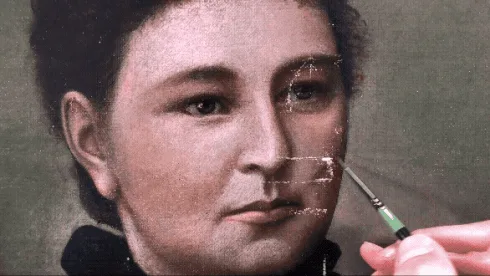
His latest project, a nameless portrait that arrived in his studio folded inside a mangled shipping parcel, serves as a testament to the precarious nature of cultural heritage. To the untrained eye, the object—crushed, creased, and stripped of its structural integrity—might have looked like refuse. To the eye of a trained conservator, it was a challenge. In his most recent video feature, titled "Fortune Favors the Fold," Baumgartner demonstrates that even the most catastrophic damage can be mitigated through patience, science, and an unwavering commitment to the ethics of conservation.
The Chronology of Restoration: From Ruin to Radiance
The restoration process is rarely a sprint; it is an endurance sport that demands absolute precision. The journey of this anonymous portrait began long before it reached the easel, likely suffering from decades of improper storage or reckless handling that culminated in its near-fatal journey through the mail.
Phase I: Triage and Assessment
Upon arrival, the portrait was in a state of crisis. The canvas, traditionally a sturdy medium, had been subjected to the physical indignity of being folded. This creates stress fractures in the paint film, leading to cleavage—where the paint separates from the canvas—and, in severe cases, total loss of the image. Baumgartner’s first task is always non-invasive: assessing the chemical stability of the pigments and the mechanical integrity of the fibers.
Phase II: Structural Consolidation
Before any aesthetic work can be performed, the structural foundation must be stabilized. This involves the use of specialized adhesives that are, crucially, reversible. In the world of high-end conservation, the "do no harm" principle is paramount. Any intervention must be undoable by future conservators, ensuring that no modern restoration permanently alters the original intent of the artist.

Phase III: The Delicate Unfolding
The most harrowing part of this specific project was the physical manipulation of the canvas. Because the painting had been folded, the fibers were weakened. Using a controlled environment—often involving controlled humidity and heat—Baumgartner gently coaxed the fibers back into a planar state. This is a process fraught with risk; a single miscalculation could result in further flaking or tearing.
Phase IV: Inpainting and Finishing
Once the canvas was flat and mounted on a new, archival-grade stretcher, the "cosmetic" work began. Unlike the crude, heavy-handed overpainting Baumgartner frequently critiques, professional inpainting is meant to be visible under close inspection or infrared light. It is intended to bridge the gap for the viewer’s eye without deceiving the historian. Using pigments that match the original palette but remain distinct, he carefully restored the portrait’s visage, layer by layer.
Supporting Data: The Science of Conservation
The field of art conservation has evolved from the subjective "touch-ups" of the early 20th century into a rigorous scientific discipline. Baumgartner’s studio relies on a deep understanding of organic chemistry and material science.
- Reversible Adhesives: Conservators utilize synthetic resins and natural glues (such as sturgeon glue) that can be removed with specific solvents, ensuring the painting remains as close to its original state as possible.
- Archival Materials: By utilizing museum-grade backing boards and acid-free stretcher bars, Baumgartner ensures that the environmental factors that caused the initial decay—moisture, acidic wood, and fluctuating temperatures—are neutralized.
- The Ethics of Intervention: Modern standards dictate that the conservator’s mark must be distinguishable from the artist’s. This creates a historical record of the painting’s life, acknowledging the damage it sustained and the care it received.
Official Perspectives: The Philosophy of Baumgartner Restoration
Julian Baumgartner’s approach is rooted in the belief that art is a communal resource. "We are merely stewards," he has often noted. The philosophy of Baumgartner Fine Art Restoration is not about making a painting look "brand new." Instead, it is about halting the entropic decay that threatens to erase historical identity.
When asked about the "bad overpainting" he frequently encounters, Baumgartner emphasizes that the biggest enemy of art is often well-intentioned, but poorly executed, restoration. "When someone uses an oil-based paint to fix an oil painting, they are creating a future disaster," he explains. Oil paint continues to cross-link and darken over centuries. If a restorer adds a layer of modern oil paint, it will eventually become impossible to remove without destroying the original underneath. This is why his studio emphasizes the use of specialized, stable materials that do not age at the same rate as the original work.

Implications: The Future of Cultural Stewardship
The public fascination with Baumgartner’s work—as evidenced by the millions of viewers who tune in to watch his restoration videos—speaks to a broader cultural hunger for permanence in a disposable world.
A Shift in Perception
For decades, the work of a conservator was largely invisible, relegated to the quiet, dusty backrooms of museums. By documenting the "miraculous" recovery of works like this folded portrait, Baumgartner has democratized the appreciation for technical skill. Viewers are no longer just looking at a finished image; they are learning to appreciate the struggle against time.
The Sustainability of Art
The implications for the art market and private collectors are profound. Many families hold onto heirlooms that are degrading in attics or basements. The success of this restoration serves as a call to action: art is not static. If we wish to pass our history down to future generations, we must view ownership not as a right, but as a responsibility.
The Technological Frontier
While the tools of the trade remain largely manual—fine brushes, scalpels, and steady hands—the industry is increasingly incorporating digital imaging, multispectral analysis, and advanced climate control systems. As these technologies become more accessible, the barrier to entry for professional conservation may lower, potentially saving thousands of overlooked works that currently sit on the brink of being lost forever.
Conclusion: A Second Chance at Life
As the video concludes, the anonymous portrait—once a victim of folding, moisture, and neglect—stands upright, its features restored and its integrity reinforced. It is a quiet, profound victory. The painting has been granted a "second chance," not just to be seen, but to endure.

In a world that moves at an increasingly frantic pace, the work of Julian Baumgartner reminds us of the value of slowing down. Whether it is a masterpiece by a household name or a nameless portrait found in a box, the act of restoration is an act of defiance against the inevitable. It is a declaration that the past has value, and that with the right care, the stories we choose to preserve can continue to speak to us for centuries to come.
"Fortune favors the fold," Baumgartner quips. In this case, it also favors the patience, the science, and the steady hand of the conservator who refuses to let the past simply fade away.










No comments yet. Be the first to join the conversation!