

Designer: Matthew Weaver & Garrett Weaver
Publisher: Weaver Media Group
Players: 1-2+
Playtime: 30 Minutes
For decades, the standard lifecycle of a baseball card has been depressingly predictable: purchased in a moment of youthful excitement, admired for a brief window, and then relegated to a dusty binder or a shoebox shoved into the darkest corner of a closet. They sit in the dark, gathering dust while their owners whisper the classic refrain: "This is definitely going to be worth money someday."
Enter Baseball Card GM, a refreshing tabletop experience from designers Matthew and Garrett Weaver that dares to ask a radical question: What if we stopped treating these cards as static investments and started using them to actually play a game? The result is a surprisingly clever sports simulation that transforms old cardboard statistics into high-stakes drama, dream-team construction, and an irresistible urge to revisit your local card shop.
The Core Concept: Bridging the Gap Between Collectibles and Gameplay
At its heart, Baseball Card GM is a baseball simulation that uses your existing collection as its engine. Whether you are a fan of modern superstars, a collector of 1980s legends, or someone who possesses nothing but a box of "bulk" commons from the local thrift store, this game provides the framework to bring those players to life.
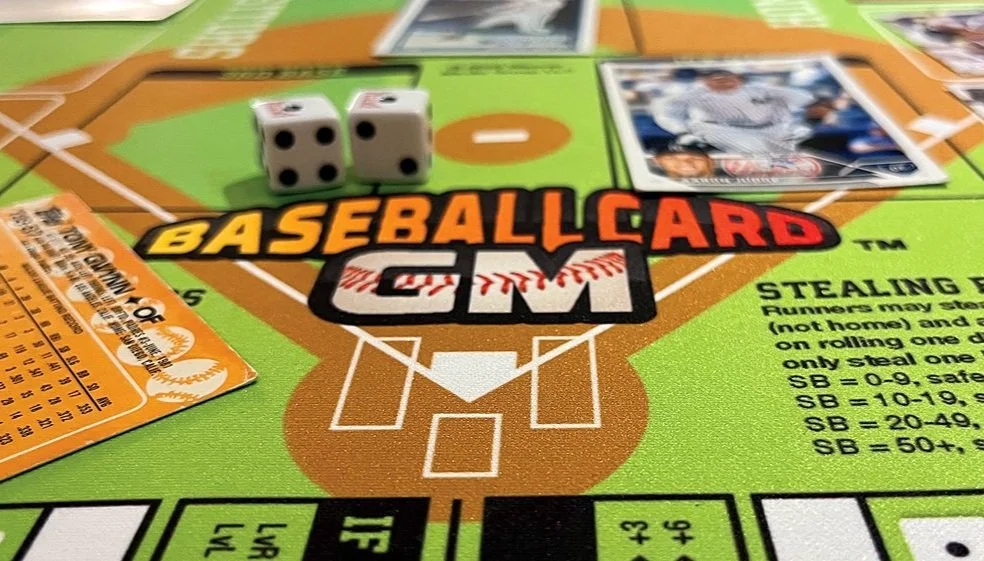
The system is elegant in its simplicity. Each player card is evaluated based on the real-world statistics printed on its reverse side. Batting averages, home run totals, ERA, and stolen base counts are not merely decorative text; they are the literal fuel for the game’s mechanics. When you assemble a roster, you aren’t just picking names—you are building a statistical profile that determines your probability of success.
The game is played on a specialized neoprene playmat that functions as both a visual representation of a diamond and a complex reference guide. Players take turns rolling two dice and consulting the mat, which cross-references the die result with the player’s specific stats. The outcomes are as varied as a real game—a deep flyout, a clutch single, a tense walk, or a disastrous strikeout.
Chronology of the Experience: From First Pitch to Final Out
The flow of Baseball Card GM is designed to mirror the rhythmic cadence of a professional baseball game, yet it manages to condense nine innings into a brisk 30-minute window.
1. Pre-Game: The Managerial Phase
Strategy begins long before the first pitch is thrown. Unlike games that rely on pre-set decks, Baseball Card GM demands that you act as a General Manager. You must curate your lineup, balancing the offensive output of your sluggers against the defensive reliability of your fielders. You choose your starting pitcher based on their ERA and your assessment of the opponent’s batting order. This phase is where the game’s "deck-building" DNA shines, as players weigh the value of their cards in a way that feels reminiscent of high-level Trading Card Games (TCGs).
2. The Mid-Game: The Rhythm of Play
Once the game begins, the action is rapid. Players cycle through their batting orders, moving runners around the bases and tracking outs with the included markers. The game avoids the "downtime" trap that plagues many sports simulations; there are no complex turn sequences to memorize. Instead, the process is streamlined: roll, consult the mat, resolve the outcome, move the runner. This creates a flow state that mimics the tension of watching a broadcast, where every pitch feels consequential.
3. Late-Game: Tactical Adjustments
As the game progresses, the system introduces layers of depth. The beginner guide eases players into the game with "favorite player" matchups, but the advanced rules allow for bullpen management, the strategic use of lefty/righty splits, and pitcher fatigue modifiers. The transition from a casual game to a tactical simulation is seamless, allowing players to scale the complexity to their own comfort levels.
Supporting Data: Why the System Works
The success of Baseball Card GM lies in its accessibility and its reliance on the "known" language of baseball. Because the game utilizes existing stats, there is a very low barrier to entry for any baseball fan.
- Speed of Play: In testing, individual half-innings consistently resolved in under three minutes. This high-velocity design ensures that the game can be played during a lunch break or as a quick diversion in the evening.
- Component Efficiency: The production is intentionally minimalist. By eschewing bulky plastic miniatures and oversized boards in favor of a well-designed neoprene mat and high-quality tokens, the developers have kept the price point accessible while ensuring the game remains portable.
- Replayability Metric: The replayability is technically infinite. Because the game is "collection-agnostic," a player with 50 cards has the same base experience as a collector with 50,000. It effectively turns "useless" bulk cards—the kind usually sold by the pound—into functional game pieces.
Official Perspectives: The Developer’s Philosophy
According to the Weaver Media Group, the primary goal was to bridge the gap between "collector culture" and the interactive nature of modern tabletop gaming. In discussions regarding the game’s development, the designers emphasized that they wanted to create a "sandbox" rather than a rigid simulation.
"We didn’t want to tell the players who the best team was," the designers noted in early development logs. "We wanted to provide a system that allowed the players’ own collections to decide who the best team was." By removing the arbitrary power-scaling found in many TCGs and relying on the historical record of the players themselves, the game creates a sandbox where a 1992 utility infielder can, on the right roll of the dice, outshine a modern-day MVP.
Implications for the Hobby
The release of Baseball Card GM has significant implications for the wider sports collectibles industry. For years, the hobby has been bifurcated: you either collect to store (hoping for appreciation) or you flip cards for profit. Baseball Card GM introduces a third, more sustainable path: playing to enjoy.
Revitalizing the "Bulk" Market
The most immediate implication is the potential for a resurgence in interest for low-value, high-volume cards. Collectors who have been frustrated by the hyper-inflation of "chase" cards may find solace in a format that celebrates the average player. It turns the process of digging through bargain bins at card shows into a tactical scouting mission.
A New Gateway for Younger Generations
The game is uniquely positioned to act as a bridge between generations. With its simple, arithmetic-based mechanics, it is an excellent tool for introducing younger fans to the nuances of baseball statistics. It demystifies the back of the card, teaching children how to interpret batting averages and ERAs in a practical, competitive context rather than abstractly.
The "Sandbox" Effect
Unlike traditional tabletop games that require constant expansions or booster packs to remain fresh, Baseball Card GM is inherently modular. If a player feels the game is becoming stagnant, they simply need to acquire a different set of cards. This effectively integrates the "hunt" of collecting with the satisfaction of gameplay.
Final Verdict: Is It For You?
If you are looking for a deep, hyper-realistic managerial simulation—the kind that tracks every individual pitch and calculates complex atmospheric variables—you may find Baseball Card GM to be a bit too streamlined. It is not a spreadsheet-heavy simulator; it is a game of probability and narrative.
However, if you are a fan of baseball, a collector looking to give your cards a new life, or a tabletop enthusiast who enjoys a quick, punchy game that rewards clever roster construction, this is an essential addition to your shelf.
It is a rare example of a game that respects the history of its subject matter while injecting a sense of fun that has been missing from the card collecting hobby for far too long. By turning the "useless" cards in your closet into the stars of your next game night, Baseball Card GM successfully achieves the dream every young collector once had: making those cards actually count for something.
Whether you are drafting a team of 1970s legends or current minor league prospects, the magic of the game isn’t in the plastic or the cardboard—it’s in the story that unfolds on the mat. And for a game that costs about as much as a couple of retail packs of cards, the value proposition is, ironically, the best "investment" in the hobby right now.











No comments yet. Be the first to join the conversation!