

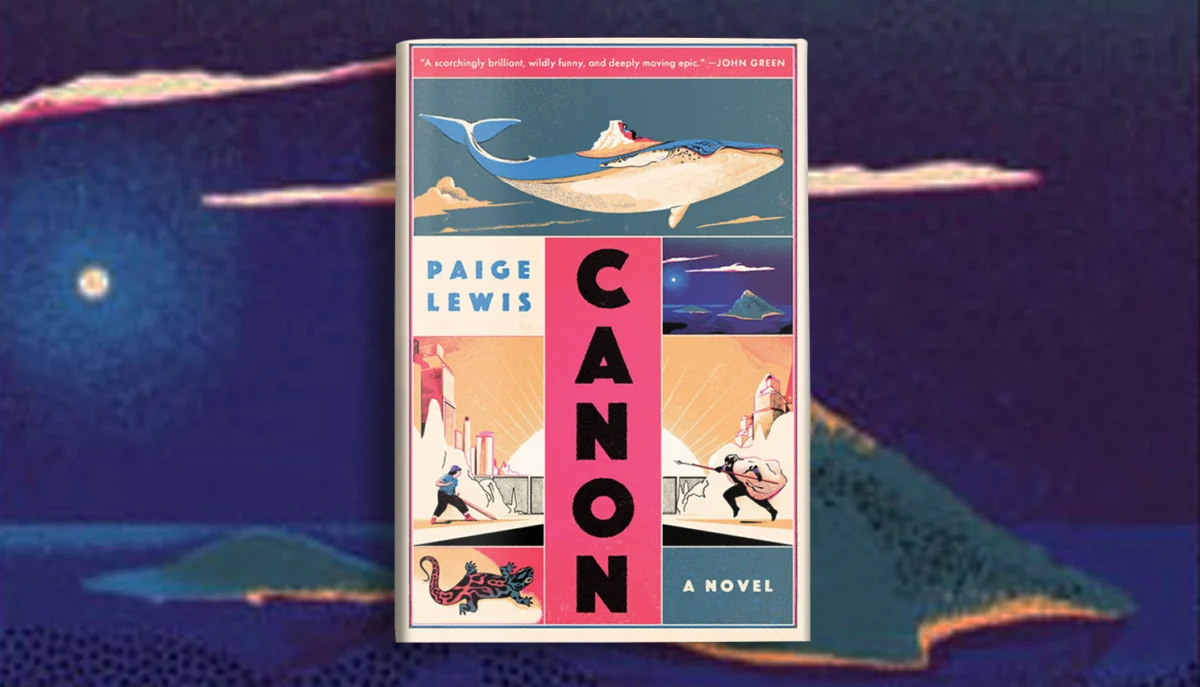
In the landscape of contemporary poetry, few voices manage to balance the weight of classical tradition with the irreverent, surreal spark of modern absurdity quite like Paige Lewis. With the release of their latest collection, Canon, Lewis has invited readers into a fractured, hilarious, and deeply moving exploration of what it means to be a "hero" in an age where the divine feels increasingly distant.
This week, Poured Over—the literary podcast hosted by the Barnes & Noble team—featured an in-depth conversation between Lewis and co-host Jenna Seery. The episode, which serves as both a masterclass in craft and a deep dive into the themes of Canon, dissects the mechanics of story structure, the evolution of the epic poem, and the persistent human impulse to categorize the chaos of existence.
Main Facts: Deconstructing the Mythological
At the heart of Canon is a project of reclamation. Lewis, known for their ability to navigate the intersection of the mundane and the metaphysical, uses this collection to interrogate the "canons" that govern our lives—be they literary, religious, or personal.
The collection acts as a surrealist dialogue with the past. By invoking the structures of epic poetry, Lewis does not merely pay homage to the ancients; they dismantle them. During the Poured Over interview, Lewis discussed the necessity of "godly proportions" in their work, explaining that by framing personal experiences through a lens of myth, the stakes of everyday life are amplified, exposed, and ultimately humanized.
"We are all living in our own personal epics," Lewis noted during the session. The collection asks the reader to consider: if a hero is defined by their suffering and their journey, what does a hero look like in a world defined by climate anxiety, digital fatigue, and the quiet tragedies of domestic life?
A Chronology of Creation: From Homer to Lewis
To understand Canon, one must look at the lineage Lewis is engaging with. The Poured Over discussion underscored a clear chronology of influence that anchors the book in literary history:
- The Classical Foundation: The conversation prominently featured Emily Wilson’s recent, celebrated translations of Homer’s The Iliad and The Odyssey. Lewis identified these as touchstones, emphasizing how Wilson’s work has cleared the path for contemporary writers to revisit the "hero’s journey" with a fresh, less dogmatic eye.
- The Modernist Experimentation: The discussion moved through the 20th century, touching on Gwendolyn Brooks’s Annie Allen—a work that fundamentally altered the trajectory of American poetry by centering the Black female experience within a formal, epic structure—and Bernadette Mayer’s Midwinter Day, which celebrates the significance of a single, unremarkable day through a massive, sprawling poetic scope.
- The Contemporary Response: Canon positions itself as the current iteration of this timeline. Lewis bridges the gap between the rigid, traditional epic and the fluid, fragmented reality of the 21st century.
Supporting Data: The Literary Ecosystem
The episode also highlighted a curated list of titles that share a thematic resonance with Canon. This "reading list" serves as a roadmap for understanding the broader intellectual climate that birthed Lewis’s collection.
The featured books—including Rebecca Lehmann’s The Beheading Game, Tom Lin’s Babylon, South Dakota, and Vincent Yu’s Seek Immediate Shelter—reveal a shared preoccupation among contemporary authors with the fragility of history and the search for sanctuary in unstable times. By placing Canon in conversation with these works, the podcast illustrates a broader trend in current literature: the move away from objective, universal truths toward subjective, hyper-specific, and often surreal experiences of reality.
Furthermore, the inclusion of Robert Louis Stevenson’s The Strange Case of Dr. Jekyll and Mr. Hyde serves as a reminder of the duality inherent in the "heroic" archetype—the constant tug-of-war between the self we present to the world and the chaotic, often darker forces that drive our actions.
Official Perspectives: The Poured Over Conversation
The dialogue between Paige Lewis and Jenna Seery provided a rare glimpse into the editorial and creative mindset behind the work.
On Story Structure
Lewis articulated that they do not view story structure as a cage, but rather as a skeleton upon which to hang the "flesh" of surrealism. "If you don’t have a structure," Lewis explained, "the strangeness has nowhere to land." By utilizing the rigid forms of the epic, Lewis allows their more surreal, humorous observations to carry greater weight, as the juxtaposition between the elevated form and the absurd content creates a unique kind of narrative friction.
On Character and the Hero
The conversation touched on the shifting definition of the hero. Lewis argued that in the modern era, heroism is no longer found in the slaying of monsters, but in the act of "witnessing." The characters in Canon are often people who are forced to observe the collapse of their own small worlds, and their "heroism" lies in their refusal to look away.
On the Role of Humor
Perhaps the most striking aspect of the interview was the discussion of humor as a tool for survival. Lewis maintains that the absurdity of the universe is not something to be mourned, but something to be laughed at. In Canon, the jokes serve as a defense mechanism—a way to bridge the gap between the terrifying scale of the divine and the fragile nature of the human.
Implications: The Future of the Epic
The implications of Canon for the literary community are significant. As readers move further away from traditional, linear narratives, Lewis’s collection offers a new model for how poetry can function as a bridge between the ancient and the avant-garde.
- Genre Blurring: By blending elements of myth, autobiography, and comedy, Canon challenges the boundaries of genre. It suggests that poetry need not be "serious" to be "important," nor does it need to be "accessible" to be "moving."
- Revisiting Tradition: The success of Canon suggests a growing appetite for works that engage with the Western canon while simultaneously questioning its validity. It invites readers to be critical participants in the literature they consume.
- The Rise of the "Small-Scale Epic": Lewis’s work demonstrates that a story does not need to span centuries or involve gods and monsters to achieve epic status. By focusing on the internal landscape of the individual, Lewis validates the importance of individual experience in a world that often seeks to categorize it into oblivion.
Closing Thoughts: A Call to Read
This episode of Poured Over, hosted by Jenna Seery and expertly mixed by Harry Liang, is an essential listen for anyone interested in the mechanics of creative writing and the future of poetry.
As Canon hits bookshelves, it stands as a testament to the fact that we are all, in our own ways, writing the myths of our time. Whether through the lens of a classic epic or the sharp, surreal wit of a modern poem, the goal remains the same: to find the divine in the details.
For those looking to dive deeper into the themes discussed, the full list of featured books is available at your local Barnes & Noble, and the podcast itself is available on all major streaming platforms. New episodes of Poured Over land every Tuesday and Thursday, with occasional Saturday releases, continuing the store’s tradition of bringing the voices of contemporary authors directly into the homes of readers.
In Canon, Paige Lewis has given us more than just a collection of poems; they have given us a manual for navigating the absurd, a companion for the long road of life, and a reminder that even when the gods are silent, we have our stories to keep us company.










No comments yet. Be the first to join the conversation!