

In the rapidly evolving landscape of speculative culture and scientific discovery, the boundaries between fiction and reality continue to blur. This week’s dispatch covers everything from the social hubs of the London science fiction scene to cutting-edge research in astrophysical phenomena and the persistent mystery of the Star Wars franchise.
I. Community and Culture: The Sci-Fi London Gathering
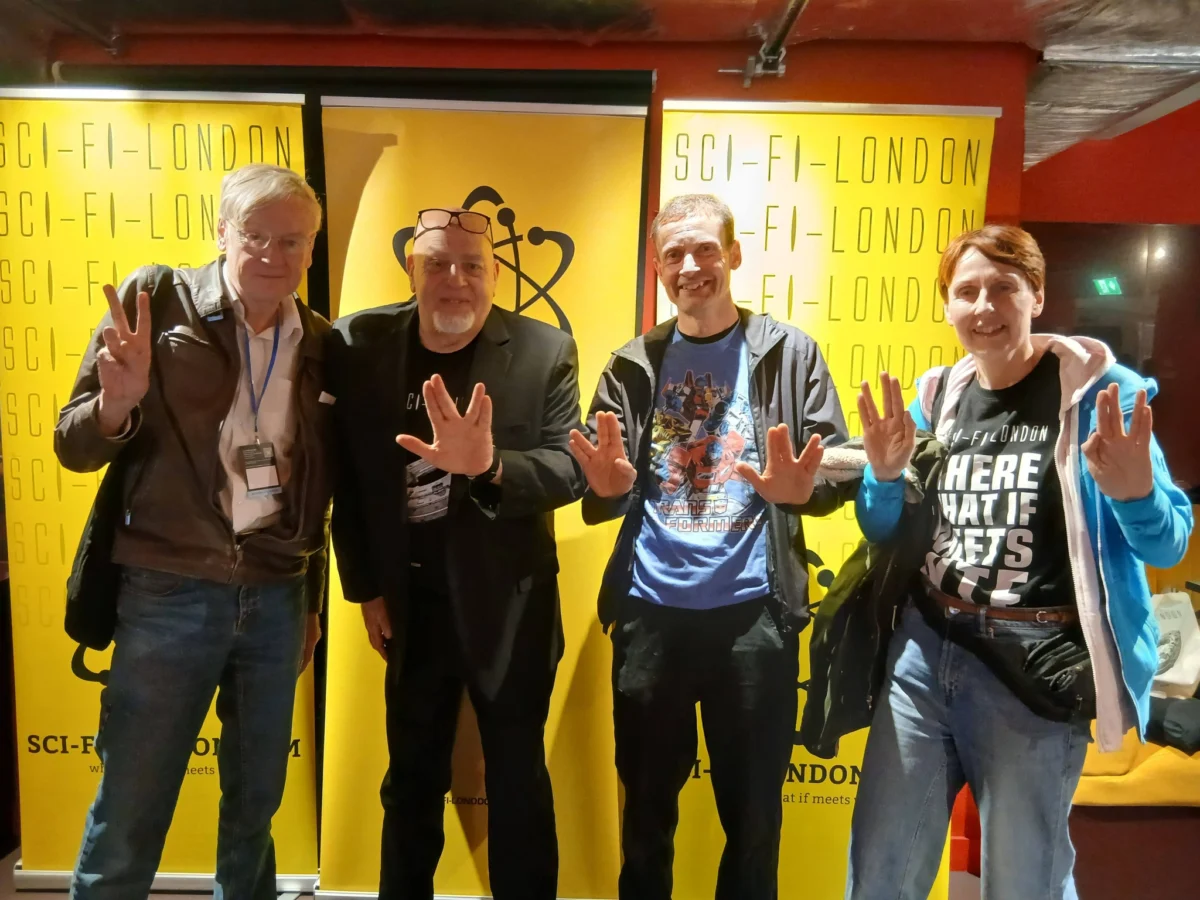
The Northumberland Heath Science Fiction Society recently marked a significant presence at the acclaimed Sci-Fi London event. Jonathan Cowie, a prominent figure in the community, shared a commemorative photograph capturing the camaraderie of the gathering.
The image features Cowie alongside event director Louis Savey, as well as siblings Stephen and Julie Perry. Such gatherings remain the heartbeat of the genre, providing a physical space for fans and professionals alike to bridge the gap between digital discourse and tangible community building. As the genre continues to expand into global streaming and massive media franchises, these grassroots organizations serve as a vital anchor, preserving the intimate spirit of fandom.
II. The "Impossible Franchise": Is Star Wars Cursed on the Big Screen?
The latest edition of the "Week in Geek" newsletter, penned by Ben Childs for The Guardian, has sparked a fierce debate regarding the cinematic future of the Star Wars universe. Following the massive, albeit uneven, success of the sequel trilogy and the subsequent pivot to Disney+ content, the franchise finds itself at a crossroads.
The Shift in Strategy
When Disney acquired Lucasfilm in 2012 for $4 billion, the move was widely viewed as a masterstroke. However, the transition from event-cinema to a "conveyor belt" model of streaming content—Andor, Ahsoka, The Mandalorian—has shifted audience expectations. While streaming allowed for deep dives into the minutiae of galactic politics, it also inadvertently "televisualized" the brand.
The Critical Reception
The latest project, The Mandalorian and Grogu, currently holds a precarious 61% rating on Rotten Tomatoes. While critics praise its polish and charm, many argue that it feels thin and formulaic. The central question remains: Has the franchise become too bloated to survive the transition back to the grand scale of the big screen? Or is the "curse" simply a symptom of a fandom that has grown hyper-critical after 14 years of constant, high-frequency content output?

III. Analog Nostalgia: The Postcard Liberation Front
In an era of instant digital communication, Paul Riddell of The Annals of St. Remedius Medical College is orchestrating a unique project: The Postcard Liberation Front. Riddell is distributing a massive, decades-spanning collection of postcards, bumper stickers, and stationery to those who still crave the tactile experience of physical media.
The collection, totaling 391 items, serves as a time capsule of pre-internet life. From museum souvenirs and natural history ephemera to cards from long-defunct businesses, the collection offers a poignant look at how we once memorialized our travels. Riddell’s project is not just a giveaway; it is a commentary on the "hoarding" of physical media and an invitation to reconnect with the world through the mailbox rather than the inbox.
IV. Fiscal Transparency: Locus Science Fiction Foundation
Financial transparency provides a rare glimpse into the health of the industry’s supporting institutions. According to a reconstruction of the 2024 Form 990 filed by the Locus Science Fiction Foundation, the organization has seen significant growth. Total revenue surged from $617,000 to $1.055 million, driven largely by a sharp increase in contributions and grants. While raw financial data cannot capture the nuances of non-profit operations, the upward trend suggests a robust level of support for the infrastructure that sustains science fiction literature and critical discourse.
V. Retrospective: Stanley Kubrick’s The Shining at 46
As we look back at the legacy of genre cinema, Cat Eldridge provides a deep dive into Stanley Kubrick’s 1980 masterpiece, The Shining. Despite a "mixed" reception upon its initial release, the film has aged into a titan of the psychological horror genre.
The Conflict of Vision
The tension between Stephen King’s original source material and Kubrick’s directorial vision remains one of the most famous rifts in literary-to-film adaptation history. Kubrick’s penchant for multiple, varying prints of his films further complicates the viewing experience, with the original director’s cut running significantly longer than versions seen by later audiences.
Critical Evolution
Critics like Gene Siskel famously dismissed the film as a "crashing disappointment," while modern voices like Peter Bradshaw have hailed it as a "logistical marvel." Roger Ebert’s assessment remains the most enduring, focusing on the film’s fundamental challenge: forcing the audience to grapple with the reliability of the observer. With a 93% audience score on Rotten Tomatoes, the film has firmly cemented its status as a cultural monolith.

VI. Scientific Frontiers: From Lunar Rovers to Black Holes
Science is rarely stagnant, and recent reports highlight the intersection of historical exploration and theoretical physics.
The Lunokhod 1 Resurrection
The Soviet Union’s Lunokhod 1 rover, which went silent on the moon in 1971, has returned to the scientific fold. For decades, the rover was "misplaced," until NASA’s Lunar Reconnaissance Orbiter located it in 2010. Researchers were shocked to find the French-built laser retroreflector in excellent condition, returning signals four times stronger than its successor, Lunokhod 2. This serves as a reminder that hardware left in the harsh environment of space can endure long past its intended mission life.
Crystals of Spacetime
Theoretical physics is currently abuzz with a new discovery regarding "crystals of space and time." Researchers from Goethe University Frankfurt and TU Wien have derived a formula describing how spacetime can organize into regular, crystal-like structures. Under specific conditions of "critical collapse," these structures may potentially collapse into microscopic black holes, opening new doors for understanding the fundamental fabric of our universe.
VII. Antarctic Ice and the Interstellar Odyssey
In a fascinating study published in Physical Review Letters, researchers have analyzed Antarctic ice cores to reconstruct the Solar System’s journey through the galaxy. By measuring isotopes of Iron-60—a byproduct of supernova explosions—scientists can map when the Earth passed through interstellar dust clouds.
The data suggests that between 40,000 and 81,000 years ago, the interstellar medium surrounding our Solar System was significantly different than it is today. This research, led by D. Koll, provides a "fossil record" of our movement through the Local Bubble, proving that our cosmic environment is as dynamic as our terrestrial one.
VIII. Robotics: The Rise of the Real-Life Mecha
The line between science fiction and engineering continues to thin with the unveiling of the GD01 by the Chinese firm Unitree. This 10-foot-tall, 1,100-pound humanoid robot is capable of transitioning from a bipedal walking stance to a quadrupedal "bounding" gait to traverse difficult terrain.

Intended for civilian transport and heavy-duty utility, the GD01 resembles the mobile suits seen in Gundam SEED. With a price point of $572,000, it is a luxury item for now, but its existence signals a shift toward a future where human-operated mecha become a practical, if specialized, tool in the real world.
IX. Implications: The Convergence of Fact and Fiction
The events of the past week highlight a recurring theme: our collective obsession with the unknown. Whether we are analyzing the decay of iron isotopes in ancient ice, debating the creative direction of a space opera, or watching a mechanical giant walk across a stage, we are engaged in a constant effort to define our place in the universe.
The growth of the Locus Science Fiction Foundation and the enduring legacy of films like The Shining suggest that we are not merely consuming stories; we are building a culture that values the exploration of the "what if." As we look to the future—whether it’s through the lens of a telescope, the pages of a book, or the mechanical legs of a robot—one thing is clear: the spirit of inquiry that drives science fiction is the same spirit that drives human progress.









No comments yet. Be the first to join the conversation!