

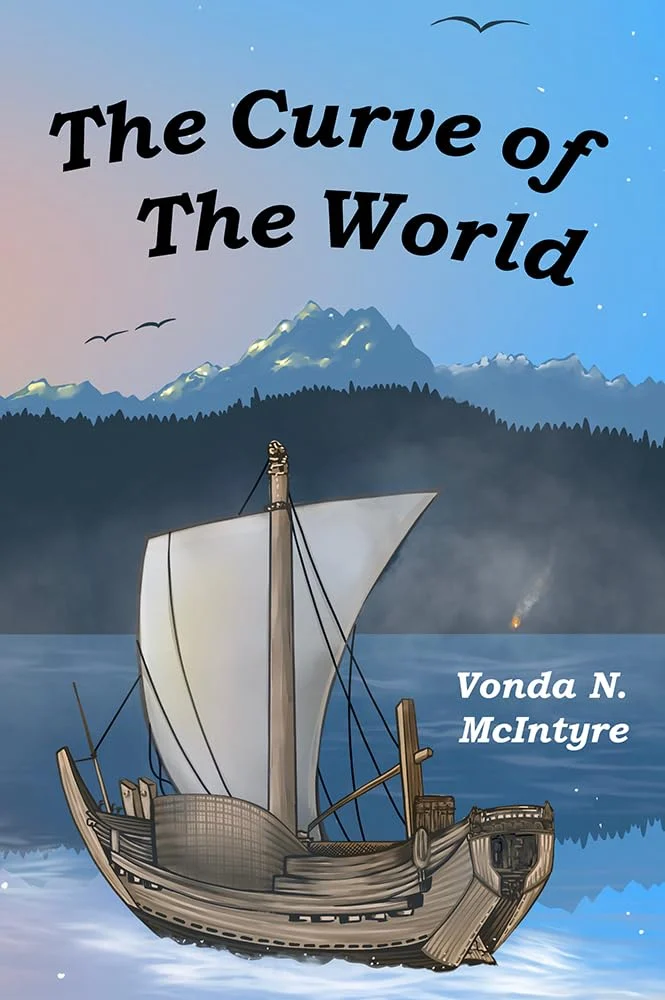
The literary world recently saw the release of The Curve of the World, the final novel by the late, legendary science fiction and fantasy author Vonda N. McIntyre. Known for her Hugo and Nebula-winning contributions to the genre and her tireless advocacy for feminist perspectives within the SFF community, McIntyre left behind a manuscript that serves as both a testament to her creative vitality and a complex puzzle for her editors. Published posthumously, the novel offers readers a final glimpse into the mind of a pioneer who helped shape modern speculative fiction.
Main Facts: A World of Idaean Complexity
The Curve of the World is a work of alternate history, seasoned with the “supernatural stardust” that characterized much of McIntyre’s earlier work. Set in a version of the ancient world where the Mediterranean—referred to as the "Sunset Sea"—is dominated by the Idaeans, a Minoan-esque, bull-dancing civilization, the novel defies easy chronological mapping. As the author herself wryly warned in the acknowledgements: “Do not try to match the Idaean timeline to ours because your head will explode.”
The narrative centers on Iakinthu, a Gephyra (trade manager and chief negotiator), as she embarks on an ambitious voyage from the heart of the Idaean civilization toward the “Sunset Country” across the Western Ocean—a journey that mirrors a transition from the cradle of the Mediterranean to the North American continent. Along the way, Iakinthu and her crew, including her lover Aranthau, navigate political upheaval, the remnants of a mysterious "sea people" race, and the looming threat of brutal, patriarchal barbarians who hunt them across the globe.
Chronology and Context: The Evolution of a Final Masterpiece
To understand The Curve of the World, one must view it through the lens of McIntyre’s long-standing fascination with the “sea people.” This recurring motif traces back to her early short stories, such as “The Genius Freaks” (1973) and “The End’s Beginning” (1976), and appears in her collaborations with the late Ursula K. Le Guin.
The timeline of the novel’s creation is equally significant. McIntyre passed away in her Seattle home in 2019, just as Handheld Press was preparing a new edition of her seminal 1975 novel, The Exile Waiting. At the time of her death, The Curve of the World existed in its fifth draft. Recognizing the magnitude of the work, publisher L. Timmel Duchamp and editors Nisi Shawl and their colleagues undertook the delicate task of finalizing the manuscript.
This posthumous editing process provides a critical context for the reader. While the editors have preserved the narrative’s integrity, the text occasionally reveals the seams of an unfinished project. For instance, the inconsistent naming of the Idaean heartland—appearing as both “Kunusu” and the placeholder “Knossos”—suggests that McIntyre was still refining the geography of her world at the time of her passing.
Supporting Data: Technical Constraints and World-Building
McIntyre’s approach to world-building in this novel is famously meticulous, focusing on an Iron Age technological level. The absence of gunpowder or industrial metallurgy is replaced by a sophisticated reliance on maritime technology and a labor-heavy economy.
The Mechanics of the Idaean World
- Maritime Innovation: The Flying Fish, the primary vessel in the novel, represents the pinnacle of Idaean engineering. Its clinker-built design and massive sails suggest a society capable of sustained, large-scale labor—a necessity, as the weaving of a single ship’s sail is depicted as a year-long undertaking.
- The Sea-People Connection: Aranthau, Iakinthu’s lover, serves as the bridge between the natural world and the supernatural. His ancestry allows him to "read" the currents and negotiate with sea creatures, providing a necessary, albeit painful, advantage in their survival.
- Societal Structures: The world is defined by its matriarchal underpinnings. Idaean society prioritizes female decision-makers, contrasting sharply with the antagonist barbarian culture, which enforces rigid gender roles and the systemic enslavement of women.
The novel’s exploration of these social structures is not merely descriptive; it is central to the plot. The introduction of a kidnapped barbarian boy, renamed "Bdarde" by Iakinthu, serves as a catalyst for tension, forcing the protagonists to confront the brutal ideologies of the cultures they encounter on their voyage.
Official Responses and Editorial Challenges
The editorial team, led by L. Timmel Duchamp, faced the unenviable task of bringing a sprawling, multi-layered epic to completion without the author’s final guidance. The response from critics and scholars has been largely one of admiration, tempered by a recognition of the book’s structural idiosyncrasies.
In her foreword, Duchamp details the collaborative effort required to stabilize the text. It remains unclear how much of the later chapters was shaped by the editorial team versus what was present in the fifth draft. Critics note that while the first quarter of the book possesses a gripping, urgent vitality, the narrative pacing slows significantly as it transitions into a "travelogue of wonders."
The inclusion of certain plot elements—such as the near-impossible method of moving a ship across the Panama land bridge or the sudden convenience of a multilingual translator character, "Bridges Words"—has sparked debate. Some readers view these as charming eccentricities of a brilliant mind, while others argue they represent a drift away from the central plot as the author prioritized world-building over narrative momentum.
Implications: A Legacy of Feminist Speculative Fiction
The implications of The Curve of the World extend beyond its success as a standalone novel. It serves as a final chapter in the career of a writer who challenged the male-dominated norms of science fiction for decades. By focusing on a matriarchal society and the fluid, often non-traditional bonds between characters, McIntyre reinforces her commitment to exploring "what if" scenarios that center on women’s agency and collective identity.
The novel also highlights the difficulty—and the importance—of publishing posthumous works. Despite the occasional "over-egged" description of communal meals or the repetitive use of olive oil as a cultural motif, the book succeeds as an immersive experience. The scenes depicting the Flying Fish navigating the volcanic aftermath of a Gulf of Mexico eruption are widely considered to be some of the most powerful writing of McIntyre’s career, demonstrating her ability to blend geological catastrophe with human drama.
Final Thoughts
While The Curve of the World may not be the most polished of McIntyre’s novels, it is perhaps her most ambitious. It is a work that demands patience from the reader, rewarding them with a slow-burn immersion into a beautifully realized, if occasionally uneven, reality.
As we look back on the career of Vonda N. McIntyre, this novel stands as a fitting, if bittersweet, conclusion. It captures the essence of a writer who never stopped asking questions, never stopped experimenting with technology and society, and never stopped pushing the boundaries of the genre she loved. For fans and scholars alike, the journey offered by the Flying Fish is one worth taking—a final, sweeping arc that connects the ancient foundations of our own history to the infinite possibilities of the speculative unknown. Though the "big one" (the volcanic eruption) that threatens the Idaeans serves as a constant, ticking clock, the real treasure of the book lies in the journey itself, proving that even at the end, Vonda N. McIntyre had worlds left to explore.










No comments yet. Be the first to join the conversation!