Asep Darmawan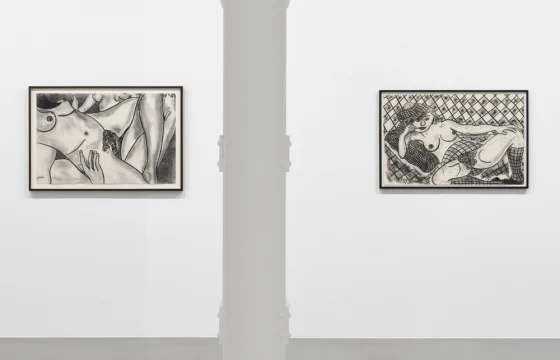
Introduction: A Provocative Return to Form
Galerie Max Hetzler in Berlin has announced an expansive solo exhibition titled X-Rated (1972–1974), showcasing a seminal body of work by the American artist William N. Copley (known professionally as CPLY). Marking the fourth dedicated presentation of his work at the gallery, this exhibition offers a deep dive into a period of radical artistic liberation. Running through April 22, 2026, the show invites contemporary audiences to revisit the intersection of high art and adult imagery, exploring how Copley managed to transform the illicit into the celebratory.
Copley’s X-Rated series is not merely an historical curiosity; it is a profound examination of the human impulse for pleasure, filtered through a lens of biting humor, Surrealist tradition, and an unabashedly pop-cultural aesthetic. In an era where visual culture is increasingly sanitized, Copley’s bold, unapologetic canvases remain as subversive as they were half a century ago.
Chronology: From Surrealist Peddler to Maverick Painter
To understand the X-Rated series, one must first look at the idiosyncratic trajectory of Copley’s life. Born into a world of conventionality, Copley initially harbored literary ambitions. However, his life took a sharp turn in the late 1940s when he co-founded the Copley Galleries in Beverly Hills alongside his brother-in-law, the artist John Ployardt.
The Surrealist Apprenticeship
The Copley Galleries were short-lived, yet their impact was seismic. By focusing exclusively on Surrealism, Copley found himself rubbing shoulders with the titans of the 20th-century avant-garde: Man Ray, Max Ernst, and Marcel Duchamp. The legendary dealer Alexander Iolas, recognizing a kindred spirit in the young Copley, urged him to transition from promoting art to creating it.
By 1951, having adopted the nom de plume "CPLY," he held his first exhibition at a Los Angeles bookstore before relocating to France. This move across the Atlantic cemented his identity as an outsider—a man who bridged the gap between American Pop art’s flat, commercial aesthetic and the European intellectual depth of Surrealism. He was, in essence, a generation younger than his mentors but spiritually tied to their quest for the irrational and the subconscious.
The Evolution of a Style
Throughout the 1950s and 60s, Copley honed a signature style characterized by bold black outlines and a self-taught, almost cartoonish figurative language. While his peers were busy abstracting their inner lives, Copley was narrating them. He utilized a literary sensibility to structure his compositions, treating every painting as a scene in a much larger, often erotic, play.
Supporting Data: The Anatomy of the ‘X-Rated’ Series
The core of the Berlin exhibition is the X-Rated series, produced between 1972 and 1975. The project originated during a period in the United States when hardcore pornography remained legally precarious. Copley, fascinated by the intersection of ritualized sexual motifs and artistic composition, began collecting "adult magazines" under the counter.
The Philosophy of the Erotic
Copley did not seek to produce pornography; rather, he sought to "break through the barrier of pornography into the area of joy." His goal was to strip away the shame and the moralizing gaze, replacing it with something more human and far more complex. He famously remarked, "That’s what makes sex so much fun: since nobody really understands it, the possibilities for originality are endless."
The Creative Process: From Sketch to Canvas
The technical rigor behind these paintings often surprises viewers who mistake his "slapdash" aesthetic for a lack of skill. Copley’s process was disciplined:
- Initial Study: A small-scale drawing to capture the raw energy of a composition.
- Refinement: A larger, secondary drawing where he introduced geometric dynamism and structural adjustments.
- Execution: The final painting, where figures were rendered with deliberate looseness.
The exhibition at Galerie Max Hetzler provides a rare glimpse into this development by displaying multiple pairings of preparatory drawings alongside finished works, such as Calcutta (1973) and its untitled counterpart. This transparency reveals how Copley manipulated the "pornographic" source material into a highly curated, artful narrative.
Official Responses and Critical Legacy
When the X-Rated series was first exhibited in 1974 at the New York Cultural Center, it faced the potential for public outcry. Yet, under the guidance of the institution’s director, Mario Amaya, the show was received with surprising intellectual warmth.
Critical Reception
Critics were forced to reckon with the duality of the work: the raw sexual content versus the sophisticated formal execution. Peter Schjeldahl, writing for Art in America, described the exhibition as "uniformly gorgeous," noting that it represented a "highly satisfying development in Copley’s work."
Other critics, such as James R. Mellow, observed that the backgrounds—animated by vivid, geometric patterns—were "almost too artful to be libidinous, let alone lascivious." These critics frequently drew comparisons to Henri Matisse, noting that while both artists were masters of the nude, Copley’s work was uniquely devoid of the traditional "idealization" found in art history. Instead, he presented the act directly, challenging the viewer to confront their own discomfort.
Implications: Why Copley Matters Today
The "X-Rated" designation—a term borrowed from the film industry to denote material for adults—was a strategic choice. By titling his works after Hollywood films like The Exorcist or Les Quatre Cent Coups, Copley created a jarring, surrealist disjunction. The titles offer a thread for the viewer to follow, yet they rarely align with the visual content of the paintings. This ambiguity forces the viewer to engage in a mental game of association.
A Subversive Charge
In the context of the early 1970s, Copley’s work was an act of defiance against the conservative art establishment and the moralistic constraints of the era. Today, in an age of hyper-connectivity and the relentless consumption of digital imagery, his paintings retain a distinct, subversive charge.
Copley’s refusal to treat sexual imagery as something to be hidden, or conversely, as something to be hyper-fetishized, remains a radical act. He treated the erotic as a playground for humor and structural experimentation. By removing the "taboo" label, he transformed sexual encounters into scenes of vibrant, patterned, and intellectually demanding art.
Artistic Neutrality and the Moral Landscape
Copley’s career serves as a rebuke to the notion of artistic neutrality. He never pretended to be a detached observer. Instead, he dove headfirst into the messy, confusing, and often hilarious reality of human desire. His work reminds us that art does not exist in a vacuum; it is shaped by the politics of its time, yet the best art manages to transcend those politics to touch on something universal.
As visitors move through the rooms at Galerie Max Hetzler, they are asked to look past the surface-level shock value. They are invited to see the meticulous composition, the historical resonance, and the sheer, unadulterated joy that Copley found in the pursuit of pleasure. In doing so, they engage with an artist who spent his life proving that even the most "prohibited" subjects can become the foundation for a masterwork.
The X-Rated (1972–1974) exhibition is more than a retrospective; it is a challenge to the contemporary viewer to reconsider their own boundaries regarding art, morality, and the expression of human nature.


 Nana Wu
 Suro Senen