

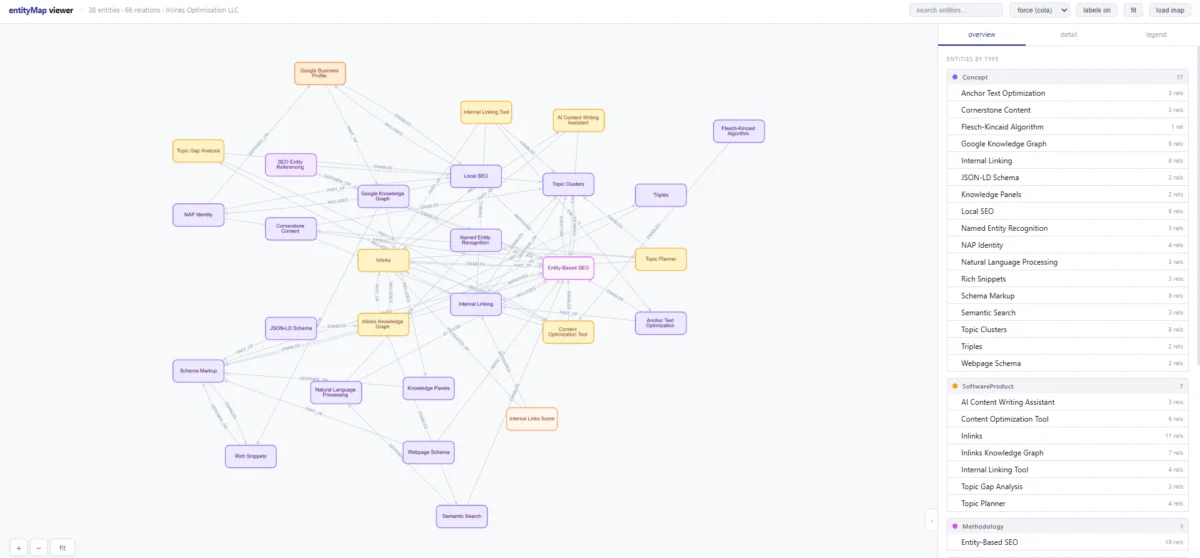
In the current digital landscape, the promise of Artificial Intelligence is colliding with a fundamental architectural flaw. As AI models become the primary interface for information retrieval, they are increasingly prone to "hallucinating" facts about businesses—inventing product names, misattributing expertise, and distorting organizational hierarchies. This is not a failure of the neural networks themselves, but a failure of the medium. The web was built for human navigation through links and prose; AI models, however, require a structured, semantic map to parse reality.
Enter EntityMap, an open-source standard currently undergoing public consultation, which promises to bridge the gap between human-readable websites and machine-readable institutional knowledge.
The Crisis of Probabilistic Retrieval
For decades, the internet has operated on a "page-centric" model. Brands publish content across dozens of disparate pages, hoping that search engines will aggregate these fragments into a coherent picture. When an LLM queries this data, it performs a probabilistic reconstruction. It "guesses" the relationship between a CEO, a service offering, and a specific technical capability based on word proximity and SEO signals.
The result, as seen in recent industry reports, is a landscape of manufactured data. AI systems often mangle facts because they lack an authoritative, structured blueprint of what a company actually is. When a brand’s digital footprint is fragmented, the AI is left to act as a creative writer rather than a data retriever. To fix this, the industry requires a move toward a "structured layer of meaning"—a way to explicitly define knowledge, map relationships, and anchor every claim in verifiable evidence.
A Chronology of the Initiative
The development of EntityMap represents a significant shift in how organizations can assert control over their AI representation.
- Pre-2026 (The Problem Phase): Industry discourse shifted from "How do we rank?" to "How does AI perceive us?" With the rise of RAG (Retrieval-Augmented Generation) systems, brands found themselves at the mercy of black-box algorithms that frequently misinterpreted their core value propositions.
- May 2026 (The Public Launch): EntityMap formally entered its public consultation phase, introducing a unified JSON-based standard for organizational knowledge.
- June 30, 2026 (The Consultation Deadline): The project established a 33-day window for technical critique, implementation testing, and community feedback.
- July 1, 2026 (Scheduled Launch): Following the review, the standard is slated for its formal release, setting the stage for wide-scale adoption by developers and SEO professionals.
Distinguishing EntityMap from Existing Standards
A common point of confusion is how EntityMap differentiates itself from the stalwarts of the web: sitemap.xml and schema.org. To understand its utility, one must understand the hierarchy of information.
The Sitemap (The Directory)
Sitemap.xml functions as a navigational guide for crawlers. It informs systems what pages exist on a domain. It is a roadmap of the library, but not a summary of the books.
Schema.org (The Annotator)
Schema.org provides context for individual pages. It tells a crawler that a specific string of text is a price, or that a specific image is a product. However, it remains page-bound. It struggles to communicate the "big picture" of a massive, multi-faceted organization.
EntityMap (The Semantic Blueprint)
EntityMap serves as a centralized, machine-readable declaration of institutional truth. It does not replace the existing standards; it acts as a superstructure. By publishing a single EntityMap file, an organization can articulate its internal knowledge graph: "These are our core services, these are the people who lead them, and here is the peer-reviewed evidence that proves our capability."
For a healthcare firm, this means linking treatment protocols directly to clinical studies. For a SaaS provider, it means explicitly defining how feature X differs from feature Y, effectively "hard-coding" the brand’s value proposition for the AI, rather than leaving it to the LLM to infer from marketing fluff.
How It Works: The Mechanics of Truth
EntityMap is designed for simplicity, ensuring that adoption is not restricted to organizations with massive engineering budgets. At its core, the file consists of three pillars:
- Entities: Explicit definitions of the "things" that matter—people, products, locations, regulations, and areas of expertise.
- Relations: The logic connecting these entities (e.g., “This consultant [Entity A] leads this department [Entity B],” or “This regulation [Entity C] mandates this compliance measure [Entity D].”)
- Evidence Chunks: The most critical component. Every claim is linked to a source URL, accompanied by metadata including the publisher’s name and a timestamp.
This metadata is designed to survive the journey into vector databases. When an AI retrieves a chunk of information to answer a user’s question, it carries the citation with it, maintaining the chain of evidence. This ensures that when a model makes a claim, it can provide an accurate source, effectively ending the era of "hallucinated attribution."

Implications for the Digital Ecosystem
The adoption of EntityMap will have profound ripple effects across several professional verticals.
For SEO and Digital Marketing
The era of "keyword stuffing" is long dead, but the era of "entity optimization" is just beginning. SEO professionals will now have a new lever to pull. By managing an EntityMap, they can ensure that search engines and AI assistants possess an accurate, high-fidelity version of their brand’s expertise. This is not a replacement for traditional content, but a way to amplify it.
For Publishers and Media
Attribution is the lifeblood of journalism. As content is disaggregated and served up in AI-generated "answers," publishers risk losing the link back to their original work. EntityMap allows publishers to define their knowledge and mandate that their attribution remains intact, even as their prose is repurposed by LLMs.
For Regulated Industries
Financial services and legal firms face existential risks if an AI misrepresents their services. A legal firm can use EntityMap to clearly define the boundaries of their expertise, preventing AI from recommending them for services they do not provide. Similarly, financial institutions can use it to ensure that regulatory disclosures are accurately parsed and presented.
The Call to Action: Why Feedback Matters
The EntityMap project is currently in a "non-ceremonial" consultation phase. With the endorsement of R.V. Guha, one of the original architects of schema.org, the project carries significant technical weight. However, the success of the standard relies on real-world testing.
The project leads are specifically calling for:
- Technical Critique: Developers are invited to stress-test the schema. What happens when it scales to millions of entities? Does the JSON structure hold up in complex environments?
- Predicate Refinement: The standard currently includes 24 core predicates (e.g.,
IMPROVES,DEPENDS_ON). Are these sufficient? Does a manufacturing firm need a different set of semantic abstractions than a non-profit? - Tooling Development: The ecosystem needs generators, validators, and management dashboards. The project is actively seeking developers to build the "infrastructure of the infrastructure."
A New Social Contract for AI
We are currently witnessing a turning point in the relationship between human organizations and synthetic intelligence. For years, companies have watched in frustration as AI models misinterpreted their work. EntityMap shifts the power dynamic: it provides a way for organizations to assert, "This is who we are, this is what we do, and here is the proof."
The standard is published under the CC BY 4.0 license, ensuring that it remains free of vendor lock-in and proprietary control. By providing a clear, open, and machine-readable format, EntityMap aims to make the web a more reliable source of truth for the next generation of intelligence.
As the June 30th deadline approaches, the question for every organization is no longer "Will AI talk about us?" but rather "Will we give the AI the map it needs to tell our story correctly?" The tools are available, the specification is open, and the opportunity to define your brand’s future in the AI era is now.
Resources for Participation:
- Specification: entitymap.org/spec/v1.0
- Validation Tool: entitymap.org/validate
- Community Hub: github.com/entitymap
Disclosure: The author is the CEO of InLinks and Waikay, both of which support the EntityMap standards proposal.












No comments yet. Be the first to join the conversation!