

The landscape for PC hardware enthusiasts in 2026 has become increasingly treacherous. As the insatiable global demand for artificial intelligence infrastructure continues to consume vast quantities of logic, memory, and storage wafers, the consumer graphics market has felt the tremors. For the average gamer, building a high-performance rig is no longer just a hobby; it is a battle against supply chain constraints and inflated price-to-performance ratios.
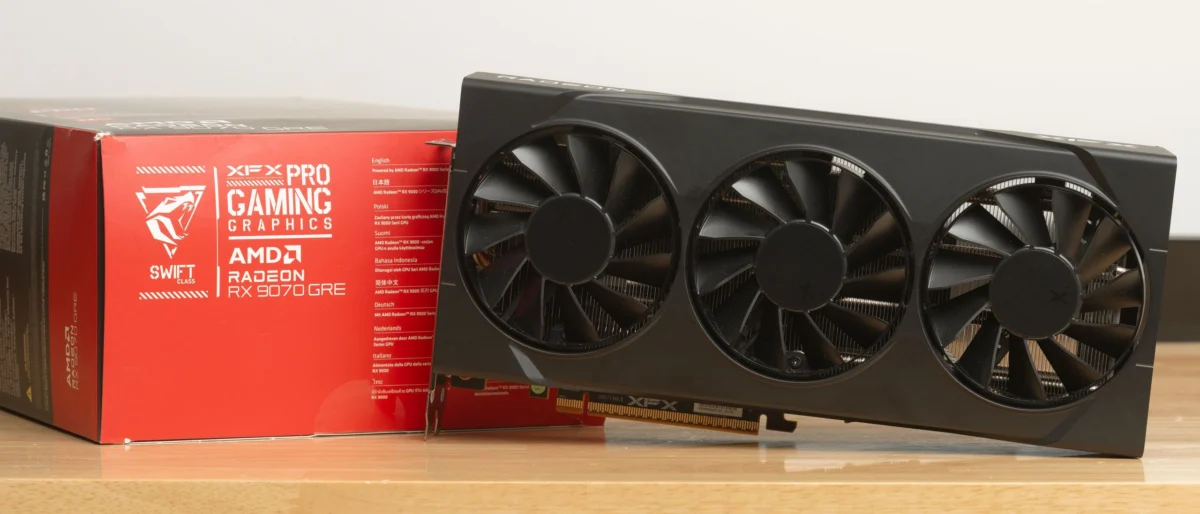
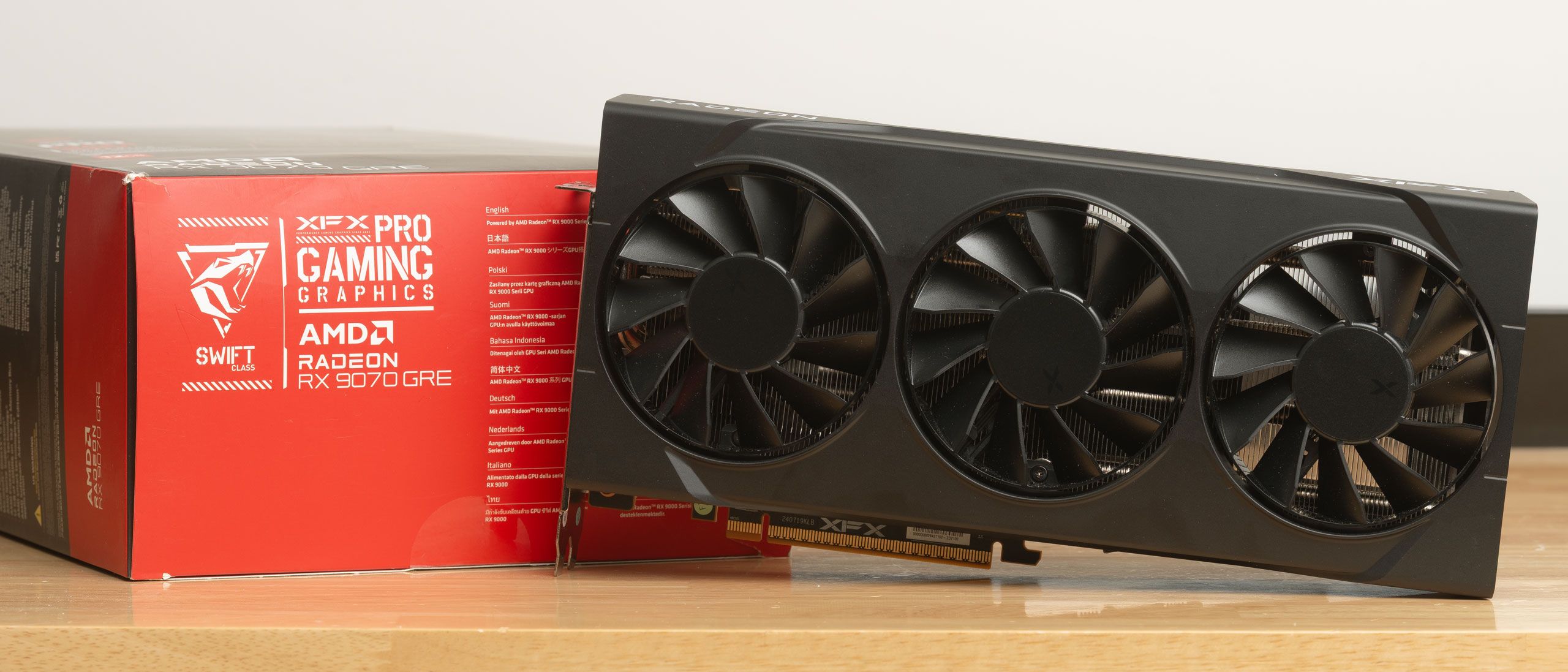
Into this turbulent environment, AMD has launched the Radeon RX 9070 GRE (Great Radeon Edition). Originally an exclusive offering for the Chinese market, this card is now making its global debut. At a launch price of $549, the 9070 GRE attempts to carve out a niche for those seeking high-refresh-rate 1080p and 1440p gaming without the exorbitant premiums now attached to high-end hardware. However, as our testing reveals, the card’s success is hampered by its cut-down architecture and the shifting expectations of the modern gaming software stack.
The Core Specs: Understanding the Navi 48 Cut-Down
At the heart of the RX 9070 GRE lies the Navi 48 GPU—the same silicon found in the more powerful RX 9070 and 9070 XT. However, the "GRE" designation implies significant pruning. Where the standard 9070 utilizes 56 RDNA 4 compute units, the GRE version is restricted to just 48. This reduction has a direct, measurable impact on texture sampling throughput, pixel fill rates, and raw floating-point operations (FLOPS).
Furthermore, AMD has opted for a leaner memory configuration. The card features 12GB of GDDR6 memory running at 18 Gbps across a 192-bit bus. This results in 432 GB/s of raw bandwidth, a marked 33% decrease compared to the 9070 and 9070 XT, which utilize 20 Gbps memory and wider buses. While 12GB remains serviceable for current 1080p and 1440p gaming, it places a hard ceiling on the card’s longevity, particularly in ray-traced titles and 4K scenarios where memory overhead is critical.
A Chronology of Market Displacement
The trajectory of the 9070 GRE is best understood through the lens of recent market shifts. When the standard RX 9070 launched a year ago at $549, it was viewed as a capable mid-to-high-tier contender. Today, that same price point is being challenged by a broader "price creep."
- Mid-2025: High-end GPUs began to see significant price hikes as AI demand surged. The RX 9060 XT 16GB, originally intended to be a $349 value king, saw its street price climb toward $450.
- Late 2025: The RTX 5060 Ti 16GB, once a $429 competitor, drifted toward the $570 range, effectively pricing itself out of relevance.
- Early 2026: Mid-range cards like the standard RX 9070 and RTX 5070 rose from their $549 MSRPs to closer to $650, leaving a vacuum for a "true" mid-range product.
The arrival of the 9070 GRE is AMD’s attempt to fill this void. By offering a card at the original $549 MSRP, AMD is hoping to capture the "entry-level enthusiast" demographic that has been alienated by the rising costs of the 50-series and higher-end 9000-series cards.
Technical Performance and AI Integration
The RDNA 4 architecture is AMD’s first to feature dedicated matrix math accelerators. These units are designed specifically for AI-driven tasks, such as upscaling and frame generation. Additionally, the architecture boasts improved Ray Tracing (RT) units, claiming up to a 2x improvement in performance over the previous RDNA 3 iteration.
The card also includes a modernized media engine, significantly improving encode and transcode speeds—a welcome addition for streamers and content creators. However, in our benchmarks, the GRE’s hardware limitations become apparent. While it excels at rasterization at 1440p, the combination of 12GB of VRAM and the reduced CU count creates a bottleneck in titles that demand heavy ray tracing. Compared to its stablemates, the GRE struggles to maintain high frame rates when path-tracing or advanced global illumination effects are enabled at resolutions above 1080p.
The Software Divide: Why Hardware is No Longer Enough
In 2026, a graphics card’s value is inextricably linked to its software ecosystem. Nvidia’s DLSS (Deep Learning Super Sampling) has become the gold standard, not just for image quality, but for the breadth of developer adoption. Owners of GeForce cards benefit from consistent, day-one support for DLSS versions, and the maturity of Multi-Frame Generation on the Blackwell architecture has effectively eliminated the early latency issues that plagued the technology.
AMD’s FSR 4 and 4.1 are technically competitive in terms of raw upscaling quality, but they lack the ubiquity of Nvidia’s suite. Community feedback consistently points to a preference for DLSS, and AMD remains on the back foot regarding frame generation multipliers. While Intel has successfully implemented 3x and 4x multipliers for its Arc products, AMD’s FSR 4 ML Frame Generation remains largely capped at a 2x multiplier, limiting its utility in high-refresh-rate gaming.
Perhaps more damaging is the "feature lockout." Titles such as Resident Evil Requiem and Pragmata feature path-traced effects that are effectively off-limits to Radeon users, as AMD lacks an equivalent to DLSS Ray Reconstruction in those specific implementations. This divergence forces a difficult choice upon the consumer: pay for the raw raster performance of a Radeon card, or pay for the comprehensive feature set of the GeForce ecosystem.
Implications for the Future
The RX 9070 GRE serves as a litmus test for AMD’s current strategy. On one hand, it provides a stable, performant path for gamers who prioritize rasterization and high-refresh gaming at 1440p. On the other, its pricing is conservative for a card that arguably needs to be more aggressive to overcome the software gap.
If AMD is to regain market share, it must address two fronts. First, it requires a more aggressive pricing strategy to justify the "feature deficit" compared to Nvidia. A price point closer to $479 would have made this card an automatic recommendation for budget-conscious enthusiasts, effectively disrupting the current market pricing. Second, AMD must increase its investment in developer relations. As the gap in RT denoising and AI-upscaling support continues to widen with every major AAA release, the burden of "evangelizing" the Radeon ecosystem becomes significantly harder.
For the gamer, the 9070 GRE is a capable card, but it arrives at a time when the decision-making process involves more than just clock speeds and VRAM. It is a reminder that in the modern era, the silicon is only as powerful as the software stack that drives it.
Tom’s Hardware Verdict: The Bottom Line
The Radeon RX 9070 GRE gives gamers a reasonably attainable path to high-refresh-rate 1080p and 1440p raster performance in 2026’s wild graphics market. However, its deeply cut-down GPU and 12GB of VRAM act as significant anchors, particularly when the card is pushed into ray-tracing scenarios at resolutions higher than 1080p. While it fills a necessary gap in the product stack, it ultimately highlights the challenges AMD faces in a market where software features and AI-driven image reconstruction have become as important as raw frame rates.
Expert Note: Our reviewers have spent hours benchmarking the 9070 GRE across a variety of modern engines to ensure that our recommendations reflect real-world usage. For more on our methodology, visit our How We Test guide.












No comments yet. Be the first to join the conversation!