Siti Muinah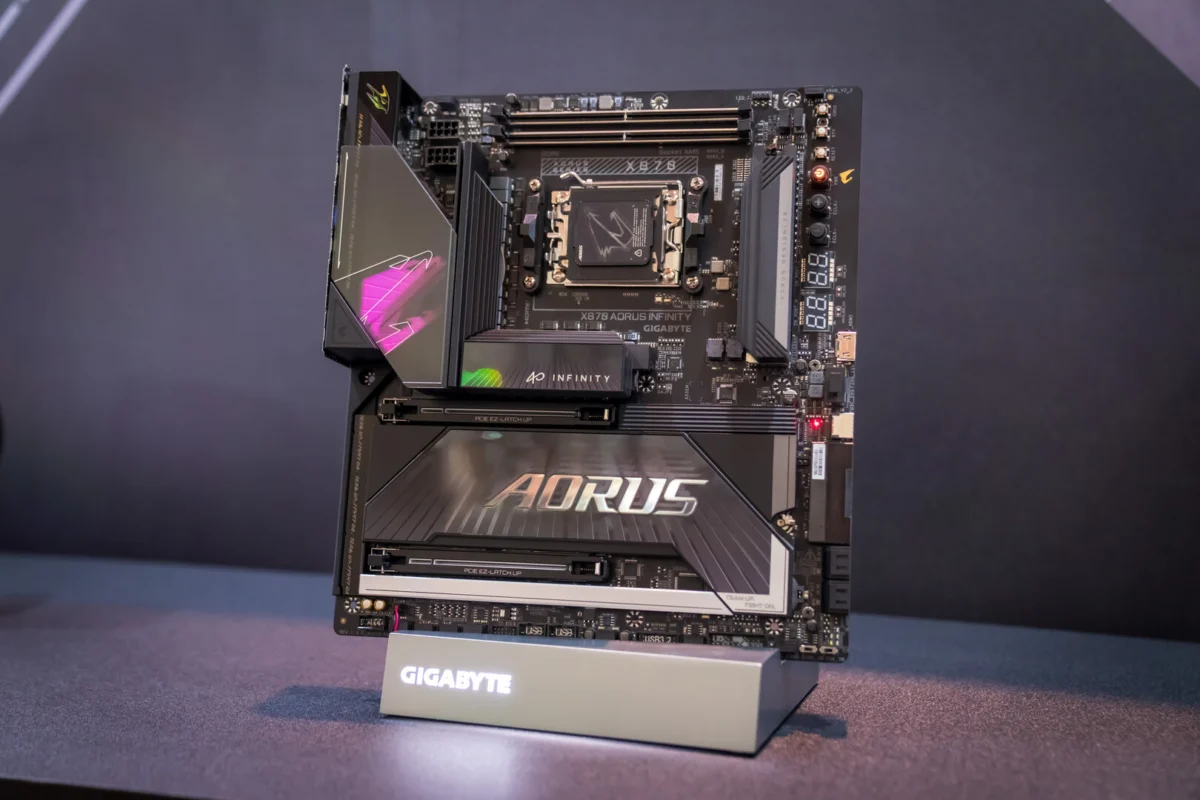
At this year’s Computex, Gigabyte has made a definitive statement regarding the future of high-end desktop computing. By unveiling the new "Infinity" series, the manufacturer is not merely iterating on existing designs; it is fundamentally rethinking how signal integrity, thermal dissipation, and AI-driven performance tuning interact within the modern PC ecosystem. The series, headlined by the X870 Aorus Infinity and the X870E Aorus Infinity Next, represents a departure from traditional manufacturing constraints, moving into a realm of bespoke engineering that blurs the line between hardware and art.
Main Facts: A Dual-Pronged Approach to High-End Performance
The core philosophy behind the Infinity series is simple yet ambitious: remove all physical and thermal bottlenecks. While both boards are built upon the X870 chipset architecture, they serve different masters. The X870 Aorus Infinity is a purist’s tool, designed specifically for extreme overclockers and memory enthusiasts who require raw signal purity. The X870E Aorus Infinity Next, conversely, serves as the technological flagship, showcasing radical manufacturing techniques—specifically additive manufacturing (3D metal printing)—to solve long-standing thermal dissipation issues.
Both boards share a common commitment to high-frequency memory, supporting speeds of up to 11,400 MT/s. By limiting both motherboards to two DDR5 slots, Gigabyte is making a calculated trade-off: sacrificing total memory capacity for the sake of signal integrity and stability.
Chronology: The Evolution of the "Tachyon" Philosophy
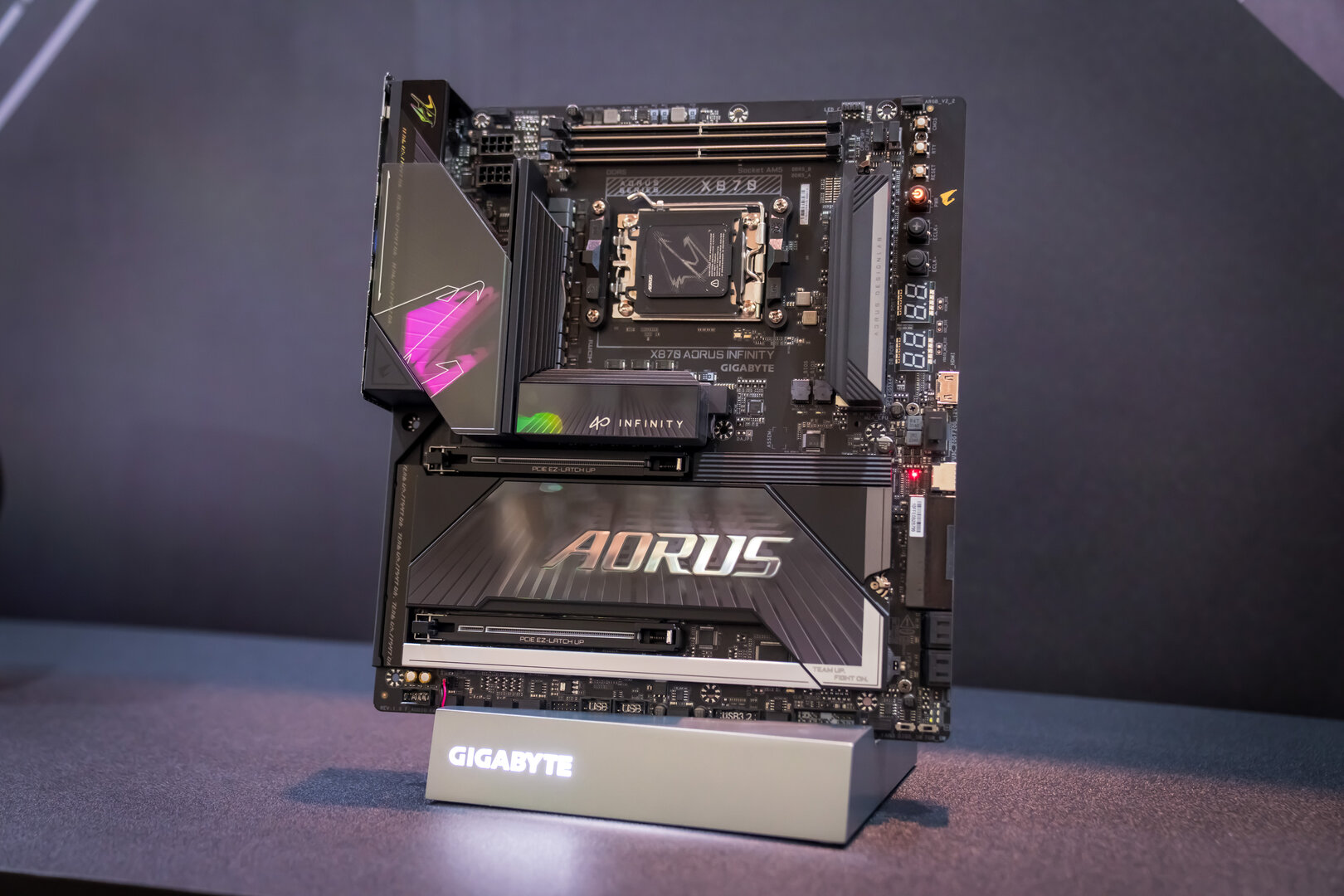
To understand the X870 Aorus Infinity, one must look at the history of Gigabyte’s "Tachyon" series. For years, the Tachyon line has been the industry standard for competitive overclockers. The key innovation, which has been carried over to the X870 Infinity, is the rotation of the CPU socket by 90 degrees counter-clockwise.
The Engineering Logic
In a standard motherboard layout, the RAM slots are positioned to the right of the CPU. By rotating the socket and moving the RAM slots to the top of the board, Gigabyte shortens the physical distance between the processor’s memory controller and the DIMM slots. This reduction in trace length significantly decreases electrical interference, allowing for the extreme frequencies that define modern world-record attempts.
Following the success of this layout in previous generations (such as the AM5 and LGA 1851 platforms), Gigabyte has doubled down on this design for the X870 Infinity. The move is not merely cosmetic; it is a clinical response to the high-frequency requirements of modern memory modules, aiming to achieve CL24 timings at massive MT/s throughput.

Supporting Data: AI, Big Data, and 5,120 Amperes
Performance in the Infinity series is bolstered by software-defined hardware. The introduction of the "AI-enhanced X3D Turbo Mode 2.0" marks a transition from manual BIOS tuning to dynamic, data-driven optimization.
The Brain: AI-Enhanced Tuning
The boards feature a dedicated hardware monitoring chip that continuously tracks load behavior. Gigabyte has integrated an engine trained on "Big Data" sets—likely millions of telemetry data points from various CPU silicon qualities—to create a dynamic overclocking profile. Unlike standard "Auto-OC" features that often over-volt processors, the X3D Turbo Mode 2.0 adjusts voltages and frequencies in real-time, tailoring the output to the unique characteristics of the user’s specific CPU.
The Brawn: Power Delivery
The X870E Aorus Infinity Next is, by all accounts, a monster of power delivery. Gigabyte has opted for premium Infineon OptiMOS MOSFETs—components usually reserved for enterprise-grade data center hardware. The board boasts an astonishing 64-phase power design. Mathematically, this allows for a theoretical delivery of up to 5,120 Amperes. While no current consumer CPU requires such overhead, the design ensures that even under the most extreme sub-zero cooling scenarios, the voltage regulation modules (VRM) will never become the limiting factor.
Official Responses: The "AI Gyroid" and 3D-Printing Innovation
The most visually arresting aspect of the X870E Aorus Infinity Next is the "AI Gyroid" cooling structure. Gigabyte’s design team, speaking at the Computex keynote, emphasized that traditional CNC-machined aluminum heatsinks have reached their physical limits regarding surface area-to-volume ratios.
Breaking Manufacturing Constraints
The Gyroid structure is created via metal 3D printing. The resulting organic, bone-like lattice is impossible to manufacture using conventional casting or milling. The benefits are two-fold:
- Increased Surface Area: The intricate, interconnected design provides a 44% increase in effective cooling surface area compared to standard, blocky heatsinks.
- Biomimetic Efficiency: By mimicking the structural efficiency of internal bone marrow or trabecular bone, the heatsinks are not only lighter but also optimize airflow through the structure, preventing "dead spots" where heat can accumulate.
Gigabyte representatives confirmed that even the vapor chamber is 3D-printed, allowing for an internal geometry that facilitates faster phase-change cycles for the coolant fluid. When combined with a honeycomb-patterned backplate, the board achieves a thermal equilibrium that Gigabyte claims is unprecedented in the desktop space.
Implications: The Future of High-End Desktop Computing
The introduction of the Infinity series suggests that the "Mainstream" motherboard segment is bifurcating. On one side, we have the highly functional, feature-rich boards for daily users; on the other, we have "Ultra-Premium" hardware that behaves more like a scientific instrument than a consumer component.
The Shift Toward Additive Manufacturing
The use of metal 3D printing is the most significant takeaway from the Infinity series. If these manufacturing costs can be scaled, we are likely to see the "AI Gyroid" design language bleed into the mid-range market within the next few years. The ability to print complex, high-surface-area thermal structures means that future motherboards may be smaller, yet capable of cooling components that run significantly hotter than current chips.
The "Overclocker-as-a-Service" Model
The inclusion of AI-driven tuning via Big Data suggests that Gigabyte is moving away from the "BIOS-tinkering" era of overclocking. By delegating the optimization of CPU performance to a dedicated, trained AI chip, the manufacturer is effectively democratizing extreme performance. The user no longer needs to be an expert in voltage curves and load-line calibration; they simply need to enable the "X3D Turbo Mode" and let the hardware optimize itself.
A New Aesthetic Standard
Finally, the aesthetic departure—moving from the rigid, boxy designs of the last two decades to the fluid, organic shapes of the Infinity Next—signifies a cultural shift in PC gaming. The "Infinity" aesthetic acknowledges that high-performance PCs are now central pieces of furniture in home offices and creative studios. The bio-organic, sci-fi aesthetic provides a refreshing contrast to the "gamer-centric" RGB-heavy designs that have dominated the market for so long.
Conclusion: Setting the Bar for the X870 Generation
As the industry moves into the X870 era, Gigabyte has positioned itself not just as a manufacturer, but as a pioneer of extreme hardware engineering. The X870 Aorus Infinity and the X870E Aorus Infinity Next are not for the faint of heart or the budget-conscious. They are professional-grade tools designed for those who view the motherboard not as a static base, but as an active participant in system performance.
By combining 3D-printed thermal solutions, data-center-grade power delivery, and AI-driven performance optimization, Gigabyte has effectively pushed the ceiling of what we can expect from a motherboard. As these technologies inevitably trickle down to more accessible price points, the entire industry will benefit from the research and development poured into this "Infinity" experiment. For now, however, the series stands as a monument to the current limits of silicon and metal, representing the absolute apex of the Computex 2024 showcase.

 Nana Wu
 Ammar Sabilarrohman