

The transition to a new operating system is rarely without its growing pains, but for users running AMD’s latest high-performance processors, the launch of Windows 11 has been marked by more than just minor teething issues. As Microsoft’s latest OS began its global rollout earlier this week, early adopters and performance enthusiasts quickly reported discrepancies in system responsiveness and frame rates. Following a wave of community reports, AMD has officially confirmed that its Ryzen processors are experiencing measurable performance degradation under the new environment.
Main Facts: The Technical Breakdown
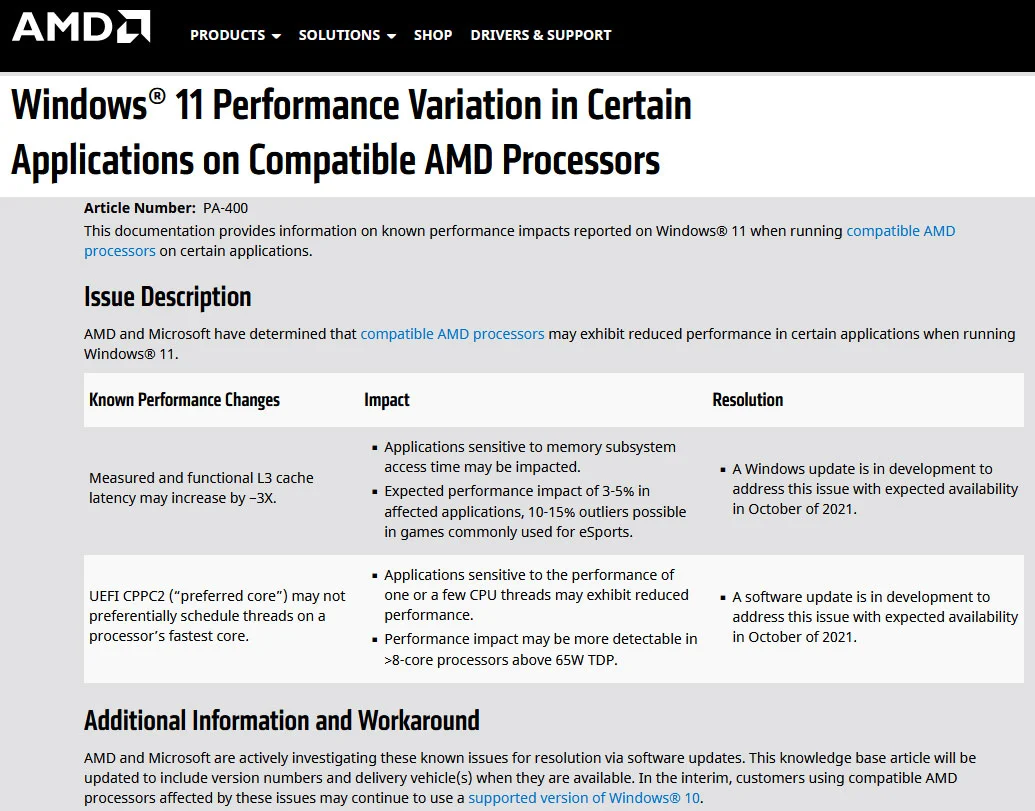
The technical friction between Windows 11 and AMD’s architecture centers on two distinct issues that, while separate, coalesce into a frustrating experience for power users and gamers alike. The primary concern involves a significant increase in L3 cache latency, while the secondary concern relates to the ineffective scheduling of tasks across the processor’s "preferred" cores.
The L3 cache latency issue is the more severe of the two. Under normal operating conditions, the L3 cache is designed to provide rapid data access to the CPU, reducing the need to reach out to slower system RAM. In Windows 11, however, this latency can effectively triple. Because modern processors rely heavily on the speed of their cache to maintain high clock-for-clock performance, this bottleneck creates a ripple effect throughout the system.
The second issue pertains to AMD’s UEFI CPPC2 (Collaborative Processor Performance Control) technology. This feature is designed to allow the operating system to identify the "fastest" cores in a processor—those capable of hitting the highest clock speeds with the lowest voltage—and shift light-thread tasks to them. In Windows 11, this mechanism is failing to trigger consistently. Consequently, tasks are often being assigned to slower cores, leading to suboptimal performance in applications that rely on burst speed rather than massive multi-threading.
Chronology of the Disruption
The issues first surfaced shortly after the Windows 11 launch on October 5, 2021. Within hours of the public release, forums such as Reddit and the official AMD community boards began to fill with anecdotal evidence of lower-than-expected benchmark scores.
- October 5: Windows 11 officially hits the market. Reports of performance degradation on Ryzen-based systems begin to circulate within hours.
- October 6: AMD releases a formal support document acknowledging the "Windows 11 performance variation in certain applications on compatible AMD processors."
- October 7-8: Technical analysts and hardware reviewers confirm the findings, specifically identifying a 3x increase in L3 cache latency and erratic core scheduling on high-TDP, multi-core processors.
- Current Status: AMD has confirmed a collaborative effort with Microsoft is underway. A software patch is expected to be deployed via Windows Update, currently projected for release later in October.
Supporting Data: Quantifying the Impact
The performance degradation is not uniform across all applications, but for those who rely on high-performance computing, the numbers are significant.
The L3 Cache Penalty
AMD’s internal testing and third-party validation have shown that memory-sensitive applications—those that frequently request data from the cache—are the most severely hampered. In general productivity software and professional workloads, users may notice a processing slowdown in the range of 3 to 5 percent. While this might be negligible for casual web browsing or office suites, it represents a tangible loss in workstation efficiency.
The Gaming Conundrum
For the gaming community, the impact is more pronounced. eSports titles, which often depend on high frame rates and low-latency data throughput, have shown performance hits between 10 and 15 percent. Because these games rely heavily on quick interactions between the CPU and the GPU, the increased cache latency forces the processor to wait for data, effectively creating a bottleneck that prevents the GPU from reaching its full potential.
The CPPC2 Scheduling Conflict
The scheduling issue is less predictable. AMD notes that the impact is most felt on processors with more than eight cores and a TDP exceeding 65W. In these high-core-count environments, the OS struggles to distinguish between the "gold" (best) cores and the standard cores. Because there is a wider variance in the physical performance capabilities of the cores in these high-end chips, failing to utilize the "fastest" cores results in a noticeable drop in single-threaded application responsiveness.
Official Responses and Remediation
In a transparent move, AMD published a dedicated FAQ page to address the user base’s mounting concerns. The official stance is one of accountability and cooperation. AMD engineers are currently working in tandem with Microsoft’s software team to identify the exact code paths causing these scheduling and latency regressions.
The Path to Resolution
Crucially, AMD has clarified that these issues are purely software-based. Users will not be required to update their motherboard BIOS, nor will they need to manually adjust UEFI settings once the fix is live. The solution will be delivered as a standard Windows Update. This is a significant relief for the average consumer, as it avoids the technical risks associated with flashing firmware.
The "Nuclear" Option
For users who require peak performance today and cannot afford the 10-15 percent hit to their gaming or productivity workloads, AMD has acknowledged only one viable workaround: rolling back to Windows 10. While the "go-back" feature in Windows 11 makes this relatively straightforward within the first ten days of an upgrade, it remains a drastic step that forces users to forgo the UI improvements and security features of the new operating system.
Implications: A Lesson in Compatibility
The current state of Windows 11 on AMD hardware serves as a stark reminder of the complexities inherent in modern computing architecture. As CPUs become more heterogeneous—incorporating specialized caches, power-management features, and complex core-scheduling hierarchies—the OS must be increasingly "aware" of the hardware it is running on.
The "Preferred Core" Challenge
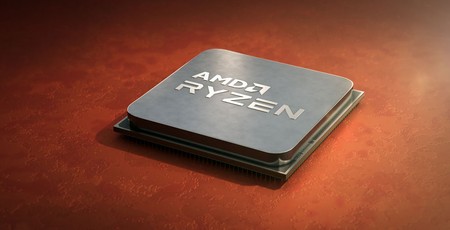
The failure of CPPC2 in Windows 11 highlights the sensitivity of modern CPU design. When an operating system is not perfectly tuned to the specific power-delivery and core-speed characteristics of a processor, the system’s performance can fluctuate wildly. This is particularly relevant for the high-end Ryzen 5000-series processors, which utilize a sophisticated "chiplet" design. Any failure in the OS to correctly interpret the topology of these chiplets can lead to performance degradation that software-side patches are intended to fix, but which nonetheless erode user confidence.
Future-Proofing Software
For Microsoft, the challenge is to ensure that its "hardware abstraction layer" remains robust enough to handle the rapid innovation occurring in the semiconductor industry. For AMD, the challenge remains the need for constant vigilance during major OS releases. While the current situation is manageable, it emphasizes the importance of early-access programs and rigorous driver testing in the pre-launch phases of new software.
Advice for Affected Users
For those currently running Windows 11 on an AMD Ryzen platform, the current consensus is to "sit tight." The promised updates are expected to arrive within the month. While the performance losses are unfortunate, they are non-destructive, meaning they will not cause long-term harm to the hardware.
If your work is not mission-critical and does not rely on the absolute maximum performance of your CPU, the stability of Windows 11 in other areas may outweigh the temporary performance hit. However, for competitive gamers or users running complex simulations and rendering tasks, the decision to roll back to Windows 10 remains the only immediate path to restoring full system capability.
As we move toward the end of October, the tech community remains focused on the upcoming Windows Update. Until that patch is released, the performance gap between Windows 10 and Windows 11 on AMD silicon will remain a key focal point for enthusiasts and professionals alike. The situation serves as an essential case study in the ongoing, delicate partnership between hardware manufacturers and software giants, proving that even with the best technology, the interface between the two remains the most critical point of failure.












No comments yet. Be the first to join the conversation!