

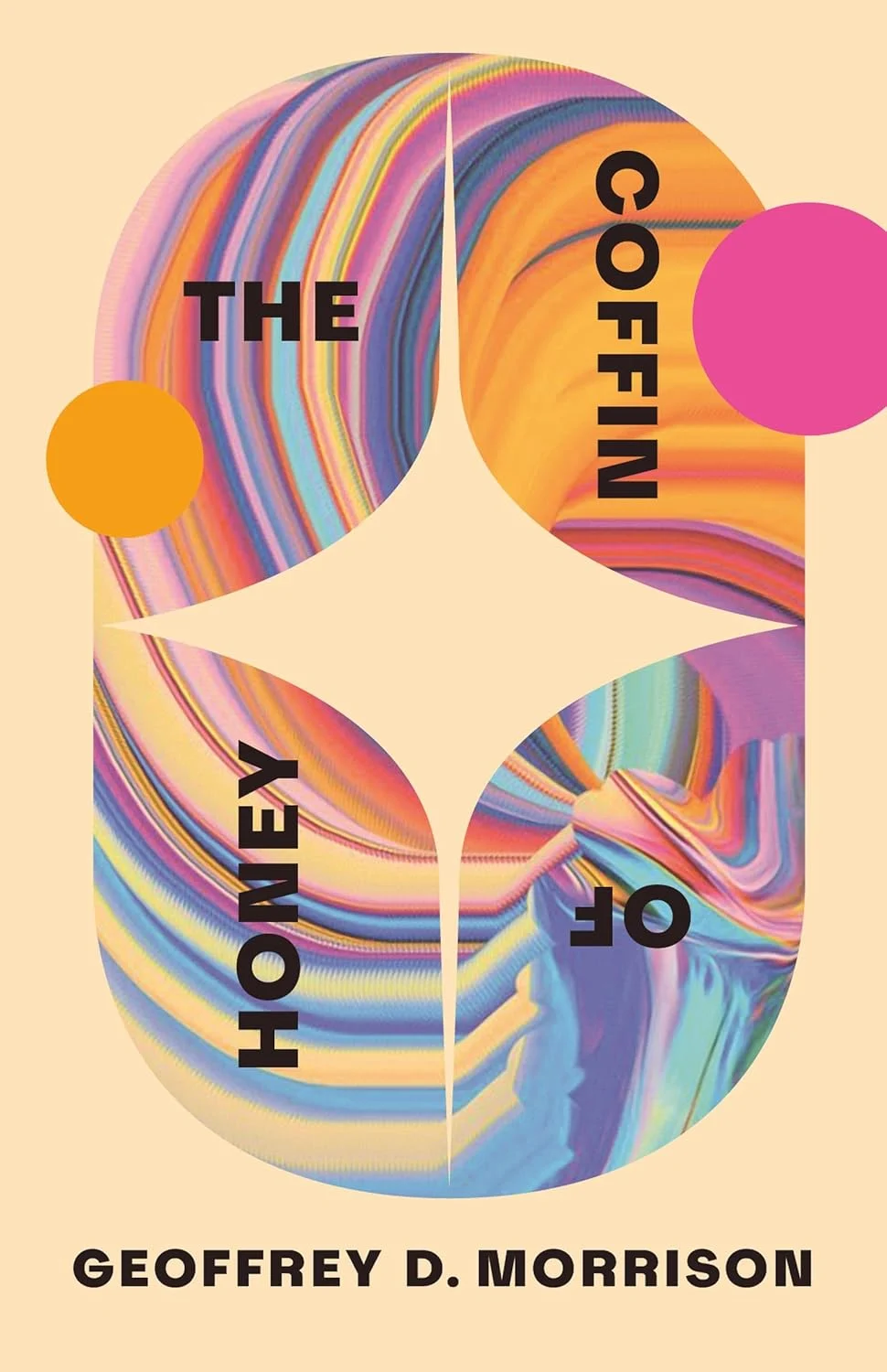
In the literary landscape of the mid-21st century, few works have arrived with the intellectual density and atmospheric peculiarity of Geoffrey D. Morrison’s latest novel, The Coffin of Honey. A sprawling, philosophical meditation on the nature of value, existence, and the failures of the human project, the book serves as both a gripping work of speculative fiction and a dense, Nabokovian puzzle box. Set in a future defined by a binary struggle between capitalist powers and the "Communard" territories, the novel asks a singular, haunting question: What remains of humanity when it is finally removed from the systems of exchange that define it?
Main Facts: A World Reconfigured
The Coffin of Honey unfolds in "Revolutionary Year 44," a timeline where the ideological conflicts of the 20th century have hardened into a new, global reality. The world has seen its coastlines reclaimed by rising tides and its national boundaries redrawn, yet the core tension remains: the relentless push-and-pull between the market and the collective.
The story introduces us to a world where the Communard lifestyle—practiced in regions like Tiohtià:ke (Montréal), Aotearoa, and the Isle of Skye—is characterized by limited digital connectivity and a rejection of hyper-consumerism. Against this backdrop, an inexplicable phenomenon begins to manifest: "nacreous lozenges," silent, alien vessels that appear to individuals at random, whisking them away to alien landscapes of stark, barren beauty. These "abductees" are returned to their starting points—or sometimes, to locations behind opposing political lines—often carrying rare, strategically valuable minerals in the dust on their clothing.
Chronology: The Arc of the Anomalies
The narrative trajectory is non-linear, constructed through a mosaic of primary sources—journal entries, government memoranda, and excerpts from fictitious academic texts like The Rhizomes of Credo: Lifeways of Red Hyrcania.
- The Inception: The phenomenon is first documented via the vanishing of Varughese, a prominent Communist Party official from Kerala, during a speech on coastal management. His abrupt disappearance into an aerial craft—and his subsequent return—triggers a global crisis.
- The Proliferation: Throughout the narrative, these events move from rare occurrences to widespread, unpredictable occurrences. Intelligence agencies across the globe scramble to analyze the returning individuals.
- The Manuscript Interval: A critical pivot occurs at the halfway point of the novel with the inclusion of "The Bell Letter," a staggering thirty-two-page manuscript embedded within a larger document. This section serves as the emotional and philosophical heart of the book, forcing a shift in the reader’s understanding of the "aliens" or the force behind the manifestations.
- The Convergence: As the novel progresses, the distinction between the "real" world and the "desert" landscapes of the alien vessels begins to blur, leading to a climax that refuses to provide the conventional closure of standard science fiction.
Supporting Data: The Anatomy of a Textual Puzzle
The Coffin of Honey is not a book to be read in a single sitting; it is a text to be inhabited. Its structure is intentionally challenging, rewarding the reader who tracks its multifaceted allusions.
The Literary and Historical Web
Morrison threads the needle of high-brow intellectualism with ease. The use of the French Revolutionary calendar for chapter headings—citing months like "Pluviôse" and "Germinal"—anchors the narrative in a history of radical change.
Furthermore, the character Forough, a resident of the Hyrcania Kolkhoz, acts as a conduit for ancient wisdom. Her obsession with the Shahnameh and the Sufi poem The Conference of the Birds provides the reader with a roadmap for interpreting the narrative. The title itself—a reference to the legend of Alexander the Great being entombed in a coffin filled with honey—serves as a metaphor for the preservation of the self against the rot of historical decay.
Linguistic and Structural Innovation
The prose is peppered with biting social commentary. In a standout moment of sharp wit, Morrison describes the alien craft’s movement: the object turns not "on a dime," but "on the absence of a monetary system as such." Such lines highlight the author’s background as a trade unionist, injecting a clear, sympathetic critique of capital into the very mechanics of the science fiction setting.
Official Responses and Geopolitical Implications
The emergence of these "alien" phenomena has sent shockwaves through the established powers. The primary concern of the state is not the metaphysical state of the returnees, but the potential for resource acquisition. When it is discovered that the returnees carry exotic minerals, the "nacreous lozenges" cease to be a mere philosophical curiosity and become a geopolitical objective.
Intelligence agencies are shown to be in a state of constant, panicked surveillance. The redaction of names and the skepticism surrounding the "honest" journals of military agents highlight the pervasive distrust characterizing this era. The state seeks to commodify the experience, while the Communards—often finding themselves on the receiving end of these returned individuals—approach the phenomenon with a mixture of reverence and weary caution.
The tension between these two poles is best exemplified by the scene in which Forough attends a capitalist-run poetry conference. Her bafflement at the social ritual of a plated dinner—wondering why the attendees did not simply cook together to foster community—serves as a microcosm of the fundamental divide in the world Morrison has built.
Implications: A Mirror for the Modern Reader
What does it mean for a novel to refuse its audience the satisfaction of a "big reveal"? For some readers, the lack of a concrete explanation for the aliens or the desert worlds might feel like a failure of narrative architecture. However, a deeper engagement with the text suggests this is the novel’s greatest strength.
The "world without exchange" that Varughese encounters is an impossible place, a space where one is truly free because there is no price tag on existence. By keeping this world fundamentally unknowable, Morrison forces the reader to confront their own relationship with the "commodified" reality of their daily lives.
The Reader’s Responsibility
Nabokov once famously remarked that "one cannot read a book: one can only reread it." The Coffin of Honey adopts this philosophy with absolute rigor. The characters—the enigmatic Varughese, the poetic and elusive Forough, and the mysterious Bell Letterist—are not meant to be fully "known." They are, like the alien entities, sketches of human experience. We never actually read Forough’s poetry, only snippets; we never see the "truth" behind the military agent’s redactions.
This incompleteness is the point. The novel acts as a Rorschach test for the reader’s own ideological and philosophical leanings. If you are a reader looking for a tidy resolution, The Coffin of Honey will frustrate you. But if you are looking for a work that interrogates the fundamental systems of value that govern our lives—a book that challenges you to look at the "feathers" left behind by our collective, sometimes clumsy, efforts at human connection—then this is a essential text.
In the final assessment, the "coffin of honey" is not merely the tomb of a conqueror. It is the vessel in which Morrison has preserved a moment of pure, unadulterated thought, suspended in a sticky, golden silence, waiting for the reader to break the seal. Whether the mystery of the lozenges is ever solved matters less than the fact that they have forced us to look at our own horizon—and, perhaps, to wonder what we might sing when we finally step through the doorway.











No comments yet. Be the first to join the conversation!