

Published: June 4, 2026
For travelers navigating the cultural heart of Japan, the journey between the neon-lit streets of Osaka, the serene deer parks of Nara, and the timeless temples of Kyoto is often viewed as a mere necessity. However, Kintetsu Railway has fundamentally transformed this transit experience with the introduction of the "AONIYOSHI," a sightseeing limited express train that elevates the commute into a destination in its own right. Designed under the philosophy of a "relaxing historical journey," the AONIYOSHI is not just a train; it is a mobile sanctuary that bridges the gap between modern travel convenience and the profound historical legacy of Japan’s ancient capitals.
Main Facts: A Symphony of Design and Comfort
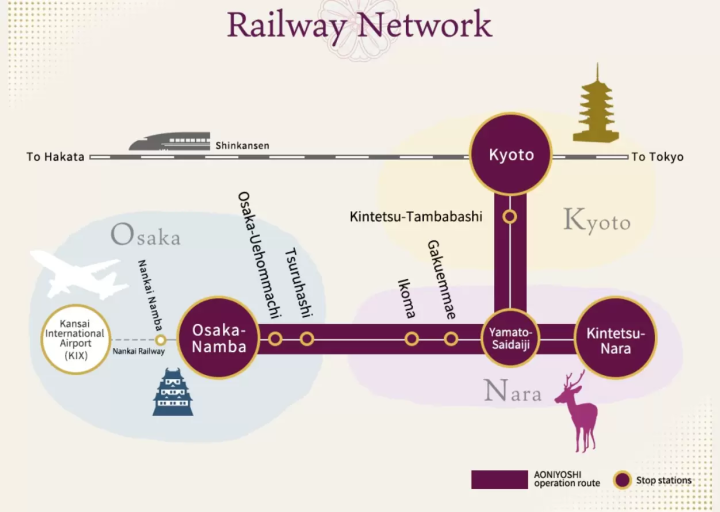
The Kintetsu AONIYOSHI operates as a premium, limited-reservation service connecting Osaka Namba, Nara, and Kyoto. Unlike conventional commuter trains that prioritize high-volume throughput, the AONIYOSHI is strictly limited to 84 passengers per journey. This scarcity is intentional, ensuring an atmosphere of exclusivity and tranquility for every traveler.

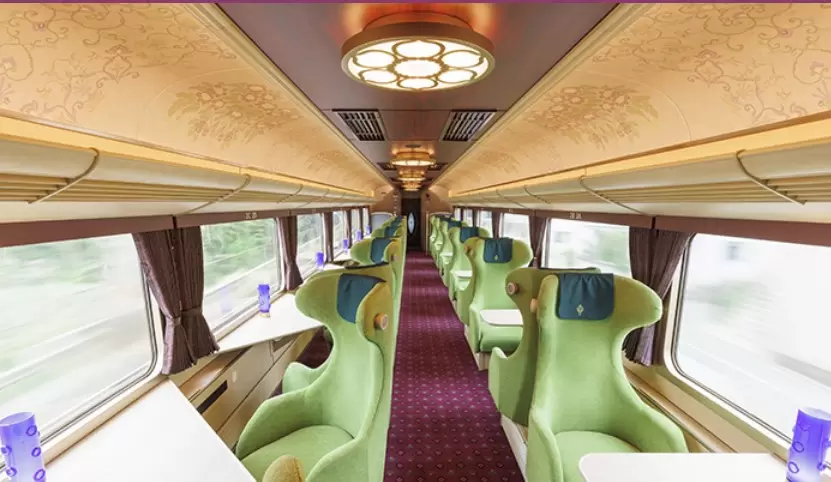
The train is defined by its deep, royal-purple exterior—a color synonymous with the nobility of Japan’s past—and a sophisticated interior that marries traditional craftsmanship with modern ergonomics. The fleet is divided into distinct seating categories, each designed to cater to specific travel demographics:
- Twin Seats (Cars 1, 3, and 4): Featuring a two-row configuration, these seats are designed for couples or solo travelers (with a child-fare supplement). They offer a wrap-around aesthetic that provides an intimate, cocoon-like feeling, ideal for viewing the passing landscapes of the Kansai region in comfort.
- Salon Seats (Car 2): Catering to families and groups of three to four, these seats represent the pinnacle of onboard privacy. Enclosed by sophisticated partitions, the salon area offers a living-room-like environment, perfect for socializing without disrupting the peace of other passengers.
Beyond the seating, the train features a dedicated library in Car 4. This curated space houses a collection of guidebooks and historical literature related to the Kintetsu line’s geography. With comfortable sofa seating, it invites passengers to disconnect from their digital devices and engage with the rich narrative of the region they are traversing.
Chronology: The Evolution of a Concept
The inception of the AONIYOSHI was driven by a desire to revitalize tourism in the Kintetsu corridor.
- The Conceptual Phase: Kintetsu Railway identified a gap in the market for a "slow travel" experience. While the Kansai region is dense with high-speed transit, the psychological experience of travel was often overlooked.
- The Naming Ceremony: The name "AONIYOSHI" was selected for its deep roots in Japanese linguistics. In traditional waka poetry, "Aoniyoshi" is a "pillow word" (makurakotoba) associated with Nara. It evokes the beauty of the city’s ancient architecture, famously characterized by the vibrant blue (ao) of the lapis lazuli and the red (ni) of the earth pigments used in temple construction. By adopting this name, the train aims to act as a poetic prologue to the passengers’ arrival in Nara.
- Service Launch: Following extensive interior refitting and service testing, the AONIYOSHI commenced operations to widespread acclaim, rapidly becoming a "must-do" item for both international visitors and domestic tourists seeking a premium regional experience.
Supporting Data: Infrastructure and Logistics
Navigating the logistics of the AONIYOSHI is straightforward, provided that travelers understand the reservation requirements. Because all 84 seats are reserved, spontaneous boarding is rarely possible, particularly during peak seasons.
Ticket Structure
To board the AONIYOSHI, passengers must hold a valid "Boarding Ticket" (base fare) and a "Limited Express Ticket." For international travelers, the Kintetsu Rail Pass serves as an excellent financial tool, as it covers the base fare, requiring only the additional purchase of the limited express supplement.
Accessibility and Reservation Systems
Kintetsu has implemented a robust digital reservation system to accommodate global travelers. The Kintetsu Express Ticket Web Reservation Service allows for bookings to be made up to one month in advance, starting at 10:30 AM JST. Given the limited capacity of the train, industry experts strongly advise booking as soon as travel dates are confirmed.

Official Responses: Frequently Asked Questions
To assist travelers in planning their journey, Kintetsu Railway has provided clarity on several common inquiries regarding the AONIYOSHI experience.
Q: Can a solo traveler book the AONIYOSHI?
A: The train is optimized for pairs and groups. There are no dedicated single-seat tickets. However, solo travelers can still enjoy the experience by purchasing a ticket for a child in addition to their own. This covers the cost of the empty seat, ensuring the solo traveler has the space to themselves.
Q: Is same-day booking possible?
A: While possible, it is highly discouraged. Due to the limited 84-seat capacity, the train often sells out weeks in advance. Travelers should treat the AONIYOSHI as a destination booking rather than an impulsive transit choice.

Q: What is the highlight of the onboard menu?
A: The sales counter in Car 2 is more than a snack bar; it is a showcase for Nara’s local culinary heritage. The standout item is the original butter sandwich, specially crafted to match the train’s color palette and branding. It is designed to be paired with locally roasted coffee or regional sake, providing a sensory experience that reflects the local terroir.
Implications: The Future of "Slow Tourism"
The success of the AONIYOSHI reflects a broader shift in the global tourism industry: the move away from "transit as a utility" toward "transit as an experience."
Economic Impact
By incentivizing travelers to spend more time on the rail network, Kintetsu is effectively increasing the average dwell time in the Nara and Kyoto regions. Passengers who might have otherwise opted for a generic commuter train are now more likely to spend time in the onboard library or purchasing local goods, creating a direct economic ripple effect for the producers along the route.

Cultural Preservation
The AONIYOSHI serves as a cultural ambassador. By educating passengers through literature and providing curated regional culinary experiences, the train prepares visitors for the historical weight of the locations they are visiting. It transforms the transition between cities from a "gap" in the schedule to an educational and relaxing component of the vacation.
The Sustainability of High-Touch Service
In an era of automation, the high-touch, human-centric service of the AONIYOSHI—complete with a staffed sales counter and physical library—stands as a counter-narrative. It suggests that even in a world obsessed with speed, there remains a deep, unmet human demand for comfort, aesthetics, and meaningful travel.
For those planning to traverse the golden triangle of Osaka, Nara, and Kyoto, the AONIYOSHI represents a rare opportunity to slow down. It invites the passenger to look out the window not at the blurring lines of urban infrastructure, but at the rolling landscapes of Japan, while sipping coffee in a chair that feels like it was designed for a bygone era of luxury. As travel continues to evolve, the AONIYOSHI serves as a masterclass in how to treat the passenger not just as a commuter, but as a guest on a journey through history.

For further details on schedules, pricing, and to secure your seat, please visit the official Kintetsu AONIYOSHI website.












No comments yet. Be the first to join the conversation!