

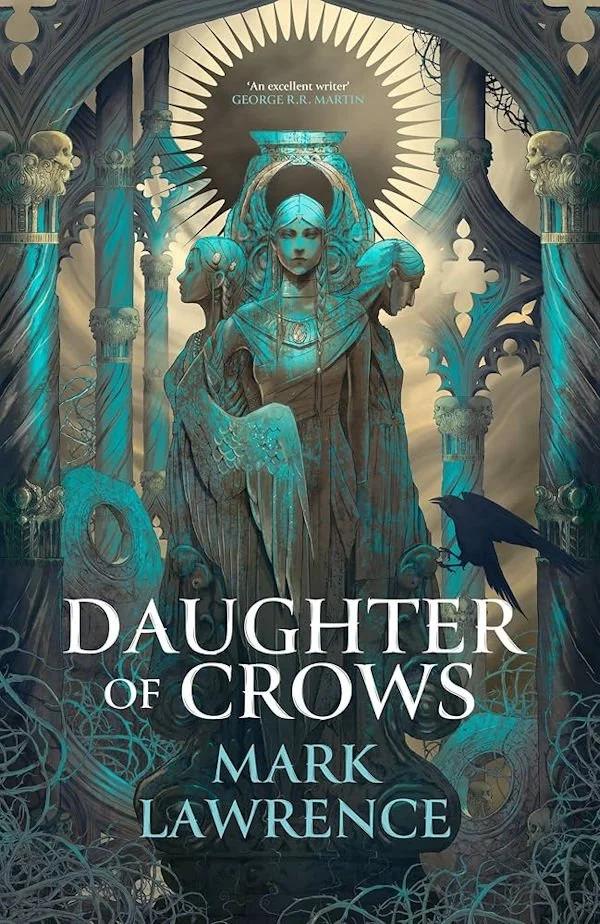
In the crowded landscape of contemporary fantasy, few authors possess the visceral, razor-sharp prose of Mark Lawrence. With his latest release, Daughter of Crows, the architect of the Broken Empire and Red Sister series returns with a work that is as philosophically complex as it is unflinchingly brutal. Daughter of Crows serves as the inaugural volume of a new dark trilogy, plunging readers into a world where the concept of "kindness" is subverted into an instrument of systemic horror.
The Academy of Kindness: An Institution of Retribution
The central pillar of Lawrence’s new world is the "Academy of Kindness." Drawing inspiration from the ancient Furies—the "Kindly Ones" of Greek mythology—the Academy is a state-sanctioned engine of vengeance. Each year, one hundred young girls are sold into this institution, a place where the halls are stained with the legacy of a decade-long nightmare.
The curriculum is not one of enlightenment, but of survival and eradication. Within the sands of the "Wound Garden" and amidst the necrotic fumes of the "Bone Garden," these girls are forged into avatars of retribution. The attrition rate is staggering: out of every cohort of one hundred, only three emerge to graduate. These survivors are bound to uphold the oldest, most merciless laws of their society. It is a premise that sets the stage for a narrative defined by stolen innocence and the high price of power.
Chronology: A Life Measured in Scars
What distinguishes Daughter of Crows from its peers is its innovative structural approach. Rather than a linear progression, the narrative is anchored by the life of its protagonist, Rue—a woman who has already survived a lifetime of trauma.
The Twilight Years: Rue as the Protagonist
We first encounter Rue not as a wide-eyed initiate, but as an elderly, bitter woman attempting to cultivate a semblance of peace. Lawrence takes a bold risk by placing an aged woman at the center of a grimdark epic. Rue’s physical limitations—the slowing joints, the fading stamina—provide a grounded, poignant contrast to the lethal efficiency of her mind. When war encroaches on her quiet life, the reader is treated to a display of violence that is both explosive and calculated. It is a testament to the fact that while age may wither the body, it can sharpen the resolve of a killer.
The Formative Years: Mollandra and the Academy
The second, and perhaps most gripping, narrative thread explores Rue’s past as "Mollandra." Here, the reader is thrust into the claustrophobic indoctrination of the Academy. These sections serve as a visceral exploration of trauma and the formation of identity. Lawrence masterfully depicts the shifting loyalties among the one hundred girls, highlighting how companionship is often the only shield against an environment designed to strip away one’s humanity.
The Origin: The Eldest
The third narrative thread, introduced as the story unfolds, is the darkest of the lot. It depicts a twisted, supernatural household where children are held as prisoners. As "the Eldest," Rue’s primary burden is the survival of the younger children under her care. This timeline provides the psychological foundation for the woman Rue becomes, illustrating the horrific transition from a victim of abuse to an agent of the Academy.
Supporting Data: The Mechanics of Character and Theme
Lawrence’s exploration of memory and identity is the intellectual engine driving the story. Throughout the book, he posits that we are not merely the sum of our experiences, but the sum of our remembered experiences.
The Psychology of Aging
By juxtaposing three distinct stages of Rue’s life, Lawrence invites the reader to interrogate how a person can remain fundamentally the same while appearing entirely different. The contrast between the child struggling to protect her kin, the young woman fighting for survival in the Academy, and the elderly woman trying to outrun her own history creates a multi-layered character study rarely seen in the genre.
The Pacing and Tone
Critically, the book avoids the "multiple POV fatigue" that often plagues modern fantasy. Lawrence allows the narrative to breathe, utilizing lulls in action to deepen the psychological weight of the story. When the pace does accelerate toward the climax, it feels earned, leaving the reader with an urgent, visceral need to see the conclusion of the arc. The prose is eloquent yet blunt, a signature style that prevents the story from descending into gratuitous misery, instead imbuing the cruelty with a strange, dark beauty.
Official Responses: An Interview with Mark Lawrence
In an exclusive exchange regarding the creation of Daughter of Crows, author Mark Lawrence shed light on the creative process behind this departure from his previous works.
On the decision to feature an older protagonist:
"The idea to show her old came from forums and social media where the desire to see older female main characters is frequently voiced," Lawrence stated. "I was either meeting that desire or calling their bluff." He further noted that the aging process—physically, mentally, and through the accretion of memories—is a complex, subtle phenomenon that allowed him to explore the disparity between the young and the old.
On the structure and timelines:
Lawrence clarified that he does not plan his novels in the traditional sense. "They just happen as I write them," he explained. While he has previously experimented with the illusion of multiple points of view through different ages of a character, Daughter of Crows marks the first time he has spanned this many decades, allowing for a broader examination of how life experiences shape the individual.
On the theme of morality:
When asked about the challenge of making a morally compromised character sympathetic, Lawrence was pragmatic: "They just have to be interesting. That can be as simple as being entertaining—a sense of humor, outrageous behavior, a dedicated focus on murder." He believes that characters who contain fascinating contradictions or reflect the struggles of the reader are ultimately the most compelling to follow.
On the future of the series:
When pushed on whether the trilogy is about uncovering the past or forging a new future, Lawrence gave a characteristically enigmatic response: "Yes." He acknowledged that for a character whose life is viewed across three different time periods, the concept of "next" is a complex, fluid target.
Implications for the Genre
Daughter of Crows is more than just a grimdark fantasy novel; it is an examination of the human condition under extreme pressure. It addresses the randomness of human connections and how early friendships—or their loss—act as the bedrock of our adult personalities.
By grounding his high-fantasy concepts in the stark reality of memory, trauma, and the physical decline of the body, Lawrence has produced a work that is intellectually rigorous. The book challenges the reader to look at the "monsters" in their own stories and recognize the humanity—however frayed or damaged—that remains.
As the first entry in a trilogy, the novel succeeds in establishing a world that is as dangerous as it is alluring. It forces us to confront the reality that while innocence may be sold or stolen, the act of survival is an indelible mark upon the soul. For fans of the genre, the wait for the subsequent installments will be a test of patience, as Daughter of Crows leaves the reader with a lingering sense of unease and a desperate need to know what, if anything, can be saved from the fire.
In conclusion, Mark Lawrence has once again proven that fantasy is at its most potent when it reflects our own darkest impulses and our most resilient virtues. Daughter of Crows is a visceral, emotionally ruthless, and fundamentally human story—a must-read for anyone who appreciates the genre pushed to its absolute limits.










No comments yet. Be the first to join the conversation!