Neng Nana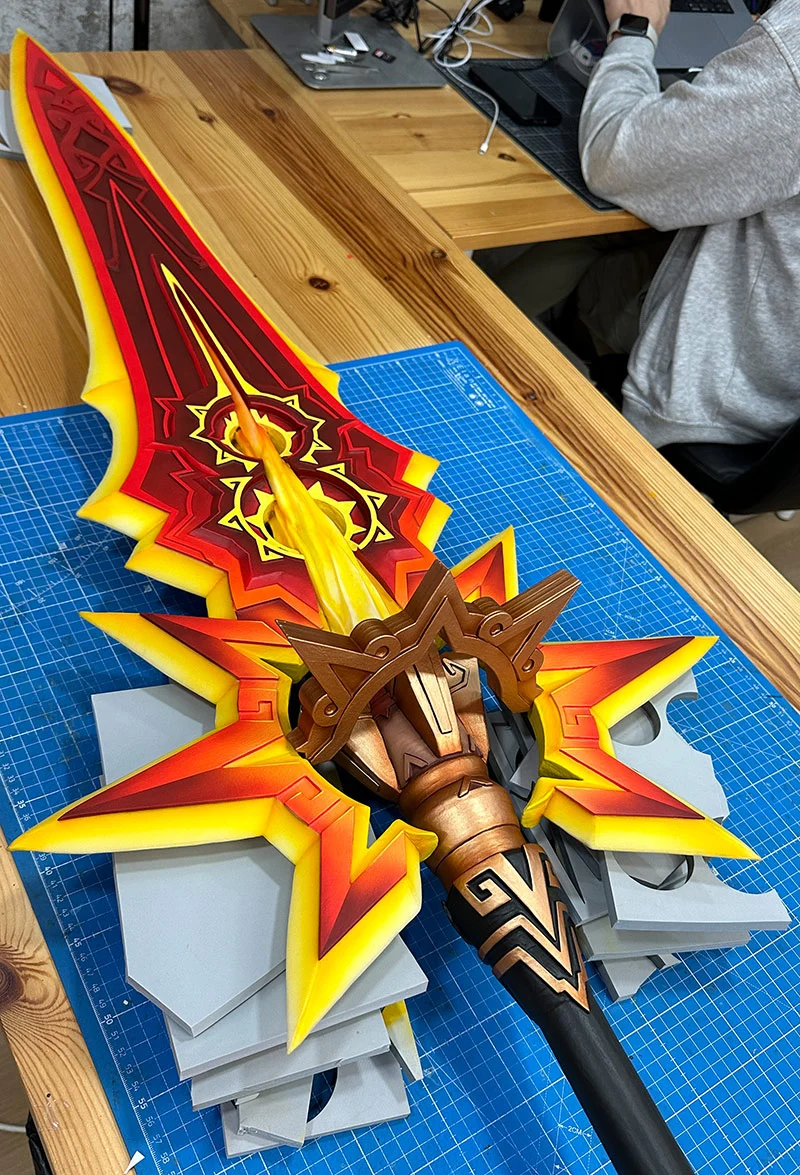
In the high-stakes world of professional cosplay, where character design meets engineering, few creators push the boundaries of materials and electronics quite like Svetlana Quindt—widely known as Kamui Cosplay. Her latest endeavor, the recreation of "A Thousand Blazing Suns," the legendary sword wielded by Mavuika, the Fire Archon of Natlan from Genshin Impact, represents a pinnacle of fan-driven craftsmanship. This project, born from a unique intersection of creative passion and an official partnership with HoYoverse, serves as a masterclass in modern prop building, utilizing advanced fabrication techniques to bring digital fantasy into the physical realm.
The Genesis of a Legend: From Digital Model to Physical Prop
The collaboration began as a serendipitous alignment of interests. As a longtime devotee of Genshin Impact and an expert in EVA foam manipulation, Quindt was naturally drawn to the striking aesthetic of Mavuika. Her design—characterized by fierce, volcanic motifs and glowing, radiant energy—offered the perfect canvas for Quindt’s signature style: high-density foam construction paired with complex, programmable LED arrays.

When HoYoverse reached out to invite her to produce official promotional content for the release of the Fire Archon, the decision was immediate. "Mauvika’s sword was the perfect project for this collaboration," says Quindt. "It’s a massive, beautiful, and challenging piece that required everything I’ve learned over the years."
Sourcing and Blueprinting
The journey began with the blueprints. While many cosplayers rely on screenshots, Quindt emphasizes the importance of utilizing official 3D assets. By navigating Aplaybox.com, a repository for HoYoverse character models, she was able to extract precise geometric data. Despite the language barrier—a hurdle easily overcome by modern translation tools—the ability to study the weapon’s scale and intricacies in 3D space was instrumental.

The challenge, however, was adaptation. The original in-game weapon is, by design, oversized, reflecting the exaggerated proportions of anime-style fantasy. For the physical build, Quindt opted for a two-meter length. While still imposing, this scale ensures the prop remains manageable for convention use while maintaining an "authentic" presence that feels natural in the hands of the cosplayer.
Chronology of Construction: A Four-Phase Process
The creation of the sword followed a rigid, professional workflow designed to maximize structural integrity and aesthetic fidelity.

Phase 1: Structural Foundation
Given the massive surface area of the blade, structural stability was paramount. The core of the sword features a rigid PVC pipe, providing a backbone that prevents the long, foam-based structure from bowing or breaking. Around this core, Quindt utilized 10mm EVA foam, layered to create depth and accommodate the internal electronics. This phase was focused on "hiding the skeleton," ensuring that the complex wiring for the 300+ LEDs remained invisible within the grip and central engine core.
Phase 2: Precision Fabrication
To maintain speed and professional precision, Quindt utilized an xTool S1 CO2 laser cutter. By translating her 2D blueprints into vector files, she was able to achieve clean, identical edges across all foam components—a task that would have been significantly more labor-intensive if done by hand with a box cutter. However, as she notes, the convenience of a laser cutter comes with the prerequisite of mastery; one must be proficient in vector software to make the machine an asset rather than a complication.

Phase 3: The Electronic Heart
The "rocket-engine" look of the sword required more than just paint; it required light. Quindt opted for an Adafruit Feather M4 Express paired with a Prop-Maker FeatherWing. This setup is a hallmark of her work, allowing for complex, reactive animations. The sword features a "pulsing fire" mode that, through motion sensing, shifts into a brilliant white flash when the sword is struck against the ground. This level of interaction turns the prop from a static display piece into a narrative tool, capturing the essence of Mavuika’s combat style.
Phase 4: The Marathon of Color
The final phase—painting—proved to be the most grueling. Using Vallejo airbrush colors, Quindt and her partner, Benni, embarked on a three-day cycle of masking, spraying, and detailing. The process required extreme patience; applying multiple layers of yellow, orange, and red while masking previously painted sections meant the team was working against the clock to prevent tape damage to the base coats. The process concluded at 6:00 AM after a 12-hour final push, followed by hand-painted detail work using high-pigmentation acrylics.

Supporting Data: The Anatomy of the Build
- Electronics: 300 addressable RGB NeoPixel LEDs.
- Controller: Adafruit Feather M4 Express with Prop-Maker FeatherWing.
- Materials: 10mm High-Density EVA Foam (The Foamory), 2mm Light-Diffusing LED Foam (Plastazote LD45).
- Fabrication Tools: xTool S1 40W Laser Cutter, Iwata Eclipse HP-CS Airbrush.
- Project Duration: Approximately seven days of full-time, professional-grade labor.
Official Collaboration and Industry Implications
The collaboration between Kamui Cosplay and HoYoverse highlights a growing trend in the gaming industry: the formalization of the relationship between game developers and the "maker" community. By providing assets and commissioning high-fidelity props, companies like HoYoverse are effectively validating the labor-intensive work of cosplayers as a legitimate form of marketing and community engagement.
This partnership serves as a case study for future collaborations. By choosing a creator known for technical prowess rather than just surface-level accuracy, HoYoverse ensures that the promotional content resonates with the "hardcore" segment of their fanbase—those who value the technical engineering behind the character’s design. For the creator, the partnership provides the resources to execute high-concept builds that might otherwise be cost-prohibitive.

Conclusion: The Impact of "A Thousand Blazing Suns"
The finished sword stands as a testament to the evolution of the cosplay hobby. What was once a craft defined by makeshift materials and glue guns has transformed into a discipline involving digital modeling, electrical engineering, and precision fabrication.
"In the end, it’s far more important to be happy with your piece than to create something perfectly scaled to the insane proportions of a fictional character," Quindt concludes. Her work on the Mavuika project serves as both an inspiration to aspiring makers and a professional benchmark for the industry. Whether through the mesmerizing fire-LED animations or the seamless integration of hardware into the hilt, the project proves that when passion meets technical discipline, the boundary between digital fiction and physical reality becomes delightfully, and impressively, thin.

For those looking to replicate aspects of this build, Quindt continues to share her knowledge through her Book of Light and Sound Effects and comprehensive tutorials, ensuring that the techniques used to build the Fire Archon’s sword remain accessible to the next generation of creators.


 Ali Ikhwan
 Nana Muazin